
PLT-120 vs PLT-198: Choosing the Right Differential or Forklift Drive Wheel
PLT-120 vs PLT-198: Choosing the Right Differential or Forklift Drive Wheel
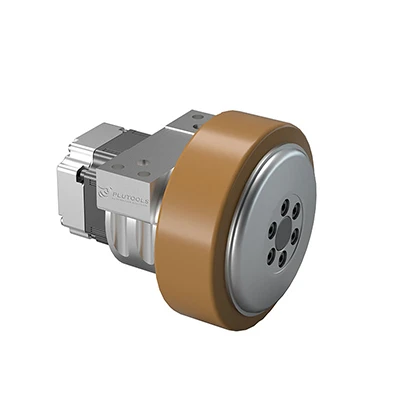
The choice between the PLT-120 differential drive wheel and the PLT-198 planetary horizontal drive wheel comes down to three published numbers: 150 kg versus 1500 kg load capacity, 400 W versus 3000 W motor power, and 1.28 Nm versus 9.55 Nm rated motor torque. If a vehicle is built around light AGV or AMR payloads, the PLT-120 fits. If the vehicle is a forklift-class or heavy pallet platform, the PLT-198 is the appropriate drive module. Everything else in this comparison guide is about confirming that answer without over-specifying or under-specifying the drive unit.
The Buyer Problem: One Drive Wheel Cannot Cover Both Ends of the Payload Range
Drive wheel selection failures rarely come from a bad product. They come from matching the wrong drive module to a vehicle concept. Two opposite mistakes repeat across automation projects.
The first is under-sizing. A 150 kg-class drive unit is specified onto a platform that later grows into pallet handling, and the result is a drive wheel operating outside its load rating, with braking and acceleration torque that cannot support the intended duty cycle. The second is over-sizing. A 3000 W, 3000 RPM drive module is specified onto a compact AMR that only needs to move a few hundred kilograms, which creates unnecessary current draw, unnecessary chassis height, and an electrical architecture sized for a machine the buyer did not build.
There is also a structural misunderstanding that confuses the decision: buyers often treat "differential" and "forklift" as opposites on a single scale, when they actually describe different structural families and different load classes. The PLT-120 is catalogued as a differential drive wheel for AGV and AMR scenarios with a compact structure and an integrated steering function. The PLT-198 is catalogued as a planetary horizontal drive wheel with steering, rated for a maximum load of 1500 kg. Those are two different answers to two different vehicle questions, and this article separates them step by step.
Industry Background: Why Drive Wheel Selection Is Tighter Than It Used to Be
Drive wheel specification is no longer a purely mechanical exercise because the platforms themselves are changing. Third-party market research indicates the global AGV wheel drives market was valued at approximately USD 1.2 billion in 2024, with a projected path to USD 3.5 billion by 2034 and a CAGR of 11.5% over the same period, per Reports and Data. Grand View Research estimated the global automated guided vehicle market at USD 5.9 billion by 2025, with Asia Pacific holding a 37.6% revenue share in that year.
The forklift side is moving in the same direction. MarketsandMarkets data indicates electric forklifts now command over 70% market share in many regions as a replacement for combustion models, which shifts the engineering focus onto electric drive and steering units rather than hydraulic and combustion powertrains. Industry analysts also report that integrated steering drive modules are increasingly replacing discrete components, reducing manufacturer assembly time and maintenance complexity.
Compliance pressure is part of the same shift. ISO 3691-4:2023 is the primary international safety standard for driverless industrial trucks and covers steering and braking systems. EN 1175:2020 specifies electrical and electronic safety requirements for industrial trucks in Europe, and ANSI/ITSDF B56.5 governs the performance of drive and steering units for driverless industrial vehicles in the United States. In practical terms, a drive wheel is now evaluated as part of a safety-relevant subsystem, not as a catalogue part number.
Detailed Solution: The Two PLT Platforms in Verified Specifications
PLT-120 — Differential Drive Wheel for 150 kg AGV and AMR Payloads
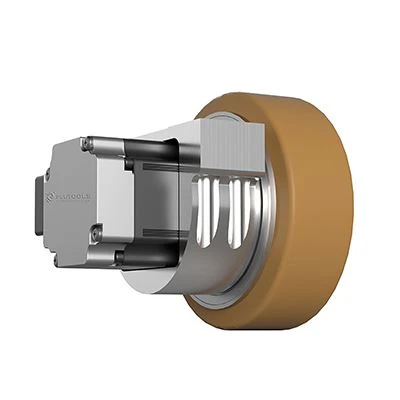
The PLT-120 is a differential drive wheel designed for use in AGV and AMR scenarios and intended for the manufacturing industry. Its structural configuration is compact for easy integration into AGV or AMR chassis, and it includes an integrated steering function with integrated steering control.
Published parameters for the PLT-120 are: rated power 400 W; rated voltage 48 V; rated current 11.2 A; rated speed 3000 rpm; rated torque 1.28 Nm; transmission ratio 9 / 20 (I); rated output torque 10 / 21 Nm; maximum acceleration and braking torque 20 / 42 Nm; IP protection level IP65; drive wheel load 150 kg; total drive wheel weight 5 ± 2 kg. The wheel tread is polyurethane and the primary material is carbon steel.
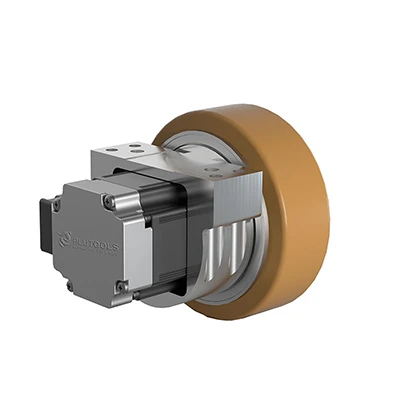
The design consequence of these numbers matters more than the numbers themselves. A 400 W module drawing 11.2 A at 48 V keeps the electrical load on the vehicle modest, which supports smaller battery packs, lighter cabling and simpler driver sizing. An IP65 rating extends the unit to dust-exposed and wash-down-adjacent industrial areas rather than clean room-only operation. And because the PLT-120 is a differential unit, it is normally deployed in pairs; third-party industry sources note that dual differential drive wheels allow a zero-turn radius, which is why this format dominates smaller logistics robots that must rotate inside narrow aisles.
PLT-198 — Planetary Horizontal Drive Wheel for 1500 kg Loads
The PLT-198 is a horizontal drive wheel classified as a planetary horizontal drive wheel with steering. It is designed for automated guided vehicle applications, typically in AGV and AMR systems, and is intended for the manufacturing industry.
Published parameters for the PLT-198 are: rated voltage 48 V; rated power 3000 W; rated current 68 A; rated speed 3000 RPM; rated torque 9.55 Nm; reduction ratio 32; output torque 260 Nm; maximum torque 576 Nm; maximum load capacity 1500 kg. The primary material is carbon steel and the wheel tread is polyurethane.
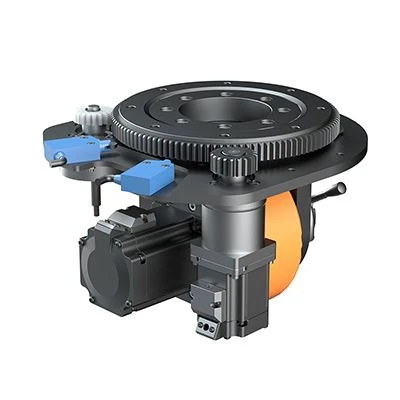
The 576 Nm maximum torque and the 32:1 planetary reduction are the defining figures here. A planetary stage multiplies motor torque into the wheel at a ratio that supports heavy starts, ramp movement and braking on loaded pallets, while holding rated speed at 3000 RPM at the motor. For a vehicle builder, that combination is what makes the PLT-198 usable as the driven axle of a forklift-class or heavy transfer platform rather than as an auxiliary drive.
The Forklift Drive Wheel Designated in the Same Family
One naming point causes confusion in shortlists, so it is worth stating plainly. The model catalogued specifically as a Forklift Drive Wheel is the PLT-210, described as a parallel horizontal drive wheel with steering and an integrated parallel horizontal structure with a steering function. The PLT-210 shares the same 48 V, 3000 W, 68 A, 3000 RPM, 9.55 Nm rated torque, 32:1 reduction ratio, 260 Nm output torque and 576 Nm maximum torque as the PLT-198, but its maximum load is published at 1200 kg rather than 1500 kg. Wheel tread is PU and load and speed options are customizable.
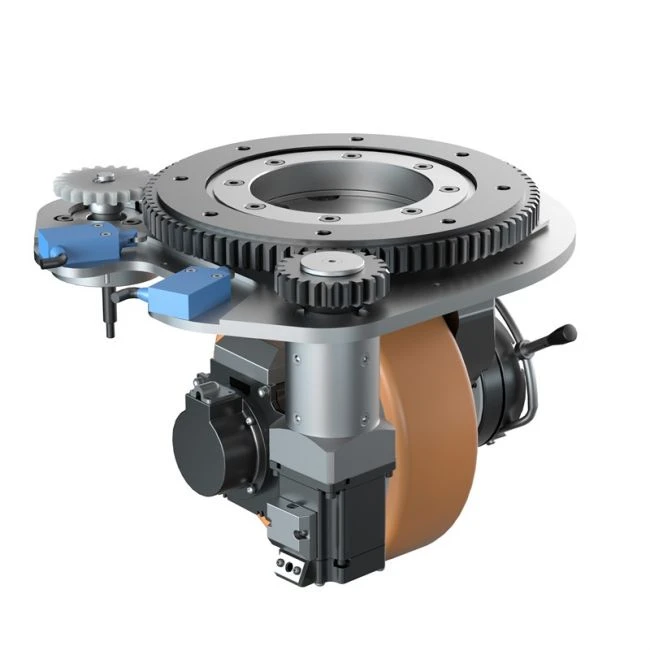
The practical reading is that PLT-198 and PLT-210 sit on the same heavy horizontal platform, differing in load rating. Buyers who need the highest published load in the horizontal family select the PLT-198; buyers who are specifying the forklift drive wheel model explicitly select the PLT-210. Either way, the decision is not "differential versus forklift" as a philosophy — it is which load class and which structural package the chassis can actually accept.
Step-by-Step Breakdown: Six Checks Before You Specify
Step 1 — Establish load per wheel, not vehicle load. The PLT-120 is published at a 150 kg drive wheel load and the PLT-198 at a 1500 kg maximum load. Divide the loaded vehicle weight by the number of driven wheels and add the dynamic transfer that occurs during braking and cornering. If the answer is near or above 150 kg per driven wheel, the differential unit is the wrong side of the boundary.
Step 2 — Check torque against the duty cycle, not just the load. Compare rated torque (1.28 Nm for the PLT-120, 9.55 Nm for the PLT-198) and the torque delivered after the gear stage: 10 / 21 Nm rated output for the PLT-120, 260 Nm output for the PLT-198. For the PLT-120, the relevant ceiling is the maximum acceleration and braking torque of 20 / 42 Nm. For the PLT-198, it is the 576 Nm maximum torque.
Step 3 — Decide mounting orientation early. Both models are horizontal-format units: the PLT-198 is catalogued as a planetary horizontal drive wheel with steering, and the PLT-120 is documented with a parallel horizontal arrangement and an integrated steering function. This determines the module height and the chassis opening the mechanical team must design around.
Step 4 — Match environmental protection to the floor. The PLT-120 is published with IP65 protection, which suits dusty workshops, humidity and light wash-down exposure. Buyers evaluating the PLT-198 or PLT-210 should confirm the required protection level with the supplier against their actual environment rather than assuming a rating that is not published in the specification sheet.
Step 5 — Size the electrical architecture to the current draw. The PLT-120 draws 11.2 A at 48 V; the PLT-198 and PLT-210 draw 68 A at 48 V. That difference propagates into battery capacity, cable cross-section, fuse and contactor selection, and driver sizing. Choosing the PLT-198 for a duty cycle that only needs 400 W pays for that current twice — once in components and once in energy.
Step 6 — Confirm the control architecture. The PLT-120 uses integrated steering control, while the PLT-198 and PLT-210 are classified as steering drive wheels. A vehicle controller designed for a simple differential pair behaves differently from one designed to command a steering drive module, so control logic should be settled before the drive shortlist is frozen.
PLT-120 vs PLT-198 vs PLT-210: Comparison Table
| Parameter | PLT-120 | PLT-198 | PLT-210 |
|---|---|---|---|
| Product category | Differential drive wheel | Planetary horizontal drive wheel with steering | Forklift drive wheel (parallel horizontal with steering) |
| Rated voltage | 48 V | 48 V | 48 V |
| Rated power | 400 W | 3000 W | 3000 W |
| Rated current | 11.2 A | 68 A | 68 A |
| Rated speed | 3000 rpm | 3000 RPM | 3000 RPM |
| Rated torque | 1.28 Nm | 9.55 Nm | 9.55 Nm |
| Ratio | Transmission ratio 9 / 20 (I) | Reduction ratio 32 | Reduction ratio 32 |
| Output torque | 10 / 21 Nm (rated) | 260 Nm | 260 Nm |
| Maximum torque | 20 / 42 Nm (maximum acceleration and braking torque) | 576 Nm | 576 Nm |
| Load capacity | 150 kg drive wheel load | 1500 kg maximum load | 1200 kg maximum load |
| IP protection | IP65 | Not stated in the published specification | Not stated in the published specification |
| Drive wheel weight | 5 ± 2 kg | Not stated in the published specification | Not stated in the published specification |
| Tread / primary material | Polyurethane tread, carbon steel | PU tread, carbon steel | PU tread, carbon steel |
| Typical fit | Light AGV and AMR platforms, per-wheel loads up to 150 kg | Heavy AGV, AMR and forklift-class platforms up to 1500 kg | Forklift-class platforms up to 1200 kg |
Vertical or Horizontal? Resolving the Mounting Risk Question
The risk question buyers ask most often is whether a vertical or a horizontal drive wheel belongs under a low-profile AGV. The two configurations are not ranked; they solve different chassis problems.
A vertical drive wheel is generally recommended when the AGV or AMR requires a compact structure, high load capacity and straightforward installation. Its motor and gearbox are arranged vertically, which reduces the horizontal footprint of the drive unit, making it suitable for heavy-duty AGVs, automated forklifts, lifting vehicles and equipment with limited chassis space.
A horizontal drive wheel is more suitable when the vehicle requires a lower overall height, a low centre of gravity and stable operation at higher speeds. The horizontal motor arrangement reduces the height of the drive module and improves stability, which is why the format is common in low-profile AGVs, warehouse AMRs, latent lifting robots and compact material-handling equipment.
The final choice should be based on installation space, load capacity, chassis height, turning structure, operating speed and maintenance requirements: vertical for compact heavy-load designs, horizontal for low-profile vehicles that need stability and easier maintenance access.
Use Cases: Matching Each Model to Its Application
Drive wheels from this family are used in intelligent logistics, industrial automation, warehousing, automotive and electronics manufacturing, food and beverage production, pharmaceutical manufacturing, e-commerce fulfillment centres, airport logistics and port transportation. Working conditions typically include continuous operation, frequent starting and stopping, forward and reverse movement, narrow aisles, heavy loads, dust, vibration and temperature variation, on concrete, epoxy, steel or slightly uneven floors.
Where the PLT-120 fits. The 150 kg drive wheel load, 400 W rating, IP65 protection and 5 ± 2 kg module weight point to light mobile platforms: compact AMRs, inspection and cleaning robots, small material-handling carts and laboratory or electronics-floor transfer units where the vehicle must be narrow, energy-efficient and able to rotate in place using a differential pair. Because load and speed options are customizable, the unit can also be adapted where a project needs a different balance of speed and payload within the differential class.
Where the PLT-198 fits. The 1500 kg maximum load, 260 Nm output torque and 576 Nm maximum torque point to heavier duties: automated forklifts, heavy pallet transportation, production-line transfer, finished-product handling and airport baggage transportation. Special versions of drive wheels in this family can be designed for low-temperature warehouses, high-humidity areas, cleanrooms, dusty workshops and heavy-duty industrial applications, which matters when the same platform is deployed across multiple sites with different floor conditions.
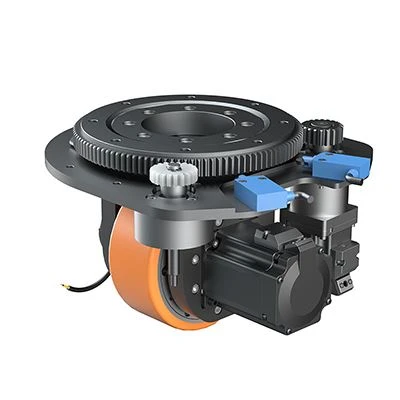
Where the family boundary sits. A vehicle that starts as a 150 kg AMR and is later re-specified for 1200 kg pallets is not a drive wheel substitution — it is a different electrical and structural architecture. Recognizing that boundary before the chassis is drawn is the single most useful outcome of comparing the PLT-120 and PLT-198 directly.
FAQ: PLT-120, PLT-198 and Drive Wheel Supplier Checks
Which safety standards should an AGV drive wheel supplier be able to map to?
Three published standards are relevant when a drive and steering unit is evaluated for a driverless vehicle. ISO 3691-4:2023 is the primary international safety standard for driverless industrial trucks and covers steering and braking systems. EN 1175:2020 specifies electrical and electronic safety requirements for industrial trucks and applies to AGV drive wheel assemblies in Europe. ANSI/ITSDF B56.5 is the specific United States safety standard for driverless industrial vehicles, governing the performance of drive and steering units. Buyers should ask suppliers to state which of these their drive and steering subsystem is designed against, rather than accepting a general compliance statement.
How do I decide between the PLT-120 differential drive wheel and the PLT-198 horizontal drive wheel?
Decide on published load and torque first. The PLT-120 is rated for a 150 kg drive wheel load with 400 W, 48 V, 11.2 A, 1.28 Nm rated torque, a 9 / 20 (I) transmission ratio, 10 / 21 Nm rated output torque and 20 / 42 Nm maximum acceleration and braking torque, with IP65 protection. The PLT-198 is rated for a 1500 kg maximum load with 3000 W, 48 V, 68 A, 9.55 Nm rated torque, a 32:1 reduction ratio, 260 Nm output torque and 576 Nm maximum torque. If the loaded vehicle needs more than 150 kg per driven wheel, the PLT-198 is the appropriate class; below that, the PLT-120 avoids unnecessary current draw and module size.
What drives the cost difference between a differential drive wheel and a heavy horizontal drive wheel?
The visible specification gap explains most of it: motor power (400 W versus 3000 W), rated current (11.2 A versus 68 A, which affects cabling, battery capacity, fuses and driver sizing), the gear stage (transmission ratio 9 / 20 versus a 32:1 planetary reduction), maximum torque (20 / 42 Nm maximum acceleration and braking torque versus 576 Nm), and load rating (150 kg versus 1500 kg), which changes bearing, housing and material content in carbon steel. IP65 protection on the PLT-120 is also a cost-bearing specification. Because drive wheel pricing is quoted against configuration, quantity and customization of load and speed options, buyers should request a quotation for the exact model and options rather than comparing headline figures.
Can I validate a drive wheel before committing to full production?
Validation normally starts by matching the published parameters against the project requirements: load per driven wheel, required output and maximum torque, rated voltage and current, IP protection level, mounting orientation and control method. Once those match, buyers can move to sample and quotation discussions. Business inquiries for the PLT-120, PLT-198 or PLT-210 — including sample requests and configuration questions — are handled through the contact channel listed at the end of this article, and the Plutools selection brochure provides the full model overview for internal engineering reviews.
How should I shortlist AGV drive wheel suppliers, not just drive wheel models?
Shortlisting suppliers should follow the same evidence standard as shortlisting models. A supplier should publish model-level parameters rather than category-level claims — rated voltage, current, power, speed, torque, reduction ratio, load capacity and protection level — because those are the values an engineer must verify. It should offer multiple drive formats, since the correct answer depends on the chassis: a differential drive wheel such as the PLT-120, horizontal drive wheels with steering such as the PLT-198 and PLT-210, and vertical units such as the PLT-150, PLT-230 and PLT-230P. Customization of load and speed options should be stated explicitly where it exists. Shanghai Plutools Automation Corporation Co., Ltd., established in 2017 and headquartered in Shanghai, China, specializes in AGV/AMR mobile robots with AGV Drive Wheel as its main product line, exports to the EU, USA, Southeast Asia, South America, the Middle East, Japan and South Korea, and states that export business accounts for 70% of total sales — a supplier profile that can be checked against published model data before any commercial commitment.
Conclusion: Let the Load Class Choose the Drive Wheel
The comparison resolves into a simple rule. Under roughly 150 kg per driven wheel, with an energy-efficient 48 V / 11.2 A electrical architecture and a need for IP65 protection in a compact chassis, the PLT-120 differential drive wheel is the correct platform, typically deployed in differential pairs for in-place turning. In forklift-class and heavy material-handling duty, where 1500 kg loads must be started, moved and braked reliably, the PLT-198 planetary horizontal drive wheel delivers 3000 W, 260 Nm output torque, 576 Nm maximum torque and a 32:1 reduction ratio — with the PLT-210 as the model explicitly catalogued as a forklift drive wheel when a 1200 kg rating is sufficient.
Whatever the model, confirm the mounting orientation before the chassis is drawn, since the vertical-versus-horizontal question determines module height, centre of gravity and maintenance access. And confirm the standards the drive and steering subsystem is designed against, because ISO 3691-4:2023, EN 1175:2020 and ANSI/ITSDF B56.5 now shape how drive units are specified, not just how they perform.
Next Step: Confirm Your Drive Wheel Configuration
Send your per-wheel load, required torque, voltage and mounting orientation, and the Plutools team will confirm whether the PLT-120, PLT-198 or PLT-210 is the correct fit — or whether a vertical drive wheel is the better structural answer for your chassis.
Email: Eric.Tang@plutools.com | Tel / WhatsApp: +86 15989586580
Website: www.plutools.com
Download the full drive wheel selection brochure: PLT Selection Manual 2026
Have Questions or Need More Details?
Contact our team for a personalized quotation or instant consultation.
Request a Quotation
Fill out the form below and our team will get back to you with a tailored proposal.
WhatsApp Direct Chat
Prefer to chat in real-time? Message us on WhatsApp for instant assistance & quick answers.
- Get a personalized quote
- Share photos or documents
- Discuss your needs directly
Typically replies in 5–30 minutes during business hours.