
Drive Wheel Application Guide: Scenario Fit for AGV, AMR and Forklift Projects
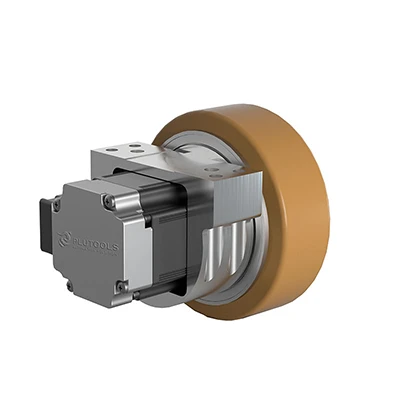
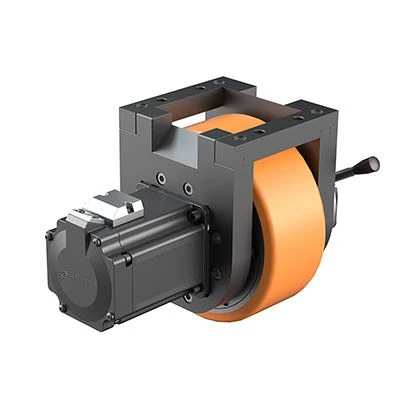
Cover: PLT-120 differential drive wheel — 48 V, 11.2 A, IP65 protection, 150 kg drive wheel load, 5±2 kg unit weight, PU tread, carbon steel construction.
Scenario fit, not motor wattage, decides which drive wheel a project can actually use. An AGV that has to turn inside a narrow aisle, an AMR that must hold traction across slightly uneven flooring, and a forklift-class platform moving pallets on a concrete dock are three different motion problems — and the drive wheel is where each one is either solved or multiplied. This application guide maps Plutools drive wheel models to the project scenarios that appear most often in AGV, AMR and automated forklift builds, and shows the specification evidence behind each match before integration begins.
Quick Answer: Scenario-to-Drive-Wheel Mapping
When the project category is already clear, the mapping below is enough to open a shortlist. The rest of this guide explains the reasoning, the constraints and the verification steps behind each entry.
- Compact AGV and AMR platforms with differential drive: Differential Drive Wheel PLT-120 — 400 W, 48 V, 11.2 A, 3000 rpm, IP65, 150 kg drive wheel load, 5±2 kg unit weight, PU tread, carbon steel.
- Steering-heavy platforms at mid payload: Parallel Horizontal Drive Wheel PLT-220 (1000 kg, 750 W, 28:1, 174 Nm maximum torque) or Forklift Drive Wheel PLT-210 (1200 kg, 3000 W, 32:1, 576 Nm maximum torque), both with integrated steering.
- Higher-load forklift-class movement: Horizontal Drive Wheel PLT-198 — 1500 kg maximum load, 3000 W, 48 V, 3000 RPM, 32:1 reduction ratio, 576 Nm maximum torque, planetary horizontal structure with steering.
- Shock-sensitive, IP-rated or 24 V AMR builds: Robot Drive Wheel PLT-230P (1200 kg, servo travel motor, 2500 W, 48 V, IP65), AGV Drive Wheel PLT-230 (1500 kg, 24 V, 1500 W, 300 Nm maximum torque) or Vertical Drive Wheel PLT-150 (500 kg, 48 V, 750 W with steering).
- Vertical versus horizontal drive wheel: a scenario checkpoint, not a preference. Mounting height, steering integration and load per unit decide it.
Problem Definition: Where Drive Wheel Scenario Fit Goes Wrong
The most expensive drive wheel mistake in a mobile robot project is rarely a failed component. It is a unit specified against the wrong scenario and then confirmed against the wrong number. Six mismatches produce most of them.
- Sizing by motor power alone. The AGV Drive Wheel Unit PLT-167 uses a 750 W, 48 V motor at a 21:1 reduction ratio and delivers 40 Nm output torque with 120 Nm maximum torque at an 800 kg maximum load. The Horizontal Drive Wheel PLT-198 uses a 3000 W, 48 V motor at 32:1 and reaches 260 Nm output torque with 576 Nm maximum torque at 1500 kg. On a datasheet both are simply drive wheels; on the floor they serve different load and acceleration envelopes.
- Assuming dual differential drive replaces steering. Dual differential drive wheels allow a zero-turn radius and are widely used in smaller logistics bots. Steering units remain the practical route when a heavier platform has to change direction repeatedly without scrubbing the floor, which is why integrated steering appears across the PLT-150, PLT-198, PLT-210 and PLT-220.
- Treating environment as a late detail. IP protection is specified per model — PLT-120 and PLT-230P are rated IP65 — while the deployment envelope covers dust, vibration, temperature change, low-temperature warehouses, high-humidity areas, cleanrooms and explosion-proof requirements. Environment decisions change the drive wheel, not only the enclosure around it.
- Overlooking the voltage architecture. The AGV Drive Wheel PLT-230 runs on 24 V (1500 W, 76 A, 2590 RPM), while most of the range is built around 48 V. Battery pack, motor driver and charging strategy follow the wheel, so the voltage decision belongs at the start of platform design.
- Choosing the drive wheel after the chassis is frozen. Mounting dimensions, encoder type, brake system, connector and cable length all sit on the customization list. Changing them once integration has started costs more than fixing them at design freeze.
- Reading one number instead of a set. Maximum load, maximum torque, reduction ratio, IP rating and unit weight have to be read together. The 5±2 kg unit weight of the PLT-120 differential drive wheel, for example, matters on a compact AMR chassis where every kilogram affects vehicle balance.
Industry Background: Why Scenario Diversity Is Growing
Scenario variety in drive wheel selection is a direct consequence of market growth and of a technology shift toward integrated units.
- The global AGV wheel drives market was valued at approximately USD 1.2 billion in 2024 and is projected to reach USD 3.5 billion by 2034, with a CAGR of 11.5% from 2024 to 2034 driven by logistics and warehouse automation (Reports and Data, 2024).
- Within that market, the industrial logistics segment for AGVs is projected to grow fastest, at a CAGR of 11.6% (MarketsandMarkets) — the segment with the widest spread of loads, floors and duty cycles.
- Asia Pacific held a 37.6% revenue share of the global AGV market in 2025 (Grand View Research), and the China mobile robot market reached a scale of 22.1 billion yuan in 2024 with more than 139,000 units sold (CMRA).
- The U.S. forklift market was valued at USD 9.11 billion in 2023, with a shift toward electric and automated drive systems (Grand View Research). Electric forklifts now command over 70% market share in many regions (MarketsandMarkets).
- Integrated steering drive modules are replacing discrete components in order to reduce manufacturer assembly time and maintenance complexity (Brandessence Research).
- Polyurethane (PU) is commonly used for forklift drive wheel tires to provide higher load capacity and floor protection in indoor settings (Mordor Intelligence), and Mecanum and omnidirectional drive systems are increasingly used for AMRs in high-density warehouses (Interact Analysis).
- Lithium-ion battery technology now powers the majority of new AGV/AMR drive units, reducing range anxiety and downtime (Fortune Business Insights).
The practical consequence for buyers and integrators is that drive wheel selection has become a scenario exercise: steering is moving into the unit rather than staying in the chassis, and load, floor and duty cycle have to be captured while the specification is still open.
Detailed Solution: Scenario-to-Model Mapping
Scenario A — Compact AGV and AMR platforms with differential drive
PLT-120 is the differential drive wheel in the range, and every part of its specification is aimed at compact platforms:
- Rated power 400 W; rated voltage 48 V; rated current 11.2 A; rated speed 3000 rpm; rated torque 1.28 Nm
- IP protection level: IP65
- Drive wheel load: 150 kg; total weight of drive wheel: 5±2 kg
- Transmission ratio: 9 and 20; rated output torque: 10 and 21 Nm; maximum acceleration and braking torque: 20 and 42 Nm
- PU wheel tread, carbon steel construction
Why this unit fits the scenario: a compact AMR or light AGV normally pairs two driven wheels to obtain a zero-turn radius, and PLT-120 is designed for that role with an integrated structure, a low unit weight and IP65 sealing. The two ratio options let the same wheel cover a faster configuration (9:1) and a more torque-oriented configuration (20:1) without changing the mounting footprint. The 150 kg drive wheel load also defines the upper end of this scenario: once a project moves beyond that class, the correct step is Scenario B or C rather than a larger motor on the same frame.
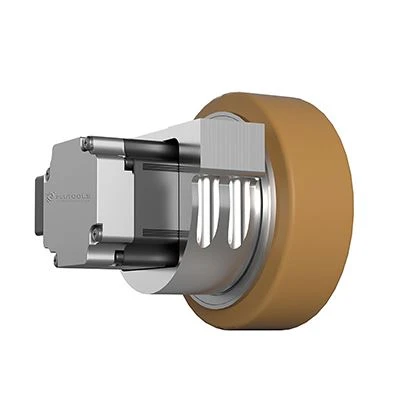
PLT-120 differential drive wheel, the unit that pairs two driven wheels for compact AGV and AMR platforms.
Scenario B — Steering-heavy platforms at mid payload
When steering has to be a property of the unit rather than a result of differential control, two parallel horizontal drive wheels with steering cover the middle of the load range.
PLT-220 — Parallel Horizontal Drive Wheel with Steering (1000 kg)
- Rated voltage 48 V; power 750 W; rated current 18 A; speed 3000 RPM; rated torque 2.4 Nm
- Reduction ratio 28; output torque 58 Nm; maximum torque 174 Nm
- Maximum load 1000 kg; PU tread; carbon steel
PLT-210 — Forklift Drive Wheel (1200 kg)
- Rated voltage 48 V; power 3000 W; rated current 68 A; speed 3000 RPM; rated torque 9.55 Nm
- Reduction ratio 32; output torque 260 Nm; maximum torque 576 Nm
- Maximum load 1200 kg; parallel horizontal structure with integrated steering; PU tread; carbon steel
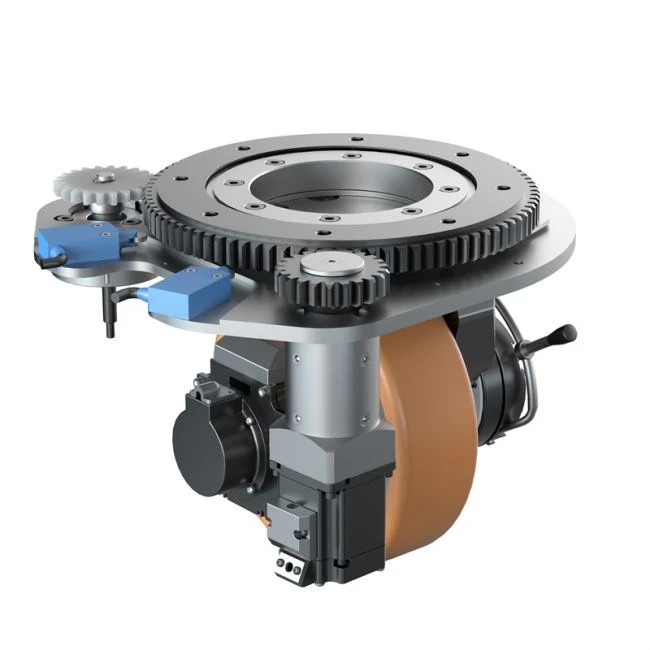
PLT-210 forklift drive wheel: parallel horizontal structure with integrated steering, 1200 kg maximum load.
The split between these two units is the clearest scenario test in the range. PLT-220 covers steering-heavy platforms whose duty cycle is dominated by positioning accuracy and repeated direction changes rather than raw tractive effort. PLT-210 keeps the same integrated steering concept but multiplies available torque through a 3000 W motor and a 32:1 reduction ratio — the configuration a forklift-class project needs when it must accelerate a loaded platform.
Scenario C — Higher-load forklift-class movement
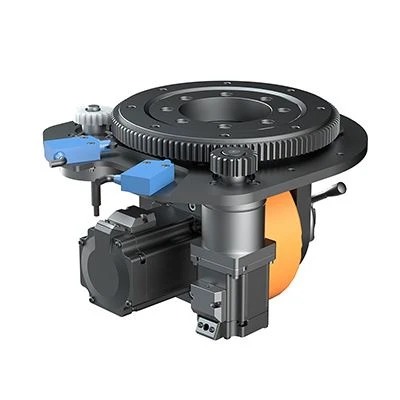
PLT-198 horizontal drive wheel: planetary horizontal structure with steering, 1500 kg maximum load and 576 Nm maximum torque.
PLT-198 — Planetary Horizontal Drive Wheel with Steering
- Rated voltage 48 V; power 3000 W; rated current 68 A; speed 3000 RPM; rated torque 9.55 Nm
- Reduction ratio 32; output torque 260 Nm; maximum torque 576 Nm
- Maximum load 1500 kg; PU tread; carbon steel
PLT-198 is the unit for projects where the maximum load requirement exceeds what a mid-range steering drive can carry and where steering must remain integrated. Its 1500 kg maximum load, 3000 W / 48 V motor, 3000 RPM speed, 32:1 reduction ratio and 576 Nm maximum torque form a specification set that matches heavy pallet movement, automated forklift chassis and ultra-heavy-duty AGV platforms. Two scenario notes matter here. First, the 32:1 ratio is what converts motor speed into usable tractive torque on a heavy platform. Second, because output torque and maximum torque differ (260 Nm versus 576 Nm), acceleration and braking events — not steady-state travel — are the loads that should be checked against the vehicle duty cycle.
Scenario D — Shock-absorbing, IP-rated and 24 V AMR builds
Not every scenario is about maximum torque. Four further configurations cover projects defined by shock absorption, IP rating, footprint or battery architecture.
- PLT-230P — Robot Drive Wheel with shock absorption: servo travel motor, 2500 W, 48 V, 62 A, 3000 RPM, gear ratio 30:1, 1200 kg load, IP65. This is the unit for AMR builds that have to absorb vibration and protect the payload.
- PLT-230 — AGV Drive Wheel (vertical, without steering): 24 V, 1500 W, 76 A, 2590 RPM, rated torque 5.5 Nm, gear ratio 30:1, output torque 108 Nm, maximum torque 300 Nm, maximum load 1500 kg — the 24 V option for high-load platforms.
- PLT-150 — Vertical Drive Wheel with steering: 48 V, 750 W, 20 A, 3000 RPM, rated torque 2.4 Nm, gear ratio 22.5:1, output torque 108 Nm, maximum torque 114 Nm, maximum load 500 kg.
- PLT-167 — AGV Drive Wheel Unit (horizontal, without steering): 48 V, 750 W, 18 A, 3000 RPM, rated torque 2.4 Nm, reduction ratio 21:1, output torque 40 Nm, maximum torque 120 Nm, maximum load 800 kg.
Scenario E — The vertical versus horizontal drive wheel checkpoint

PLT-150 vertical drive wheel with steering: 48 V, 750 W, 22.5:1 gear ratio, 500 kg maximum load.
Before finalizing any model above, the project should pass one structural checkpoint: vertical or horizontal drive wheel?
- Vertical drive wheels (PLT-150, PLT-230, PLT-230P) place the drive assembly on a vertical axis. They are the usual direction when mounting height is available but the horizontal footprint of the chassis is tight, and the vertical arrangement is also where shock absorption is offered — PLT-230P is specified with shock absorption for that reason.
- Horizontal drive wheels (PLT-167, PLT-198, PLT-210, PLT-220) mount the drive assembly in the horizontal plane. Where integrated steering is required, this is the family that provides it: PLT-198, PLT-210 and PLT-220 all combine a horizontal structure with steering, and PLT-220 and PLT-210 are specified as parallel horizontal drive wheels with steering.
- Differential drive wheels (PLT-120) sit at the compact end, where two units work as a pair to produce turning without a separate steering mechanism.
The checkpoint question is therefore not which arrangement is better in general, but which one the project can physically support: available mounting height, the need for integrated steering, the load per unit and the environment. A vertical unit chosen for footprint reasons cannot deliver the steering function in a steering-heavy project, and a horizontal steering unit chosen for a chassis with no horizontal clearance cannot be installed regardless of its load rating.
Step-by-Step Breakdown: Screening a Drive Wheel Against a Project
- Define platform class and load per unit. Establish the vehicle type (compact AGV, AMR, forklift-class) and the load each drive wheel must carry. The range spans 150 kg on PLT-120 to 1500 kg on PLT-198 and PLT-230, with 500 kg (PLT-150), 800 kg (PLT-167), 1000 kg (PLT-220) and 1200 kg (PLT-210, PLT-230P) in between.
- Define the motion profile. Decide whether the platform turns through differential control, through an integrated steering drive, or through both. Dual differential drive enables a zero-turn radius; steering units handle repeated direction changes on heavier platforms.
- Match motor, voltage and reduction ratio. Confirm the battery architecture (24 V or 48 V), then read ratio and torque as a set: 21:1 with 750 W on PLT-167, 22.5:1 with 750 W on PLT-150, 28:1 with 750 W on PLT-220, and 32:1 with 3000 W on PLT-198 and PLT-210.
- Screen the environment. Check dust, moisture, temperature variation, floor type and any special requirement — low temperature, high humidity, cleanroom, explosion-proof or heavy duty. Confirm the IP rating the chassis requires; PLT-120 and PLT-230P are rated IP65.
- Confirm the mechanical and electrical interfaces. Mounting dimensions, encoder type, brake system, connector and cable length are all customizable and should be frozen before the chassis design is finalized.
- Validate with a sample, then scale. Because the minimum order quantity is 2 units, a project can validate a pair on the real chassis before committing to a series run, with production units passing 100% test before shipment.
Use Cases: Where These Configurations Are Deployed
Drive wheels from this range are used across intelligent logistics, industrial automation, warehousing, automotive manufacturing, electronics manufacturing, food and beverage production, pharmaceutical manufacturing, e-commerce fulfillment centres, airport logistics and port transportation.
The working conditions behind those sectors explain why scenario fit matters more than a single headline number. Typical duty includes continuous operation, frequent starting and stopping, forward and reverse movement, narrow aisles, heavy loads, dust, vibration and temperature changes, on concrete, epoxy, steel or slightly uneven floors. Single-wheel drive, dual-wheel differential drive, steering drive and multi-wheel coordinated drive are all supported, controlled through speed, torque and position commands from the vehicle controller. Special versions can be designed for low-temperature warehouses, high-humidity areas, cleanrooms, dusty workshops and heavy-duty industrial applications.
Project reference — ultra-heavy-duty AGV, Brazil. A Brazil-based AGV manufacturer and industrial automation system integrator deployed 200 drive units for an ultra-heavy-duty AGV with multiple navigation modes. The drive wheels provide drive, differential steering and precise motion control, and the project has run for two years with stable operation under heavy-load conditions, accurate route tracking, flexible steering and reliable material transportation. The elements that made that scenario work are the same ones this guide recommends checking: high load capacity, high output torque, precise differential control, compatibility with multiple navigation systems, and customized system integration.
Comparison Table: Plutools Drive Wheel Models Side by Side
| Model | Type | Voltage | Power | Max load | Reduction ratio | Max torque | IP rating |
|---|---|---|---|---|---|---|---|
| PLT-120 | Differential drive wheel | 48 V | 400 W | 150 kg | 9 and 20 | 20 / 42 Nm (max acceleration and braking torque) | IP65 |
| PLT-167 | Horizontal drive wheel without steering | 48 V | 750 W | 800 kg | 21 | 120 Nm | Not stated |
| PLT-150 | Vertical drive wheel with steering | 48 V | 750 W | 500 kg | 22.5 | 114 Nm | Not stated |
| PLT-220 | Parallel horizontal drive wheel with steering | 48 V | 750 W | 1000 kg | 28 | 174 Nm | Not stated |
| PLT-210 | Forklift drive wheel (parallel horizontal with steering) | 48 V | 3000 W | 1200 kg | 32 | 576 Nm | Not stated |
| PLT-198 | Planetary horizontal drive wheel with steering | 48 V | 3000 W | 1500 kg | 32 | 576 Nm | Not stated |
| PLT-230P | Vertical drive wheel with shock absorption | 48 V | 2500 W | 1200 kg | 30 | Not stated | IP65 |
| PLT-230 | Vertical drive wheel without steering | 24 V | 1500 W | 1500 kg | 30 | 300 Nm | Not stated |
Values as published in the Plutools drive wheel specifications. PU wheel tread and carbon steel construction apply across the range.
Frequently Asked Questions
Which safety standards apply to drive and steering units in AGV, AMR and forklift projects?
Three references cover most projects. ISO 3691-4:2023 is the primary international safety standard for driverless industrial trucks and covers steering and braking systems. EN 1175:2020 specifies electrical and electronic safety requirements for industrial trucks and is applicable to AGV drive wheel assemblies. ANSI/ITSDF B56.5 is the American safety standard for driverless industrial vehicles, governing the performance of drive and steering units. Compliance documentation for a drive wheel project is normally assembled against these three references.
Can a drive wheel be adapted to an existing AGV, AMR or forklift chassis?
Yes. Plutools customizes load capacity, wheel diameter, motor power, voltage, rated speed, reduction ratio, mounting dimensions, encoder type, brake system, connector, cable length, logo and packaging. The company operates as a factory offering OEM, ODM, custom manufacturing and sample development, with a 60-engineer R&D team and more than 200 patent technology certifications behind the design work.
What is the minimum order quantity for a scenario-matched drive wheel, and how is supply scaled?
The minimum order quantity is 2 units, which allows a project to start with a validation pair before committing to a series run. Production covers small to large batches on a monthly capacity of 12,000 units, and every unit passes 100% test. Pricing follows the final specification, because load capacity, reduction ratio, encoder type, brake system and connector all change the configuration.
How is a drive wheel validated before series production?
Validation starts with sample development, which the factory supports as part of its OEM/ODM model, and production units are 100% tested before shipment. For scenario fit, a sample pair of differential drive wheels such as PLT-120 lets the integrator verify IP65 sealing, the 5±2 kg unit weight and the 150 kg rated load against the real chassis before the series order.
What lead time should an AGV, AMR or forklift project plan for?
Standard lead time is 30–45 days, with a minimum order quantity of 2 units and a monthly capacity of 12,000 units. To start a scenario-fit review, send the platform load, voltage, mounting dimensions and motion profile to Plutools (email Eric.Tang@plutools.com, phone +86 15989586580), or download the 2026 Plutools selection brochure for the full model range before the design freeze.
Conclusion: Choose by Scenario, Then Verify by Specification
Scenario fit is a sequence, not a single decision. The platform class sets the load per unit; the motion profile decides whether the platform needs differential drive, integrated steering or a combination; the environment sets IP and material requirements; and only then does the specification — voltage, power, reduction ratio, output torque and maximum torque — confirm which model belongs in the chassis. Read in that order, the range resolves cleanly: PLT-120 for compact differential AGV and AMR platforms, PLT-220 and PLT-210 for steering-heavy mid-payload projects, PLT-198 for higher-load forklift-class movement, and PLT-150, PLT-167, PLT-230 and PLT-230P for footprint-, shock- or voltage-constrained builds.
Shanghai Plutools Automation Corporation Co., Ltd. is a Shanghai-based manufacturer focused on AGV/AMR mobile robot drive wheels, founded in 2017 and operating a 10,000 m² production facility with more than 100 employees, a 60-engineer R&D team and over 200 patent technology certifications. Around 70% of output is exported, serving the EU, USA, Southeast Asia, South America, the Middle East, Japan and South Korea.
Next Step: Match a Drive Wheel to Your Project
Send your platform load, voltage, mounting envelope and motion profile to the Plutools team and request a sample or quotation against the confirmed specification. Minimum order quantity is 2 units, lead time is 30–45 days, and every unit is 100% tested before shipment.
Download the 2026 Plutools Drive Wheel Selection Brochure for the full model range, or contact Eric.Tang at plutools.com — email Eric.Tang@plutools.com, tel +86 15989586580, WhatsApp +86 159-8958-6580.
Have Questions or Need More Details?
Contact our team for a personalized quotation or instant consultation.
Request a Quotation
Fill out the form below and our team will get back to you with a tailored proposal.
WhatsApp Direct Chat
Prefer to chat in real-time? Message us on WhatsApp for instant assistance & quick answers.
- Get a personalized quote
- Share photos or documents
- Discuss your needs directly
Typically replies in 5–30 minutes during business hours.