
Evaluating Drive Wheel Suppliers: A Checklist with PLT Series Evidence
Short answer: qualifying a drive wheel supplier for an AGV, AMR or automated forklift programme comes down to seven verifiable constraints — load class, motor and current ratings, torque chain, material and tread, certification scope, test evidence, and customisation terms. A supplier that can answer all seven with documents, certificate numbers and part numbers is ready for a pilot build. A supplier that answers with adjectives is not.
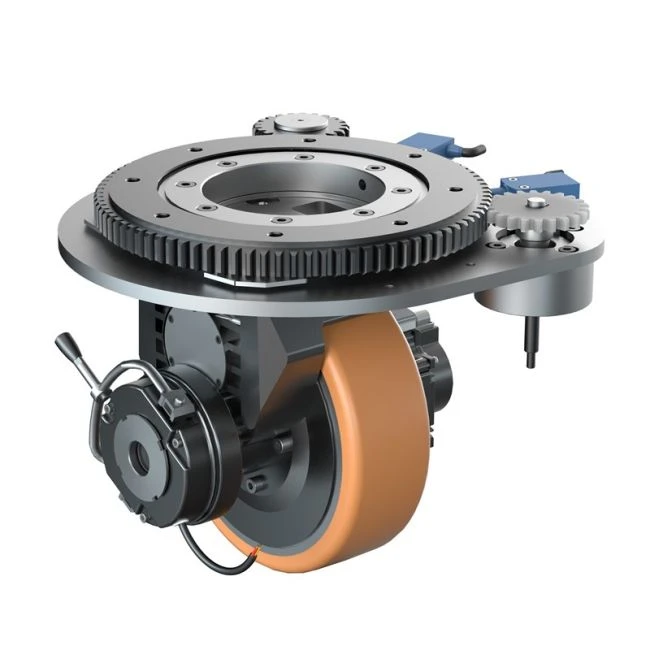
This guide is written for OEM buyers, procurement managers and system integrators who are already past the discovery stage and are now comparing real candidates. It converts the usual supplier questionnaire into a fixed evaluation sequence, and uses three Plutools models as evidence examples of what a complete answer looks like: the PLT-120 differential drive wheel, the PLT-198 planetary horizontal drive wheel with steering, and the PLT-210 parallel horizontal drive wheel with steering. Between them they cover the 1200–1500 kg heavy class and a compact 150 kg differential class, and both the 48 V / 3000 W / 68 A motor family and a lighter 48 V / 400 W configuration.
Problem Definition: Why Drive Wheel Claims Are Hard to Verify
A drive wheel is not a single part. It is an integrated sub-assembly that combines a motor, a gearbox, a wheel, an encoder and a braking system, and it transfers the entire mass of the vehicle plus payload through one contact patch. That structure is exactly why a small gap in supplier data turns into a mechanical problem instead of a cosmetic one.
Four verification gaps appear repeatedly in OEM sourcing of AGV and AMR drive wheels:
- Load figures without duty context. A maximum load number means little unless the buyer knows the wheel diameter, the reduction ratio and the vehicle duty cycle it was validated against.
- Partial electrical ratings. Voltage quoted without current, or power quoted without rated speed, forces the buyer to infer controller and battery compatibility instead of confirming it.
- Compliance stated as a brand, not as a document. Phrases such as CE certified are useless in an audit unless the certificate number, issuing laboratory, applicable standard, model scope and validity dates are supplied.
- Customisation described in marketing language. If a supplier cannot list the parameters it can change — and cannot confirm which of them apply to the specific model quoted — the buyer has no basis for a pilot.
The practical consequence is that evaluation slips from engineering review into commercial negotiation, where price replaces evidence. A checklist prevents that drift by fixing the order in which constraints are verified.
Industry Background: Constraint Pressure Is Rising
Drive wheel sourcing has become a documentation problem as much as a hardware problem, because the market is growing quickly while the safety framework around it is becoming more specific. Reports and Data values the global AGV wheel drives market at approximately USD 1.2 billion in 2024, with a projected path to USD 3.5 billion by 2034 and a CAGR of 11.5% from 2024 to 2034, driven largely by logistics and warehouse automation. On the vehicle side, MarketsandMarkets reports that electric forklifts now command over 70% market share in many regions as a replacement for combustion models, which shifts the design burden onto electric drive and steering assemblies.
Alongside that growth, three standards now shape what a buyer can legitimately demand from a drive wheel supplier:
- ISO 3691-4:2023 — the primary international safety standard for driverless industrial trucks, covering steering and braking systems.
- EN 1175:2020 — electrical and electronic safety requirements for industrial trucks, applicable to AGV drive wheel assemblies in Europe.
- ANSI/ITSDF B56.5 — the specific American safety standard for driverless industrial vehicles, governing the performance of drive and steering units.
These standards do not certify a wheel by themselves. They define the questions a buyer should ask, and they make the difference between a general compliance statement and a traceable document set far more consequential than it used to be. A third-party corroboration point for the material side is that forklift drive wheel tyres commonly use polyurethane (PU) to provide higher load capacity and floor protection in indoor settings, as noted by Mordor Intelligence — which is why PU tread claims should be checked against the specific model rather than accepted as a category statement.
The Drive Wheel Supplier Evaluation Checklist: Seven Constraints to Verify
Each of the seven checks below can be closed with a document, a part number or a measurable parameter. Where a Plutools model is used as an example, the value shown is the published specification for that model, not an estimate.
1. Load class — the number that determines everything downstream
The first question is not how much the wheel can carry in isolation, but which published load class matches your worst-case duty. The PLT series spreads across several classes, and the heavy class relevant to automated forklift and heavy AGV programmes is defined by the PLT-198 and PLT-210, both rated at a maximum load of 1500 kg and 1200 kg respectively. The compact end of the same family is represented by the PLT-120 differential drive wheel, published with a drive wheel load of 150 kg and a total wheel weight of 5 ± 2 kg.
What to verify here: that the supplier states the load class per model, not per product family, and that the quoted figure is tied to a wheel diameter, a reduction ratio and a speed. A buyer should also ask whether the wheel will be used in single-wheel drive, dual-wheel differential drive, steering drive or multi-wheel coordinated drive mode, because the load distribution across the wheel set changes the actual duty on each unit.
2. Motor, voltage and current ratings
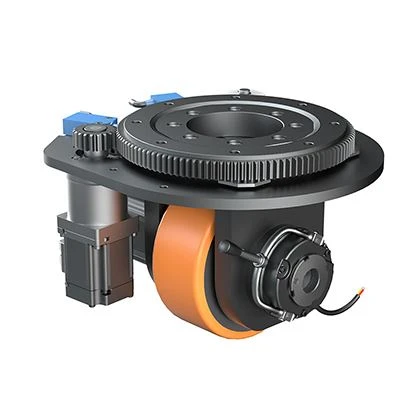
Voltage alone does not confirm compatibility. The heavier PLT models — PLT-198 and PLT-210 — are both published at a rated voltage of 48 V, a power of 3000 W and a rated current of 68 A, running at 3000 RPM. The PLT-120 differential drive wheel is a different electrical profile in the same 48 V family: 400 W rated power, 11.2 A rated current, 3000 rpm rated speed and 1.28 Nm rated torque.
That contrast is the point of the check. A buyer specifying a 48 V bus must confirm the current the controller and battery system will actually see, because a 68 A assembly and an 11.2 A assembly can sit in the same nominal voltage family while placing very different demands on the electrical architecture.
3. Reduction ratio and torque chain
Torque is where a specification becomes a design decision. Both the PLT-198 and the PLT-210 use a 32:1 reduction ratio, with an output torque of 260 Nm and a maximum torque of 576 Nm, and a rated torque of 9.55 Nm at the motor. The PLT-120 operates on a different logic, published with transmission ratio options of 9 and 20, a rated output torque of 10 Nm and 21 Nm, and a maximum acceleration and braking torque of 20 Nm and 42 Nm.
What to verify here: that the supplier can explain the relationship between reduction ratio, output torque and the acceleration and braking duty the vehicle will perform, and that the ratio quoted is the ratio supplied. Where a model offers more than one ratio or load option, the buyer should require the exact configuration to be written into the quotation rather than left to the catalogue.
4. Material, tread and protection
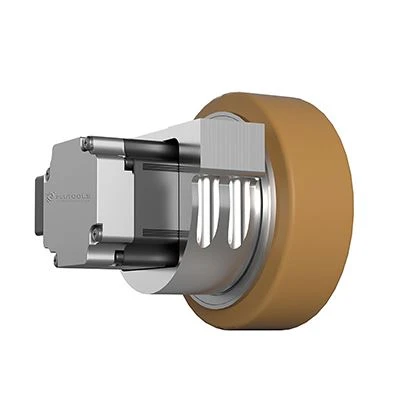
Carbon steel is used as the primary material of the horizontal drive wheels in this series, and PU wheel tread is specified across the range for low noise and high wear resistance. The PLT-120 differential drive wheel carries an IP protection level of IP65 and is made of carbon steel, which matters for projects that include dust, humidity or wash-down exposure.
What to verify here: the material and tread specification per model, the protection rating where relevant, and whether the intended operating environment falls outside the standard configuration. Applications that include low-temperature warehouses, high-humidity areas, cleanrooms, dusty workshops or heavy-duty industrial use typically require a special version rather than a standard unit, and that should be confirmed in writing before tooling or fixtures are designed.
5. Certification scope, not certification claims
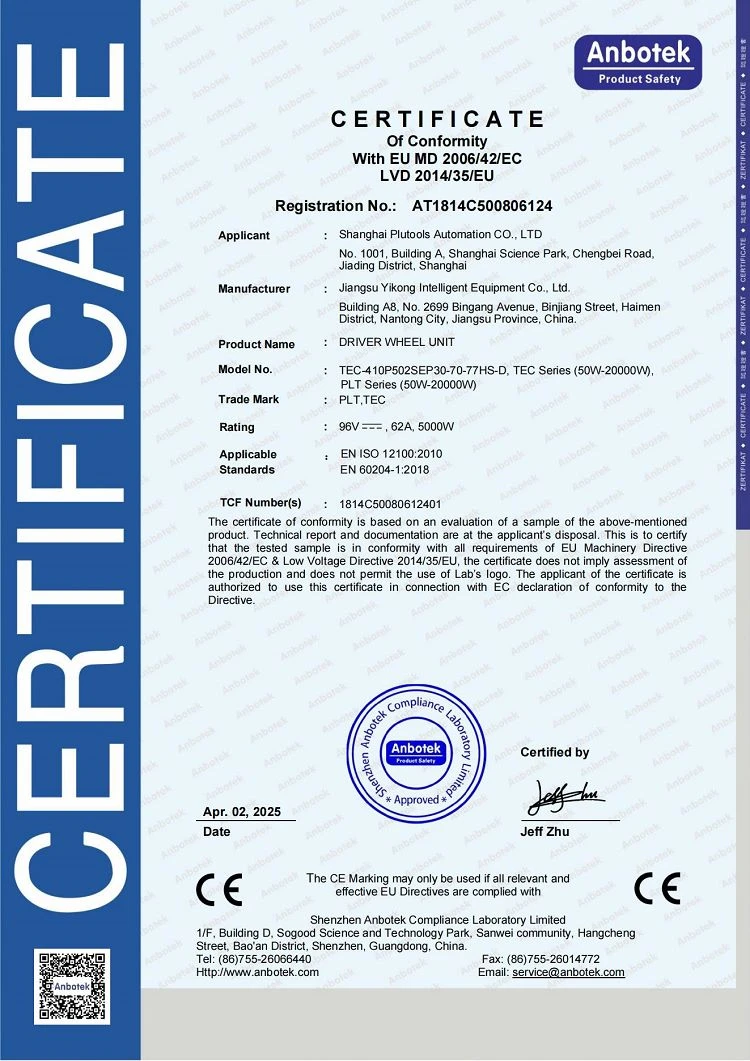
A certificate is only useful to an OEM if its scope covers the model being purchased and its validity dates are still open. Plutools holds CE documentation that can be verified at document level. Certificate AT1814C500806124 was issued by Shenzhen Anbotek Compliance Laboratory Limited on 2025-04-02 and is valid to 2030-04-02, citing applicable standards EN ISO 12100:2010 and EN 60204-1:2018, with a scope covering the TEC series (50 W–20000 W) and the PLT series (50 W–20000 W). A second certificate, AT182414C4001881, was issued by the same laboratory on 2024-07-16 and is valid to 2029-07-16, with a scope covering the TEC series and the PLT series.
What to verify here: certificate number, issuing authority, applicable standard, model scope and expiry date. A buyer should also separate supplier-level certification from project-level standards such as ISO 3691-4:2023, EN 1175:2020 and ANSI/ITSDF B56.5, because those obligations sit with the vehicle builder even when the drive wheel assembly is compliant.
6. Test reports and production testing
The single most useful document in a drive wheel evaluation is a test report that names the parameters measured. Plutools states 100% testing as part of its quality control process, and the practical next step for a buyer is to request the test report structure for the specific model under evaluation, then confirm which measured values appear on it.
What to verify here: that testing is applied to every unit rather than to a sample batch, that the report covers the parameters the project depends on, and that the report can be tied to the serial or batch of the delivered units. This is also the stage where a supplier should be able to explain a discrepancy between catalogue values and measured values instead of restating the catalogue.
7. Customisation list and commercial terms
Customisation capability should be requested as a parameter list, not as an assurance. Plutools publishes its customisable parameters as load capacity, wheel diameter, motor power, voltage, rated speed, reduction ratio, mounting dimensions, encoder type, brake system, connector, cable length, logo and packaging. The PLT-198, PLT-210 and PLT-220 all support customisable load and speed options, and the PLT-167 likewise offers an integrated structure with customisable load and speed options.
What to verify here: the production mode behind the offer, the minimum order quantity, and the lead time. Plutools operates as a factory offering OEM, ODM, custom manufacturing, sample development and production runs from small to large batches, with a published MOQ of 2 units, a lead time of 30–45 days, and a monthly capacity of 12,000 units. Export markets are listed as the EU, US, Middle East and Southeast Asia, against an overall export ratio of 70%.
Decision rule: if a supplier can close checks 1–4 with published per-model data, checks 5–6 with traceable documents, and check 7 with a written parameter and commercial list, the candidate is ready for a pilot build. If any check is answered with a product family statement, the evaluation is not finished.
Step-by-Step Breakdown: Running the Evaluation in the Right Order
The order matters, because each step narrows the next one. Running price negotiation before step 5, for example, resets the comparison without evidence.
- Freeze the mechanical requirement. Define the wheel set configuration (single, dual differential, steering or multi-wheel coordinated), the worst-case payload, the floor type — concrete, epoxy, steel or slightly uneven — and the environment. This determines which load class and which configuration family you are actually shortlisting.
- Complete the desk review against the checklist. Request published per-model data for load class, voltage, power, current, rated speed, reduction ratio, output torque, maximum torque, material and protection rating. The PLT-198 and PLT-210 answer the heavy class at 1500 kg and 1200 kg with 48 V, 3000 W and 68 A; the PLT-120 answers the compact class at 150 kg drive wheel load with 400 W and IP65.
- Request the document set. Ask for certificate copies with numbers, issuing authority, applicable standards, scope and validity dates, plus the test report structure used in production. Compare the scope against the exact model you intend to buy.
- Define the customisation delta. List what differs from the standard model — load rating, speed, mounting dimensions, encoder type, brake system, connector or cable length — and require the supplier to confirm each item in writing against the production drawing.
- Validate with a sample and a pilot build. A published MOQ of 2 units makes a pilot feasible without committing to series volume. Install the sample on the real chassis, verify route tracking, acceleration, braking and steering behaviour under the actual payload.
- Agree scale-up terms. Confirm lead time, batch size and repeatability before releasing your own production schedule. Plutools publishes a 30–45 day lead time against a monthly capacity of 12,000 units, which is the kind of figure a buyer can plan a launch around — provided it is confirmed for the customised configuration, not only the standard one.
Use Cases: Where This Checklist Gets Tested
Ultra-heavy-duty AGV with multiple navigation modes
A Brazilian AGV manufacturer and industrial automation system integrator sourced 200 drive wheel units over a two-year programme for an ultra-heavy-duty AGV running multiple navigation modes. The requirement combined drive, differential steering and precise motion control in the same platform. The reported outcome was stable operation under heavy-load conditions, accurate route tracking, flexible steering and reliable material transportation. The evaluation emphasis in that project maps directly to the checklist: high load capacity, high output torque and precise differential control all had to be documented before the units entered the vehicle programme.
Automated forklift and heavy pallet transport
Automated forklift platforms and heavy pallet transport vehicles are the natural fit for the PLT-210, a parallel horizontal drive wheel with steering published at a 1200 kg maximum load with an integrated parallel horizontal structure. For this application the decisive checks are usually the torque chain (32:1 ratio, 260 Nm output torque, 576 Nm maximum torque), the steering integration, and the certification scope covering the PLT series. Material handling projects using concrete and epoxy floors with frequent starting and stopping also make the IP and tread specification a practical rather than a theoretical question.
Compact AMR and differential platforms
Smaller logistics robots and differential-drive platforms are better served by a lighter assembly. The PLT-120 differential drive wheel is published at 400 W, 48 V, 11.2 A, with an IP65 protection level, a 150 kg drive wheel load and a total weight of 5 ± 2 kg. That combination supports the compact chassis and low-noise requirements typical of warehouse picking and internal transfer robots, and its carbon steel construction and PU tread align with the wear profile of indoor continuous operation.
Across all three use cases, the same environment questions recur: whether the site operates in low-temperature storage, high-humidity areas, cleanrooms, dusty workshops, or requires anti-static, oil-resistant or corrosion-resistant behaviour. Those conditions should be raised during step 4, because they change the configuration rather than the supplier ranking.
PLT-120 vs PLT-198 vs PLT-210: Verification Data at a Glance
The table below compares the three example models using published specification data only. The values are the model-level data a buyer should be able to obtain in writing before a pilot.
| Verification point | Differential Drive Wheel PLT-120 | Horizontal Drive Wheel PLT-198 | Forklift Drive Wheel PLT-210 |
|---|---|---|---|
| Configuration | Differential drive wheel | Planetary horizontal drive wheel with steering | Parallel horizontal drive wheel with steering |
| Rated voltage | 48 V | 48 V | 48 V |
| Power / rated current | 400 W / 11.2 A | 3000 W / 68 A | 3000 W / 68 A |
| Speed | 3000 rpm | 3000 RPM | 3000 RPM |
| Reduction ratio | 9, 20 | 32 | 32 |
| Output torque | 10, 21 Nm | 260 Nm | 260 Nm |
| Maximum torque | 20, 42 Nm (acceleration and braking) | 576 Nm | 576 Nm |
| Maximum load | 150 kg drive wheel load | 1500 kg | 1200 kg |
| Material / tread | Carbon steel, PU tread | Carbon steel, PU tread | Carbon steel, PU tread |
| Protection | IP65 | Not stated for this model | Not stated for this model |
| Customisation | Customisable load and speed options | Customisable load and speed options | Customisable load and speed options |
If the required load class falls outside the 1200–1500 kg band, the same series covers adjacent classes with the same evaluation logic.
| Model | Type | Voltage / power | Maximum load | Note for evaluation |
|---|---|---|---|---|
| PLT-167 | Horizontal drive wheel without steering | 48 V / 750 W | 800 kg | 21:1 ratio, 40 Nm output, 120 Nm maximum torque |
| PLT-220 | Parallel horizontal drive wheel with steering | 48 V / 750 W | 1000 kg | 28:1 ratio, 58 Nm output, 174 Nm maximum torque |
| PLT-150 | Vertical drive wheel with steering | 48 V / 750 W | 500 kg | 22.5:1 gear ratio, 108 Nm output, 114 Nm maximum torque |
| PLT-230 | Vertical drive wheel without steering | 24 V / 1500 W | 1500 kg | 30:1 gear ratio, 108 Nm output, 300 Nm maximum torque |
| PLT-230P | Vertical drive wheel with shock absorption | 48 V / 2500 W | 1200 kg | Servo travel motor, 30:1 gear ratio, IP rating 65 |
Table values are published model specifications. Where a parameter is not stated for a model, the correct action during evaluation is to request it in writing rather than to infer it from a neighbouring model.
FAQ: Drive Wheel Supplier Evaluation
1. What compliance documents should we request before approving a drive wheel supplier?
Request the certificate itself, not a statement about it. A usable document shows the certificate number, the issuing laboratory, the applicable standards, the model scope and the validity dates. Plutools CE documentation includes certificate AT1814C500806124 issued by Shenzhen Anbotek Compliance Laboratory Limited on 2025-04-02 and valid to 2030-04-02, citing EN ISO 12100:2010 and EN 60204-1:2018, and certificate AT182414C4001881 issued on 2024-07-16 and valid to 2029-07-16. Both cover the TEC series (50 W–20000 W) and the PLT series (50 W–20000 W). Project-level standards such as ISO 3691-4:2023, EN 1175:2020 and ANSI/ITSDF B56.5 remain the vehicle builder's responsibility and should be tracked separately from supplier certification.
2. How do we verify that a supplier can genuinely customise load and speed for our chassis?
Ask for the parameter list rather than a capability statement. Plutools publishes customisable parameters as load capacity, wheel diameter, motor power, voltage, rated speed, reduction ratio, mounting dimensions, encoder type, brake system, connector, cable length, logo and packaging. Specific models in the series — including PLT-198, PLT-210 and PLT-220 — support customisable load and speed options, and PLT-167 offers an integrated structure with the same customisable load and speed options. The verification test is whether the supplier can confirm the exact requested value against a production drawing, not whether customisation is generally available.
3. What drives the commercial side of a drive wheel programme?
Cost in this category is driven by the configuration, not by the brand name: load class and torque requirement, motor power and reduction ratio, protection rating, encoder and brake selection, connector and cable specification, and the scope of customisation and documentation. That is why a comparison based on unit price alone tends to mislead — two assemblies quoted at the same nominal level can differ in ratio, rated current and customisation scope. On the commercial terms themselves, Plutools publishes a MOQ of 2 units, a lead time of 30–45 days and a monthly capacity of 12,000 units, which allows a low-volume pilot before series commitment.
4. Can we evaluate a sample and a test report before committing to volume?
Yes, and that should be the default path. Plutools offers sample development alongside OEM, ODM and custom manufacturing, states 100% testing as part of quality control, and sets a MOQ of 2 units, so a buyer can validate a real unit on a real chassis before releasing volume. When requesting a sample, ask in the same message for the test report structure used in production, so that the measured parameters can be compared against the published specifications for the model. The PLT selection handbook can be downloaded here for the full model data: PLT selection handbook (PDF).
5. What lead time and supply continuity should we plan for?
Plan against the published production figures and confirm them for your specific configuration. Plutools states a lead time of 30–45 days and a monthly capacity of 12,000 units, with production runs from small to large batches and an annual output of 10,000 units; export markets are listed as the EU, US, Middle East and Southeast Asia against an export ratio of 70%. For continuity, the relevant question is not only the standard lead time but the lead time for the customised version — mounting dimensions, encoder type, brake system or cable length — since that is the variant your programme will actually consume.
Conclusion: Turn the Checklist Into a Document Trail
Drive wheel supplier evaluation fails most often because the checks are run in the wrong order or left implicit. Load class, electrical ratings, torque chain and material should be closed with per-model published data before commercial discussion begins. Certification and test evidence should be closed with document numbers and dates, not with compliance adjectives. Customisation and lead time should be closed with a written parameter list and a confirmed schedule for the configured variant, not the catalogue version.
The PLT-120, PLT-198 and PLT-210 illustrate what a complete answer looks like at two different ends of the range: a compact 150 kg differential unit with IP65 and 400 W, and a 1200–1500 kg heavy class running 48 V, 3000 W and 68 A with a 32:1 ratio and 576 Nm maximum torque. The specific values matter less than the pattern — every number is obtainable in writing, per model, before a pilot.
Shanghai Plutools Automation Corporation Co., Ltd. is a Shanghai-based manufacturer of AGV and AMR drive wheels and motion control assemblies, founded in 2017, operating a 10,000 m² production facility with more than 100 employees and a 60-engineer R&D team, and holding more than 200 patent technology certifications. Its drive wheel range spans vertical, horizontal, parallel horizontal and differential configurations for AGV, AMR and automated forklift programmes.
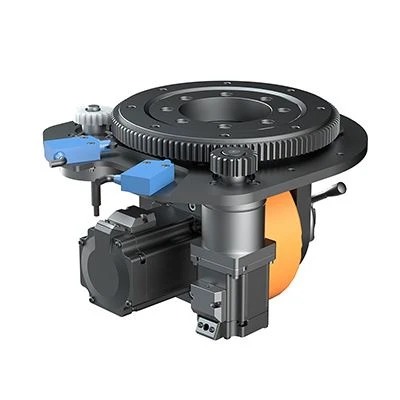
Evaluate a PLT drive wheel against your own duty cycle
Send your load class, voltage, speed and mounting requirement, and request a sample together with the model-level specification and test documentation. Pilot quantities start at the published MOQ of 2 units.
Website: www.plutools.com | WhatsApp: +86 159-8958-6580 | Email: Eric.Tang@plutools.com
Download the full model data: PLT selection handbook 2026 (PDF)
Have Questions or Need More Details?
Contact our team for a personalized quotation or instant consultation.
Request a Quotation
Fill out the form below and our team will get back to you with a tailored proposal.
WhatsApp Direct Chat
Prefer to chat in real-time? Message us on WhatsApp for instant assistance & quick answers.
- Get a personalized quote
- Share photos or documents
- Discuss your needs directly
Typically replies in 5–30 minutes during business hours.