
Differential Drive Wheel: A Plain-Language Explainer
Short answer: a differential drive wheel is a drive wheel used as one half of a driven pair. Both units sit on a common axis and each has its own motor. The vehicle steers by running one wheel faster than the other, so it needs no separate steering motor, steering gear or tie rod. Equal speed on both sides drives it straight, a speed difference makes it curve, and opposite rotation spins it on the spot.
A differential drive wheel is easier to understand as half of a pair than as a standalone component. On an AGV or AMR, two of these units are mounted facing the same direction on a shared axis. Each unit carries its own motor and gearbox, and nothing on the vehicle physically rotates the wheel around a vertical axis. Steering comes entirely from the speed difference between the left and right unit. That single design choice — no steering unit at all — is what defines the family.
This explainer is written for the people who have to specify, buy or integrate drive wheels: AGV and AMR builders, system integrators, importers and procurement engineers. It defines the term in plain language, shows where the differential layout sits next to vertical and horizontal drive wheels, and then uses one real product, the Plutools PLT-120, to show how published figures on a differential drive wheel translate into build decisions.
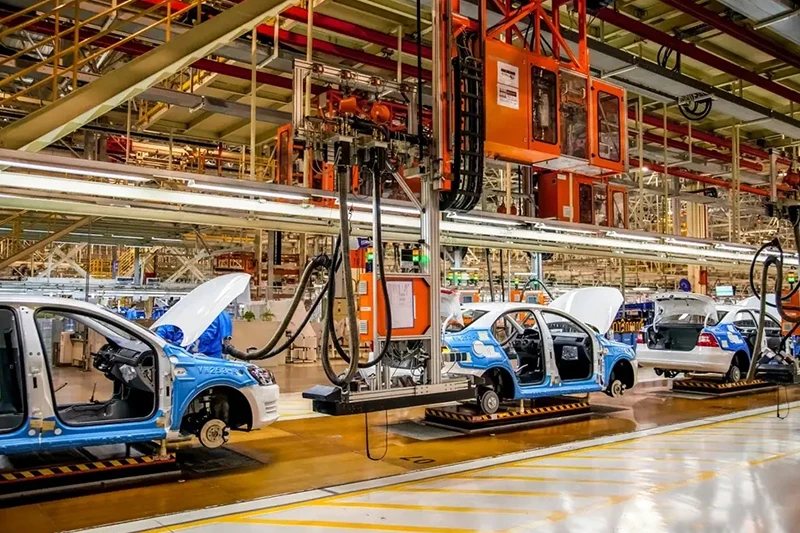
Drive wheel units are chosen as part of a steering concept, not as an isolated component. Image: Plutools product applications.
The Question That Comes Before “Which Wheel?”
Most drive wheel specification errors start one step too early. A project team opens a catalogue, compares load ratings and picks a wheel — before deciding how the vehicle is supposed to turn. Load capacity tells you how much weight a unit can carry. It says nothing about whether the vehicle needs a steering motor, a steering controller, a heading sensor or the extra chassis height that a steering axis demands.
There are two basic ways a wheeled AGV or AMR changes direction:
- Steered motion. One or more wheel units pivot around a vertical axis. The vehicle turns because a wheel is physically angled, which requires a steering motor, a steering gearbox and a control loop that keeps steering angle and drive speed synchronised.
- Differential motion. No wheel is angled. Two driven wheels on a common axis run at different speeds, and the vehicle turns because one side travels further than the other.
A plain-language test settles it: if you removed the steering motor from this vehicle, would it still be able to turn? If yes, the vehicle steers differentially and its drive wheels belong to the differential family. If no, the vehicle needs steering-capable units, such as parallel horizontal drive wheels with an integrated steering axis.
One naming trap is worth clearing up. The word is borrowed from the automotive differential, a gear set that lets two wheels on one axle rotate at different speeds. In a mobile robot, the same speed difference is created electronically by driving the left and right units independently. There is no automotive-style differential gearset inside a differential drive wheel; the “differential” describes the behaviour of the pair.
Industry Background: Why This Layout Keeps Appearing in Logistics Robots
Numbers first, interpretation second.
- The global AGV wheel drives market was valued at approximately USD 1.2 billion in 2024 and is projected to reach USD 3.5 billion by 2034, growing at a CAGR of 11.5% from 2024 to 2034 (Reports and Data).
- The global AGV market was expected to reach USD 5.9 billion by 2025, with Asia Pacific holding a 37.6% revenue share in 2025 (Grand View Research).
- The China mobile robot market reached a scale of 22.1 billion yuan in 2024, involving over 139,000 units sold (China Mobile Robot Alliance).
- Electric forklifts now command over 70% market share in many regions as a replacement for combustion models (MarketsandMarkets).
- The industrial logistics segment for AGVs is projected to grow fastest, at a CAGR of 11.6% (MarketsandMarkets).
Three structural reasons sit behind those figures.
Zero-turn manoeuvring fits dense layouts. Dual differential drive wheels allow a zero-turn radius and are widely used in smaller logistics bots (Mobile Robot Guide). In a warehouse aisle, rotating on the spot removes the swept path that a steered vehicle needs.
Fewer mechanical parts. Integrated steering drive modules are replacing discrete components to reduce manufacturer assembly time and maintenance complexity (Brandessence Research). The differential layout takes that logic to its conclusion: it removes the steering actuator altogether and moves the coordination problem into software, where it can be tuned without new hardware.
Electrification changes the base. With electric forklifts above 70% share in many regions, the drivetrain conversation shifts from hydraulics and combustion engines to motors, batteries and controllers — a context in which independently driven wheels are a natural fit.
Standards context. Vehicle-level safety requirements do not disappear because a wheel does not steer. ISO 3691-4:2023 is the primary international safety standard for driverless industrial trucks and covers steering and braking systems; EN 1175:2020 specifies electrical and electronic safety requirements for industrial trucks; ANSI/ITSDF B56.5 is the American safety standard for driverless industrial vehicles and governs the performance of drive and steering units. A differential drive wheel changes how a truck steers, so the steering and braking behaviour those standards describe still has to be demonstrated at vehicle level.
How Differential Motion Produces Steering
Take two identical drive wheels, mount them on the same axis at the left and right of the chassis, and give each its own motor. What the vehicle does next depends only on the speed commands.
| Left unit | Right unit | What the vehicle does |
|---|---|---|
| Same speed, forward | Same speed, forward | Drives straight |
| Faster | Slower | Curves toward the slower side |
| Slower | Faster | Curves toward the slower side, in the opposite direction |
| Forward | Reverse, same speed | Rotates in place — zero turn radius |
| Stopped | Driving | Pivots around the stopped wheel |
Three practical consequences follow, and they matter more at the buying stage than the mechanism itself.
- The controller becomes the steering system. Speed coordination, wheel odometry and heading control all move into the vehicle controller. Two units of the same model driven by mismatched controllers will not track straight.
- The tread slides during rotation. A zero-turn manoeuvre is a scrub manoeuvre: the tread has to slide sideways across the floor. Tread compound and floor finish therefore affect both wear and floor marking. Polyurethane is commonly used on forklift drive wheel tires because it supports higher load capacity and protects floors in indoor settings (Mordor Intelligence).
- Stability has to come from somewhere else. A two-wheel differential pair defines a line, not a plane. Vehicles typically add castors or an equivalent support arrangement, and weight distribution decides how much load each drive unit actually sees.
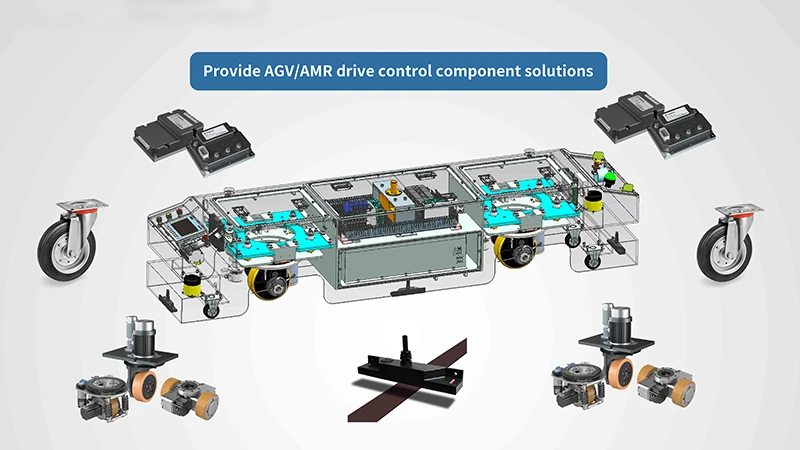
Drive architecture is decided at chassis level: the wheel family follows from how the vehicle is meant to turn.
Where the Differential Drive Wheel Sits in the Family
Drive wheels are usually grouped by how the motor and gearbox are arranged relative to the wheel, and by whether a steering axis exists.
Vertical drive wheels. The motor and gearbox are arranged vertically, which reduces the horizontal footprint of the drive unit. They suit compact structures with high load capacity and straightforward installation, and are generally recommended for heavy-duty AGVs, automated forklifts, lifting vehicles and equipment with limited chassis space.
Horizontal drive wheels. The motor is arranged horizontally, which reduces the height of the drive module and improves vehicle stability through a lower centre of gravity. They are commonly used in low-profile AGVs, warehouse AMRs, latent lifting robots and compact material-handling equipment.
Parallel horizontal drive wheels with steering. These units keep a steering axis and are arranged parallel to the chassis, so the vehicle turns by angling the wheel rather than by speed difference. They belong to the steered branch of the family.
Differential drive wheels. The distinguishing feature is the absence of a steering axis. Each unit is one half of a pair, and steering is produced by speed difference. A differential unit is therefore not “better” or “worse” than a vertical or horizontal unit — it answers a different question about the vehicle.
| Decision point | Differential drive wheel | Vertical drive wheel | Horizontal drive wheel |
|---|---|---|---|
| How the vehicle turns | Speed difference between the left and right unit; no steering axis | Steering behaviour handled by the vehicle's steering arrangement | Steering behaviour handled by the vehicle's steering arrangement |
| Motor and gearbox orientation | One motor and gearbox per unit, arranged as a paired drive | Motor and gearbox arranged vertically | Motor arranged horizontally |
| Effect on chassis space | No steering actuator to package; coordination moves into the controller | Reduces horizontal footprint, useful when chassis space is limited | Reduces module height and lowers the centre of gravity |
| Load and stability focus | Load shared across the pair; castors or a support arrangement typically needed | Strong load-bearing capability; structure and load distribution must be designed carefully for tall or heavy vehicles | Better anti-tipping performance because the motor sits closer to the ground |
| Typical applications | Smaller logistics bots that need zero-turn manoeuvring | Heavy-duty AGVs, automated forklifts, lifting vehicles | Low-profile AGVs, warehouse AMRs, latent lifting robots |
| Integration considerations | Speed coordination and odometry sit in the controller; tread wear from scrub turning | Relatively simple installation structure; overall integration cost can be lower | Mounting and chassis design can be more complex, which may raise initial cost |
| Maintenance access | Access depends on how the pair is mounted in the chassis | Access defined by the vertical stack and surrounding structure | Convenient maintenance access in low-profile layouts |
The vertical and horizontal columns summarise the selection logic Plutools publishes for those two families; the differential column describes the paired, non-steered layout.
The PLT-120 as a Worked Example
Specifications are easier to read when they are attached to a real part. Plutools (Shanghai Plutools Automation Corporation Co., Ltd.) is a Shanghai-based manufacturer specialising in AGV and AMR mobile robots and the industrial application of core motion control technology, with the AGV Drive Wheel as its main product line. The PLT-120 is a differential drive wheel in that line, and its published figures are enough to walk through every decision a buyer faces.
| Published figure | PLT-120 | What it means in plain language |
|---|---|---|
| Product category | Differential drive wheel | Used as one half of a two-wheel differential pair; no steering axis |
| Load capacity | 150 kg | The vertical load the unit is rated to carry |
| Rated voltage | 48 V | The voltage class to match against the vehicle battery and driver |
| Rated current | 11.2 A | The current figure used when sizing wiring, protection and the controller |
| Drive motor | 48 V | The motor is matched to the same 48 V system |
| Protection | IP65 | Dust-tight and protected against water jets |
| Tread material | Polyurethane (PU) | Supports load capacity and protects indoor floors |
| Body material | Carbon steel | Structural housing material for the drive unit |
| Total weight | 5±2 kg | Mass added to the chassis, before payload |
| Design intent | AGV and AMR scenarios | Specified for mobile robot drive applications |
Reading the load figure. 150 kg is a per-unit rating. On a two-wheel differential vehicle, payload and chassis weight are divided between the drive units and any support castors, and that split changes as the vehicle accelerates, brakes or carries an offset load. The useful question is not “does 150 kg cover my payload?” but “what share of my worst-case load reaches this unit, and what margin do I want on top?”
Reading the electrical figures. 48 V rated voltage, a 48 V drive motor and 11.2 A rated current describe one electrical envelope. The practical task is matching: battery nominal voltage, driver input range, connector and cable ratings, and protective devices all have to sit inside the same class. Putting a 48 V unit into a system designed around a different voltage class is a redesign, not an adjustment.
Reading the mechanical figures. A polyurethane tread on a carbon steel body is a common combination for indoor industrial wheels: PU for floor protection and load support, steel for the structural housing. A total weight of 5±2 kg per unit is the figure to add to the chassis mass budget, and because it is stated as a range, mass calculations should use the range rather than a single value.
Reading IP65. IP65 addresses ingress protection: dust-tight and resistant to water jets. It is relevant wherever vehicles work around dust, wash-down or humid production areas. It is an environmental rating, not a statement about vehicle-level electrical safety, which is assessed separately under standards such as EN 1175:2020.
Step-by-Step: Specifying a Differential Drive Wheel for a Build
- Confirm the steering concept. Decide whether the vehicle steers by speed difference or by a steering axis. This one decision determines whether a differential unit or a steered unit is on the table at all.
- Build the load case. Take the worst-case combination of chassis, payload, attachments and dynamic transfer, then work out what reaches each drive unit. Add margin for uneven floors and off-centre loads.
- Fix the electrical envelope. Match rated voltage, motor voltage and rated current to the battery and controller, and check cable, connector and protective device ratings at the same time.
- Choose the tread and body for the environment. Polyurethane tread on a carbon steel body suits indoor floors; abrasive, oily or outdoor surfaces change the requirement.
- Set the ingress protection target. IP65 is a sensible baseline for dusty or wash-down-adjacent areas. Confirm the rating applies to the assembled unit, not only to the motor.
- Plan the mounting and the support arrangement. A differential pair needs castors or an equivalent support arrangement, plus enough structure to keep both units in the same plane. Sketched early, this avoids chassis rework later.
- Validate before scaling. Run a sample or first article through a pre-shipment test, and check straight-line tracking, in-place rotation and tread wear on the floor the vehicle will actually use.
- Freeze the repeat-order specification. Record the exact model, voltage, tread, protection level and any customization so that the second order matches the first.
Use Cases: Where a 150 kg-Class Differential Unit Fits
The PLT-120 is designed for AGV and AMR scenarios, and that scope is narrower than “any mobile machine”.
Cart and shelf transport in intralogistics. Vehicles that shuttle totes, carts or shelves between stations need to turn inside an aisle and often need to rotate on the spot. A differential pair delivers that behaviour without a steering actuator competing for space under the deck.
Compact AGVs with tight packaging. When chassis volume is the constraint, removing the steering motor frees space and simplifies the mechanical build, while the coordination work moves into the controller where it can be tuned.
Fleets where repeatability matters more than peak performance. Distribution and multi-shift operations care about consistent behaviour across many units. A standard differential unit with a fixed specification is easier to replicate than a steered assembly with more moving parts.
Where it is not the first choice. Heavy-duty automated forklifts and lifting vehicles are generally better served by vertical drive wheels, which combine a compact horizontal footprint with high load-bearing capability. Low-profile vehicles that need a low overall height and stable operation at higher speeds are generally better served by horizontal drive wheels. The differential layout is at its best when manoeuvrability in a small footprint is the priority.
Long-Term Programs: What to Verify Beyond the Datasheet
For a distributor, importer or OEM building a product line rather than a single prototype, the drive wheel is a long-term commitment. A unit that performs on the bench but shifts subtly between batches becomes a field problem eighteen months later. Four checks matter.
Repeatability and revision control. Ask how the specification is frozen and how changes are communicated. A differential pair is only as good as the match between its two units, so consistency within a batch and across batches is a genuine requirement.
Customization capability. Load and speed options are customizable on the PLT-120, which only helps if the supplier can engineer and document the change. Plutools states more than 22 years of industry R&D and production experience, a 60-engineer R&D team and more than 200 patent technology certifications — capability that decides whether a customization request is answered with a datasheet or with an engineering review.
Production scale. The company was founded in 2017 and is headquartered in Shanghai, China, operating a 10,000 square metre manufacturing facility with approximately 100 staff and an annual production capacity of 10,000 units. For a fleet program, capacity is a supply-continuity question rather than a marketing one.
Export and documentation experience. Exports account for 70% of sales, with major markets in the EU, USA, Southeast Asia, South America, the Middle East, Japan and South Korea. Suppliers serving those markets routinely handle documentation, packaging and delivery terms that domestic-only suppliers do not.
Manufacturing capacity and revision control matter as much as the datasheet once a differential drive wheel becomes a repeat-order part.
FAQ
What safety standards apply to a differential drive wheel?
The wheel is a component, so the standards apply at vehicle level. ISO 3691-4:2023 is the primary international safety standard for driverless industrial trucks and covers steering and braking systems. EN 1175:2020 specifies electrical and electronic safety requirements for industrial trucks. ANSI/ITSDF B56.5 is the American safety standard for driverless industrial vehicles and governs drive and steering unit performance. A differential vehicle steers without a steering axis, but the steering and braking behaviour these standards describe still has to be demonstrated on the finished truck. Ingress protection such as the PLT-120 IP65 rating is an environmental rating, not a substitute for electrical safety assessment.
Can load capacity and speed be customized for a specific vehicle?
Yes. The PLT-120 is published with load and speed options customizable, alongside its standard 150 kg load capacity, 48 V rated voltage, 11.2 A rated current and 48 V drive motor. Customization is an engineering step: the request has to state target load, speed, duty cycle and operating environment so the unit can be matched. Plutools works from a 60-engineer R&D team and more than 200 patent technology certifications.
What are the purchasing terms for a drive wheel order?
MOQ is 2 units. Delivery terms are FOB Shanghai, acceptance criteria are based on a pre-shipment test, and payment terms are 50/50.
Can we validate a unit before committing to a fleet program?
Acceptance is based on a pre-shipment test, so validation is built into the order process. A practical validation checks straight-line tracking with both units under load, in-place rotation on the actual floor, tread wear after repeated turns, and confirmation that the electrical envelope matches the battery and controller. Because the minimum order quantity is 2 units, a pair can be ordered for evaluation.
Differential, vertical or horizontal drive wheel — how do I choose?
Choose by the manoeuvre the vehicle has to perform. If it must rotate in place or turn inside a narrow aisle without a steering actuator, a differential drive wheel is the natural fit. If it must carry heavy loads in a compact horizontal footprint, such as heavy-duty AGVs, automated forklifts and lifting vehicles, a vertical drive wheel is generally recommended. If it needs a low overall height, a low centre of gravity and stable higher-speed travel, such as low-profile AGVs, warehouse AMRs and latent lifting robots, a horizontal drive wheel is the better choice. The vertical-versus-horizontal selection question is the natural next step once the differential option has been ruled in or out.
Conclusion
A differential drive wheel is not a complicated idea once the vehicle is described before the part: two driven wheels on one axis, independent motors, steering by speed difference, no steering unit. What makes it worth understanding is how many downstream decisions it settles — controller architecture, chassis space, support castors, tread choice and the maintenance plan.
The PLT-120 shows how the category looks in practice: a differential drive wheel rated to 150 kg, running on a 48 V system with 11.2 A rated current and a 48 V drive motor, with IP65 protection, a polyurethane tread on a carbon steel body and a total weight of 5±2 kg, designed for AGV and AMR scenarios, with load and speed options customizable. Treat those figures as a checklist rather than a conclusion: match the load case, match the electrical envelope, match the environment, then validate on the floor the vehicle will actually drive on.
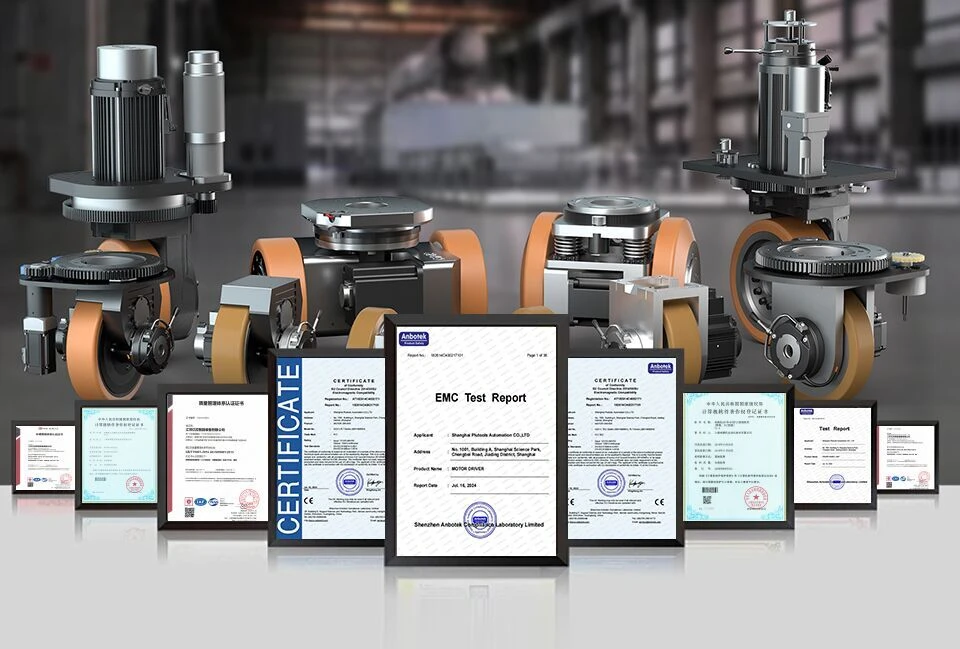
Documentation and pre-shipment test records are part of supplier qualification for repeat-order drive wheel programs.
Next Step: Sample, Quote or Selection Support
If the differential layout fits your vehicle, the next step is a specification conversation rather than a catalogue order. Plutools supplies AGV drive wheels with MOQ 2 units, FOB Shanghai delivery terms, pre-shipment test acceptance and 50/50 payment terms.
Selection manual and brochure (PDF): PLT Drive Wheel Selection Manual 2026
Email: Eric.Tang@plutools.com · Tel / WhatsApp: +86 159-8958-6580 · Website: plutools.com
Address: No. 1001, Building A, Shanghai Science Park, Chengbei Road, Jiading District, Shanghai, China
Have Questions or Need More Details?
Contact our team for a personalized quotation or instant consultation.
Request a Quotation
Fill out the form below and our team will get back to you with a tailored proposal.
WhatsApp Direct Chat
Prefer to chat in real-time? Message us on WhatsApp for instant assistance & quick answers.
- Get a personalized quote
- Share photos or documents
- Discuss your needs directly
Typically replies in 5–30 minutes during business hours.