
AGV Stuck in Tight Spaces? Solve It with a Parallel Horizontal Drive Wheel (PLT-120)
Short answer: when an automated guided vehicle cannot finish a turn, the constraint is usually the geometry of the drive wheel rather than the navigation stack. The PLT-120 is a differential drive wheel built on a parallel horizontal arrangement with an integrated steering function, rated to a maximum load of 1200 kg and a maximum torque of 576 Nm. Because the wheel can be reoriented instead of being dragged through a fixed arc, the chassis sweeps less floor area during a heading change — and swept floor area, not motor power, is what decides whether a low-profile AGV fits a narrow aisle or has to reverse out of it.
Shanghai Plutools Automation Corporation Co., Ltd. (Plutools) is a Shanghai-based manufacturer of drive wheels and motion modules for AGV, AMR and mobile robot platforms. The company was established in 2017, runs a 10,000 m² production facility with an annual output of 10,000 units, and exports to the EU, USA, Southeast Asia, South America, the Middle East, Japan and South Korea, with export business accounting for 70% of sales. The PLT-120 is the compact steered option in that range — a unit intended for chassis design teams who have already been told that the aisle cannot be widened.
What “Stuck in Tight Spaces” Actually Looks Like on the Floor
The problem rarely presents as a clean engineering symptom. On real sites it appears as a set of repeatable, expensive behaviours that operators describe before engineers can explain them:
- The vehicle stops short of a pick face and performs a multi-point shuffle instead of a single clean rotation.
- The drive wheel scrubs and chirps against the floor because the chassis is fighting its own axle geometry.
- The vehicle cannot square up to a trailer, conveyor end or rack bay without a manual correction.
- The body overhang clips racking after the drive wheel has already cleared it.
- Operators quietly re-route the job so the vehicle goes down an aisle forwards and reverses back out, doubling travel distance and battery draw.
Where the limit actually comes from
Three mechanical causes dominate, and only one of them is fixable in software.
1. Fixed axle geometry. If the plane of the wheel cannot change relative to the chassis, every heading change requires the entire vehicle body to swing around a pivot outside itself. The tighter the aisle, the more correction cycles the vehicle needs — and each correction adds scrub, time and positional error.
2. Wheelbase and body width. A long or wide chassis sweeps a large envelope regardless of how capable the drive unit is. This is a vehicle architecture issue, but the drive unit either leaves room to solve it or does not.
3. Mounting envelope. A tall drive assembly pushes the deck up and the body out. On a vehicle working under racking or beside conveyor legs, vertical and lateral clearance is the scarcest resource on the project.
A steering-capable drive wheel attacks cause one directly and gives the chassis designer freedom on causes two and three, because the wheel no longer dictates where the body has to sit.
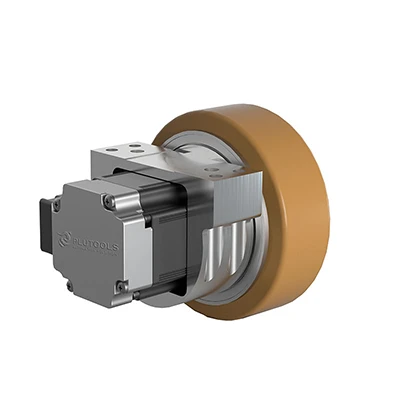 PLT-120: a differential drive wheel on a parallel horizontal arrangement with an integrated steering function, designed for integration into AGV/AMR chassis.
Why Tight Footprints Became a Purchasing Criterion
Automation projects have shifted from greenfield warehouses with generous aisles to existing buildings where the floor plate is fixed and the aisle width was set years before anyone considered robots. That shift is visible in the market numbers.
Reports and Data valued the global AGV wheel drives market at approximately USD 1.2 billion in 2024 and projected it to reach USD 3.5 billion by 2034, growing at a CAGR of 11.5% from 2024 to 2034, driven largely by logistics and warehouse automation. Grand View Research projected the global AGV market to reach USD 5.9 billion by 2025, with Asia Pacific holding a 37.6% revenue share in that year. Inside China, the China Mobile Robot Alliance recorded a mobile robot market scale of 22.1 billion yuan in 2024 across more than 139,000 units sold.
The composition of that growth matters more than the headline figures. MarketsandMarkets projected the industrial logistics segment for AGVs to grow at a CAGR of 11.6%, which is precisely the segment where vehicles work inside existing racking rather than on open factory floor. Meanwhile, electric forklifts now command over 70% market share in many regions as a replacement for combustion models, and Interact Analysis notes that omnidirectional and Mecanum drive systems are increasingly used for AMRs in high-density warehouses — both signals that layout density, not travel speed, has become the design constraint.
On the component side, Brandessence Research observed that integrated steering drive modules are replacing discrete components in order to cut manufacturer assembly time and maintenance complexity. That is the context in which a steered, integrated horizontal drive wheel stops being a premium option and starts being the default engineering answer to a space problem.
The Fix: A Parallel Horizontal Drive Wheel with Integrated Steering
What the PLT-120 is
The PLT-120 is a differential drive wheel in the Plutools PLT series. Its structural configuration is a parallel horizontal arrangement with an integrated steering function, and its control method is integrated steering control. The unit is designed for integration into AGV and AMR systems and for use in AGV and AMR scenarios, within the manufacturing industry. The wheel tread is polyurethane (PU) and the primary structural material is carbon steel.
Two design decisions sit behind that description. “Horizontal” means the motor and gearbox sit parallel to the wheel axis rather than standing vertically above it, which keeps the assembly low and lets it tuck into a shallow chassis without raising the deck. “With steering” means the wheel can be driven to a new heading independently of the chassis, so the vehicle can rotate around a point close to its own centre rather than being forced to swing around a distant pivot.
Published specification
| Parameter | PLT-120 |
|---|---|
| Model | PLT-120 |
| Category | Differential drive wheel |
| Structural configuration | Parallel horizontal arrangement with an integrated steering function |
| Control method | Integrated steering control |
| Maximum load capacity | 1200 kg |
| Maximum torque | 576 Nm |
| Output torque | 260 Nm |
| Rated torque | 9.55 Nm |
| Reduction ratio | 32 |
| Rated voltage | 48 V |
| Rated current | 68 A |
| Motor power | 3000 W |
| Rated speed | 3000 RPM |
| Ingress protection | IP65 |
| Wheel tread | Polyurethane (PU) |
| Primary material | Carbon steel |
How the configuration reduces the turning envelope
The mechanism is straightforward once the wheel is treated as a geometry problem rather than a power problem:
- The wheel plane can be changed before the chassis moves. With integrated steering control, the PLT-120 can be driven to a new heading while the body remains stationary. A fixed axle cannot do this — the wheel must travel along the floor to change its heading, and that travel is exactly the arc the chassis has no room for.
- Rotation happens closer to the vehicle centre. When the drive wheel can align with the intended direction of travel, a rotation manoeuvre no longer needs a pivot point outside the footprint. The floor area swept by the body during a turn is therefore smaller than the area swept by the same body on a fixed axle.
- Scrub is replaced by rolling. Lateral scrubbing is the visible symptom of a fixed axle being forced sideways. Rolling a steered wheel into position removes most of that scrub, which protects the PU tread and reduces the positional error that forces a second correction cycle.
- Differential control adds an in-place option. Dual differential drive configurations are already known for enabling a zero-turn radius in smaller logistics robots, as noted by Mobile Robot Guide. A steered horizontal unit can be combined with that behaviour rather than competing with it: the differential pair provides rotation, and the steering function provides alignment before and after it.
- The horizontal arrangement protects the clearance budget. By keeping the assembly flat, the parallel horizontal layout allows the deck to stay low and the body to stay narrow, which is the second half of the tight-space problem.
Design note: steering freedom is not a substitute for adequate torque. The PLT-120 delivers a maximum torque of 576 Nm and an output torque of 260 Nm through a reduction ratio of 32, from a rated torque of 9.55 Nm at 3000 RPM. Chassis teams should size the drive against the worst-case manoeuvre — typically a loaded start on a ramp or a rapid reversal at a pick face — not against the average transport cycle.
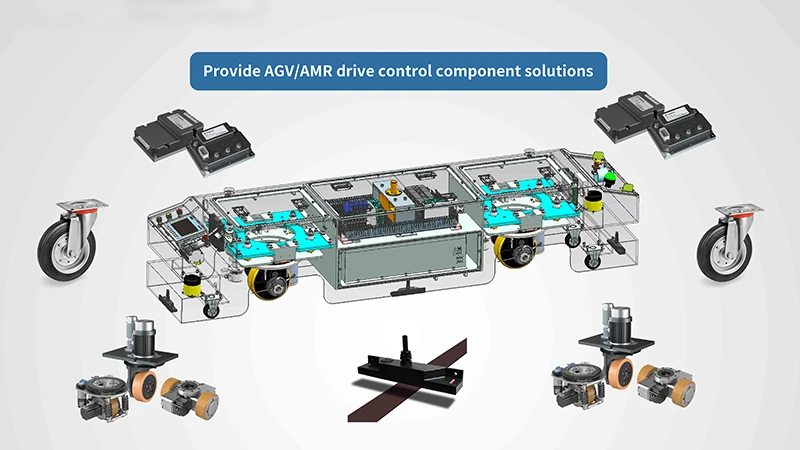 Manoeuvring geometry is set by the drive wheel configuration before any navigation parameter is tuned.
Step-by-Step: Specifying PLT-120 Into a Space-Constrained Chassis
The sequence below reflects the order in which the decisions constrain one another. Changing the order usually results in a vehicle that passes a specification review and still fails on the floor.
Step 1 — Measure the manoeuvre, not the aisle
Record the tightest manoeuvre the vehicle must complete: entry into a rack bay, alignment to a conveyor end, docking to a trailer, or a turnaround at a dead end. The binding number is the swept area of the body during that manoeuvre, which is larger than the aisle width and is the value the drive wheel configuration actually changes.
Step 2 — Convert payload into load per drive wheel
The PLT-120 carries a maximum load of 1200 kg per unit. Total vehicle payload, the number of load-bearing wheels, and the load transfer during acceleration and cornering together determine whether one unit is sufficient. On a three-point chassis the drive wheel often carries a disproportionate share of the deck load.
Step 3 — Match torque to the worst-case move
Compare the required tractive effort against the published 576 Nm maximum torque and 260 Nm output torque. The reduction ratio of 32 is the lever that converts the 9.55 Nm rated torque at 3000 RPM into usable wheel torque, so the ratio and the load rating should be reviewed together rather than separately.
Step 4 — Fix the steering architecture
Decide whether the vehicle uses a single steered drive wheel with castors, a steered unit paired with a differential set, or a multi-wheel coordinated arrangement. The PLT-120 uses integrated steering control, which simplifies the interface to the vehicle controller compared with assembling a separate steering motor, gearbox and feedback chain.
Step 5 — Check the mounting envelope against the real chassis
The horizontal arrangement exists to keep build height down. Confirm the mounting height, wheel position and service access against the actual chassis drawing, not against a general arrangement sketch. A compact structure only helps if the maintenance access path survives the packaging study.
Step 6 — Validate environment and compliance at vehicle level
The PLT-120 carries IP65 ingress protection and a PU tread, which suits the indoor factories, automated warehouses, production workshops and semi-outdoor industrial environments where these vehicles normally operate — including concrete, epoxy and steel floors. Vehicle-level conformance is demonstrated at the chassis level against standards such as ISO 3691-4:2023, which covers steering and braking systems for driverless industrial trucks, EN 1175:2020 for electrical safety, and ANSI/ITSDF B56.5 in the United States.
Step 7 — Prototype the turn before the full build
Build the tightest manoeuvre first. If the vehicle can complete it loaded, on the real floor surface, with the real navigation stack, the layout is validated. If it cannot, the fix is far cheaper at that stage than after the fleet order.
Use Cases Where This Configuration Pays Off
Narrow-aisle warehousing and rack access. Where the aisle cannot be widened and the rack bay must be entered square, the ability to align the wheel before committing the body removes the correction cycle that costs the most time.
Line-side and assembly delivery. Production-side routes involve frequent starts, stops and reversals in congested space. Integrated steering control combined with the 3000 W drive motor supports accurate acceleration and deceleration within short distances.
Trailer, conveyor and rack docking. Docking demands square alignment at low speed. A steered wheel can be trimmed into alignment rather than the whole chassis being nudged, which reduces the number of approach attempts.
Heavy-deck platforms. A 1200 kg maximum load rating per unit means the configuration is not restricted to small bots; it suits tugger and platform vehicles that also have to turn inside a building.
Low-noise environments. The PU tread is specified for low noise and high wear resistance, which matters in electronics, food and beverage, pharmaceutical and e-commerce fulfilment environments where vehicles pass close to people.
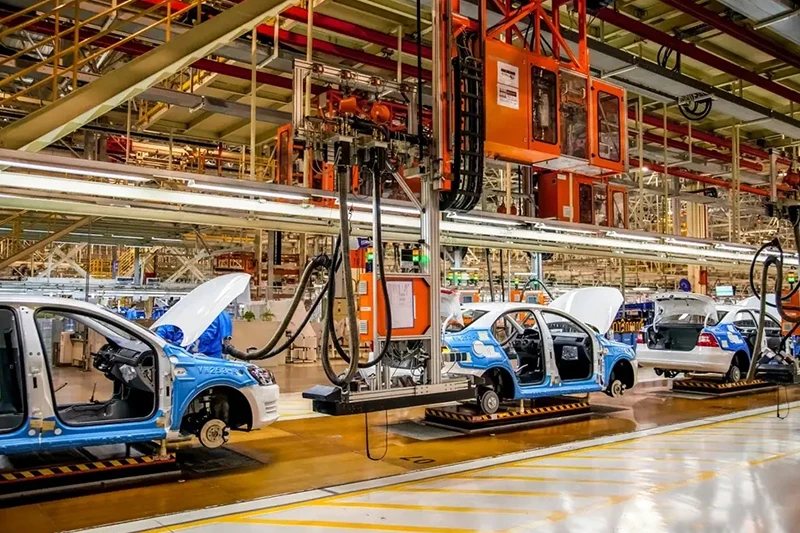 Typical deployment: warehousing, line-side delivery, docking and heavy-deck transport inside existing buildings.
PLT-120 Compared with Other Plutools Drive Wheel Configurations
The table below uses published Plutools specification data for the series. It is a configuration reference, not a ranking: the correct unit depends on the manoeuvre, the load and the chassis envelope, and several models overlap deliberately.
| Model | Configuration | Steering | Max load | Max torque | Output torque | Reduction ratio |
|---|---|---|---|---|---|---|
| PLT-120 | Differential drive wheel, parallel horizontal arrangement | Integrated steering function | 1200 kg | 576 Nm | 260 Nm | 32 |
| PLT-167 | Horizontal drive wheel | Without steering | 800 kg | 120 Nm | 40 Nm | 21 |
| PLT-198 | Planetary horizontal drive wheel | With steering | 1500 kg | 576 Nm | 260 Nm | 32 |
| PLT-220 | Parallel horizontal drive wheel | With steering | 1000 kg | 174 Nm | 58 Nm | 28 |
| PLT-210 | Forklift drive wheel, parallel horizontal | With steering | 1200 kg | 576 Nm | 260 Nm | 32 |
| PLT-150 | Vertical drive wheel | With steering | 500 kg | 114 Nm | 108 Nm | 22.5 |
| PLT-230 | Vertical drive wheel | Without steering | 1500 kg | 300 Nm | 108 Nm | 30 |
| PLT-230P | Vertical drive wheel with shock absorption | Integrated steering function | 1200 kg | — | — | 30 |
Read the table in two passes. First, filter by steering: the PLT-167 and PLT-230 have no steering function and therefore suit chassis where the turning envelope is already solved by other means. Second, compare the load and torque columns within the steered group. The PLT-120 and PLT-220 are both parallel horizontal units with steering, but they sit at different points on the load and torque scale — 1200 kg and 576 Nm against 1000 kg and 174 Nm — so the choice is driven by the worst-case move rather than by the arrangement itself. Where the deck load is higher again, the planetary PLT-198 is rated to 1500 kg with the same 576 Nm maximum torque.
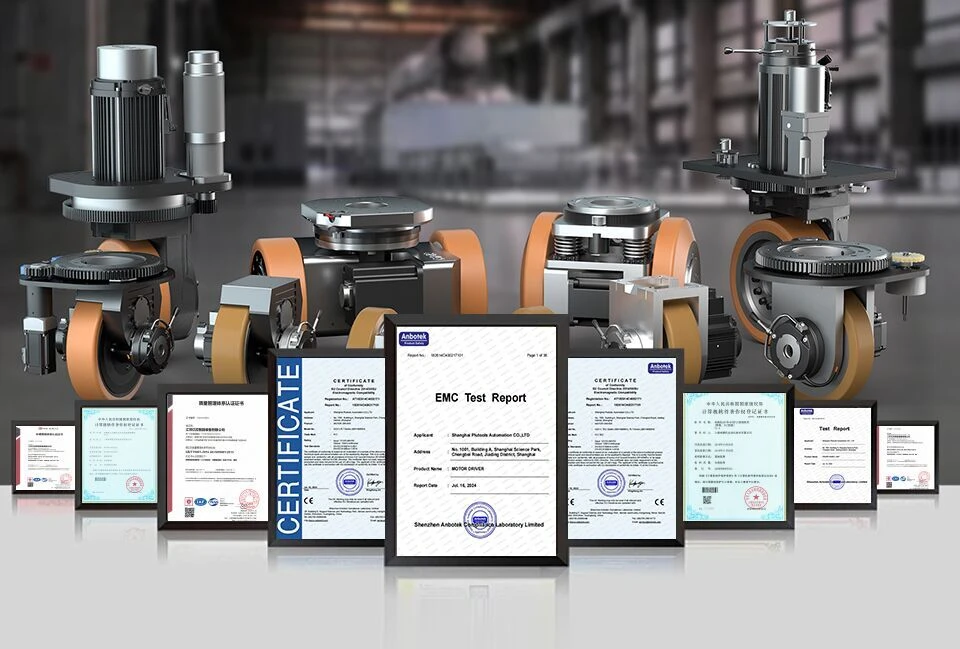 Compliance is verified at vehicle level; component documentation supports the chassis builder’s own declaration.
Frequently Asked Questions
1. Is the PLT-120 protected against dust and water in a normal factory environment?
The PLT-120 carries IP65 ingress protection, which suits the indoor factories, automated warehouses, production workshops and semi-outdoor industrial environments where these vehicles typically operate. Ingress protection is only one part of compliance, however. Chassis builders normally validate the finished vehicle against ISO 3691-4:2023, which covers steering and braking systems for driverless industrial trucks, EN 1175:2020 for electrical and electronic safety requirements, and ANSI/ITSDF B56.5 in the United States. Because the drive wheel is a component rather than a vehicle, conformance is demonstrated at chassis level, using component documentation as supporting evidence.
2. How much load and torque can the PLT-120 handle?
The PLT-120 is rated to a maximum load capacity of 1200 kg and a maximum torque of 576 Nm, with an output torque of 260 Nm produced through a reduction ratio of 32 from a rated torque of 9.55 Nm at 3000 RPM. It runs on a 48 V supply with a rated current of 68 A and a 3000 W motor, uses a polyurethane wheel tread on a carbon steel structure, and supports customizable load and speed options. It is a differential drive wheel on a parallel horizontal arrangement with an integrated steering function.
3. What drives the cost of a steered horizontal drive wheel?
Plutools does not publish list prices, so cost should be read from the specification rather than from a headline number. The parameters that move a quotation are the load rating, the torque and reduction ratio required by the worst-case manoeuvre, whether the steering function is integrated or assembled from discrete parts, the ingress protection level, and any customization of load and speed options. Two further factors belong in the budget comparison even though they are not on the drive wheel datasheet: the cost of widening an aisle or re-laying a route, and the cost of extra correction cycles over the life of the vehicle. A steered unit frequently removes both.
4. Can we validate a unit before committing to a production programme?
Validation should start with the manoeuvre rather than the component. Send the tightest turn, the load per wheel and the chassis envelope to the Plutools team, and confirm the configuration against the published 1200 kg load rating and 576 Nm maximum torque before any tooling decision. When comparing AGV drive wheel suppliers at this stage, check four things: whether the load and torque figures are stated per unit and traceable to a model number, whether steering is integrated or bolted on, whether the ingress protection level is declared, and whether load and speed options can be customized for the project. Pluto ols publishes the full PLT selection catalogue for exactly this comparison, and the sales team can be reached directly for sample and validation requests.
5. What should we plan for lead time and supply?
Plutools does not publish fixed lead times, because lead and speed options can be customized per project and the schedule depends on the final configuration. What can be planned against is capacity: a 10,000 m² production facility, an annual output of 10,000 units, and a workforce of approximately 100 people, with export business already accounting for 70% of sales across the EU, USA, Southeast Asia, South America, the Middle East, Japan and South Korea. For a firm date, confirm the configuration at inquiry stage rather than after the chassis design is frozen.
Next Step: Check the Turn Before You Commit the Chassis
Send Plutools the tightest manoeuvre on your route, the payload per drive wheel and your mounting envelope. The team will confirm whether the PLT-120 — 1200 kg maximum load, 576 Nm maximum torque, parallel horizontal arrangement with integrated steering — fits the space you actually have.
Download the PLT selection catalogue: PLT Selection Manual 2026
Contact: Eric.Tang | Eric.Tang@plutools.com | Tel: +86 15989586580 | www.plutools.com
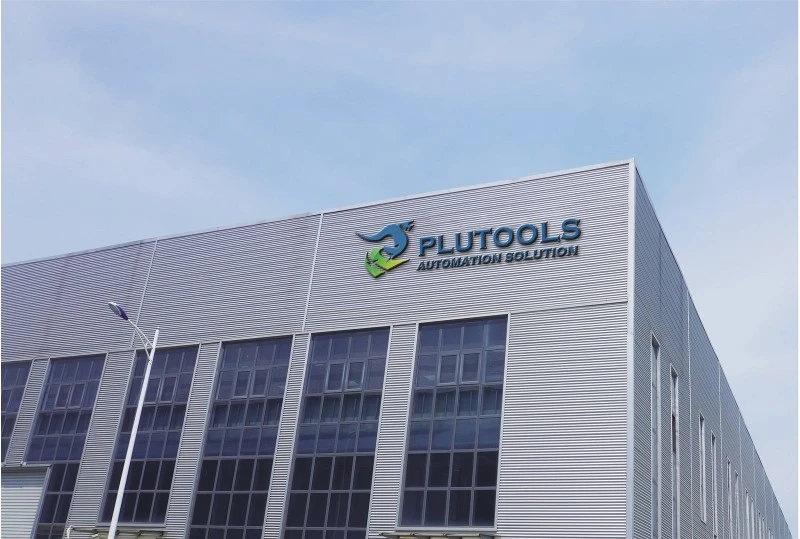 Plutools production facility in Shanghai: 10,000 m² and an annual output of 10,000 units.
Conclusion
A vehicle that cannot turn in a tight aisle is not badly driven; it is badly constrained by its drive geometry. Fixed axles force the entire chassis to swing, scrub the tread, and push operators into reverse-out routines that cost time and battery on every cycle.
The PLT-120 addresses that constraint at the point where it originates. A parallel horizontal arrangement with an integrated steering function lets the wheel be reoriented before the body commits, keeps the assembly flat enough to protect the clearance budget, and delivers 1200 kg of load capacity and 576 Nm of maximum torque through a 32:1 reduction ratio, in a unit carrying IP65 protection and a PU tread. For chassis teams told that the aisle is fixed, the wheel is the variable that can still move.
To verify the fit for a specific layout, download the PLT selection manual or contact Plutools at Eric.Tang@plutools.com / +86 15989586580.
Have Questions or Need More Details?
Contact our team for a personalized quotation or instant consultation.
Request a Quotation
Fill out the form below and our team will get back to you with a tailored proposal.
WhatsApp Direct Chat
Prefer to chat in real-time? Message us on WhatsApp for instant assistance & quick answers.
- Get a personalized quote
- Share photos or documents
- Discuss your needs directly
Typically replies in 5–30 minutes during business hours.