
Drive Wheel Specs That Matter: Certifications, Load Ratings & Real Build Decisions
Drive Wheel Specs That Matter: Certifications, Load Ratings & Real Build Decisions
Buying or specifying a drive wheel for an AGV, AMR, or automated forklift is not a single-part decision. The component carries the vehicle, delivers the torque, handles stopping and steering, and must comply with electrical and machinery safety requirements before the machine can operate in a warehouse or factory. This article explains which drive wheel specifications and certifications matter most during the research and evaluation stage, and how to verify them against a manufacturer's actual data.
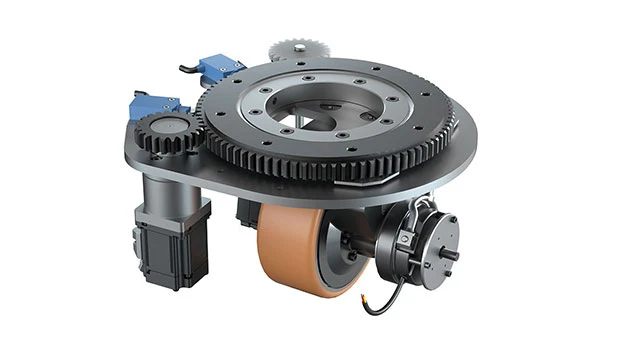
Why Drive Wheel Specifications Are a Constraint, Not Just a Feature
A drive wheel is the interface between a mobile robot's control system and the physical floor. Its rated voltage, motor power, output torque, reduction ratio, max load, and protection level define what the vehicle can carry, how fast it can accelerate, whether it can climb a ramp, and whether it is protected from dust and water in a production hall. For an OEM or system integrator, these parameters also determine the required battery capacity, mounting space, and controller pairing. A technically good drive wheel that does not match the vehicle architecture becomes a project delay.
Market Context: Why Verification Matters More in a Growing Market
The global AGV wheel drives market was valued at approximately USD 1.2 billion in 2024 and is projected to reach USD 3.5 billion by 2034, with an expected CAGR of 11.5% according to Reports and Data. The broader AGV market is also expanding; Grand View Research projected that the global Automated Guided Vehicle market would reach USD 5.9 billion by 2025. With more suppliers entering the supply chain, buyers increasingly need documented, model-specific data rather than generic promises. The industrial logistics segment is expected to grow at a CAGR of 11.6%, meaning drive wheels will be installed in larger fleets, under longer operating hours, and in more demanding environments.
Because this level of growth attracts a wide range of suppliers, a structured verification process protects the buyer. The most efficient approach is to check three layers: product-level specifications, compliance and certification evidence, and the supplier's ability to deliver custom variants without compromising quality.
What a Drive Wheel Specification Actually Covers
Drive wheel assemblies integrate a motor, gearbox, wheel tread, and often a steering mechanism or brake. The specification sheet is the contract between the designer's assumptions and the physical part. The following parameters should be readable and verifiable on any datasheet.
1. Rated Voltage and Motor Power
Rated voltage must match the vehicle's battery system. Common configurations in AGV and AMR design include 24V and 48V architectures. Motor power, measured in watts, determines whether the drive wheel can sustain the required speed and acceleration under load. For example, Plutools models range from a 400W differential drive wheel to 3000W horizontal and forklift drive wheels, and a 2500W robot drive wheel with servo motor.
2. Output Torque and Maximum Torque
Output torque is the continuous torque available at the wheel after reduction. Maximum torque is the peak torque available for short periods such as acceleration, ramp climbing, or emergency braking. A heavy AGV may need a high max torque even if its rated output torque is moderate. For instance, the PLT-198 Horizontal Drive Wheel has an output torque of 260 Nm and a maximum torque of 576 Nm at 3000 RPM, with a rated voltage of 48V and power of 3000W.
3. Reduction Ratio and Speed
The reduction ratio multiplies motor torque but reduces output speed. It is a key trade-off decision: a high reduction ratio gives higher torque but lowers maximum travel speed. The PLT-167 AGV Drive Wheel Unit, for example, uses a reduction ratio of 21, output torque of 40 Nm, and maximum torque of 120 Nm, with a max load of 800 kg. The PLT-230 AGV Drive Wheel uses a 30:1 ratio, output torque of 108 Nm, and maximum torque of 300 Nm, supporting a max load of 1500 kg.
4. Max Load and IP Protection Level
Max load defines how much vehicle and payload weight the drive wheel can support. The appropriate load rating depends on how many drive wheels and support wheels the vehicle uses and how the weight is distributed. Some applications also require dust and water protection. The PLT-120 Differential Drive Wheel has an IP protection level of IP65 and supports a drive wheel load of 150 kg. The PLT-230P Robot Drive Wheel has an IP rating of 65 and a load capacity of 1200 kg.
5. Wheel Tread and Materials
Polyurethane (PU) treads are widely used in indoor materials-handling applications because they offer higher load capacity and protect floors while providing low noise and wear resistance. Carbon steel is a common primary structural material for the drive wheel housing. Several Plutools drive wheels specify carbon steel as the primary material. Buyers operating in low-temperature warehouses or explosion-risk areas may need special versions; Plutools indicates that special versions can be designed for low-temperature warehouses, high-humidity areas, cleanrooms, dusty workshops, and heavy-duty industrial applications.
Rated Voltage: 48V
Power: 3000W
Rated Current: 68A
Speed: 3000 RPM
Rated Torque: 9.55 Nm
Reduction Ratio: 32
Output Torque: 260 Nm
Max Torque: 576 Nm
Max Load: 1500 kg
Structure: Integrated parallel horizontal structure with steering function
Material: Carbon steel
Tread: PU wheel tread
Certification Compliance for Drive Wheels in AGV, AMR, and Forklift Programs
Certification is not a formality; it affects whether a machine can be sold, installed, and insured in a target market. For industrial trucks and AGVs, three standards are frequently referenced: ISO 3691-4:2023 for driverless industrial truck safety, EN 1175:2020 for electrical and electronic safety requirements for industrial trucks, and ANSI/ITSDF B56.5 for driverless industrial vehicles in the USA.
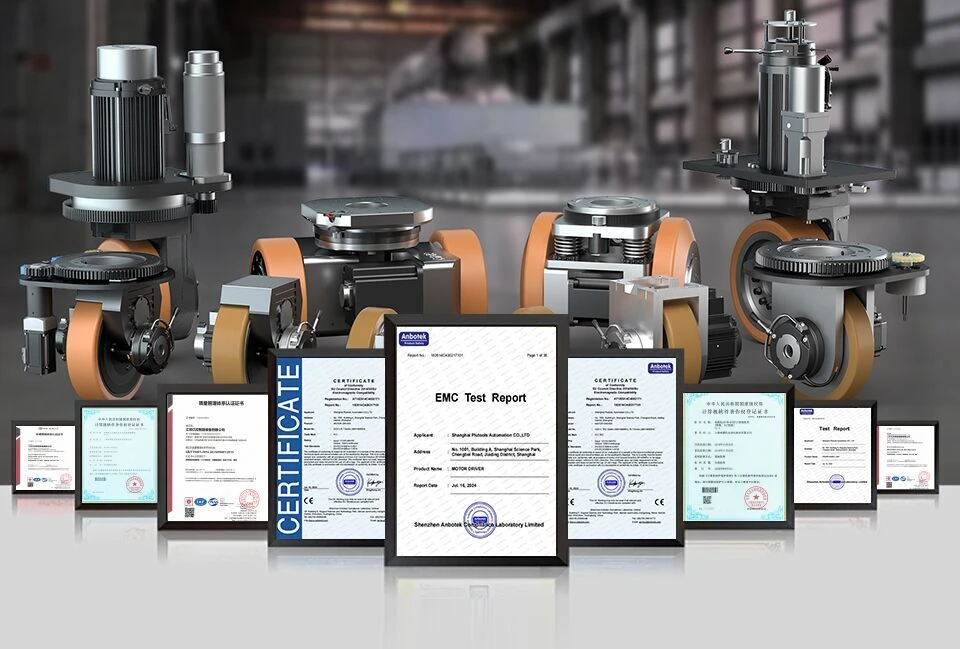
At the component level, a drive wheel manufacturer should be able to provide CE certificates that list the relevant product series and standards. Plutools holds two CE certificates issued by Shenzhen Anbotek Compliance Laboratory Limited:
- Certificate AT1814C500806124, valid from 2025-04-02 to 2030-04-02, covering TEC Series (50W–20000W) and PLT Series (50W–20000W), with applicable standards EN ISO 12100:2010 and EN 60204-1:2018.
- Certificate AT182414C4001881, valid from 2024-07-16 to 2029-07-16, covering TEC167P401SP30-21-11HS-D, TEC Series (50W–20000W), and PLT Series (50W–20000W), with the same standards.
These certificates list the PLT-220, PLT-167, PLT-230P, PLT-198, PLT-150, PLT-210, PLT-230, and PLT-120 models. Buyers should always request the certificate and confirm that the exact model and series are listed in the scope. A certificate covering a similar model does not automatically cover the model you are evaluating.
Drive Wheel Types: Understanding the Fit Before Comparing Suppliers
Drive wheels are commonly grouped by orientation and steering capability. Knowing the difference helps you shortlist the right models before comparing prices or suppliers.
Vertical Drive Wheels
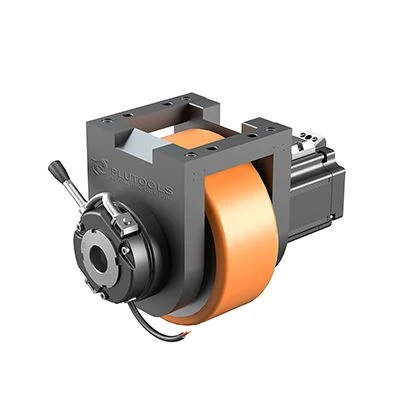
A vertical drive wheel positions the motor and gearbox vertically. It is generally recommended when the AGV or AMR requires a compact structure, high load capacity, and straightforward installation. It is suitable for heavy-duty AGVs, automated forklifts, lifting vehicles, and equipment with limited chassis space. Plutools offers vertical drive wheels in both steering and non-steering versions, including the PLT-150 Vertical Drive Wheel with Steering, the PLT-230 Vertical Drive Wheel without Steering, and the PLT-230P Robot Drive Wheel with shock absorption.
Horizontal Drive Wheels
A horizontal drive wheel positions the motor horizontally, which helps lower the vehicle's height and center of gravity. It is commonly used in low-profile AGVs, warehouse AMRs, latent lifting robots, and compact material-handling equipment where stability and maintenance access are important. Examples include the PLT-198 Planetary Horizontal Drive Wheel with Steering, the PLT-210 Forklift Drive Wheel, the PLT-220 Parallel Horizontal Drive Wheel with Steering, and the PLT-167 Horizontal Drive Wheel without Steering.
Differential Drive Wheels
A differential drive wheel integrates the drive and steering functions into a single assembly, which can simplify the vehicle structure. The PLT-120 Differential Drive Wheel has a rated power of 400W, rated voltage of 48V, IP65 protection, a drive wheel load of 150 kg, and a total weight of 5±2 kg. Its transmission ratios are 9 and 20, with rated output torque of 10 and 21 Nm respectively, and maximum acceleration and braking torque of 20 and 42 Nm. This type of configuration is often used in lighter logistics robots that need precise turning and compact integration.
Rated Power: 400W
Rated Voltage: 48V
Rated Current: 11.2A
Rated Speed: 3000 RPM
Rated Torque: 1.28 Nm
IP Protection Level: IP65
Drive Wheel Load: 150 kg
Total Weight: 5±2 kg
Transmission Ratio: 9, 20
Rated Output Torque: 10, 21 Nm
Max Acceleration and Braking Torque: 20, 42 Nm
Step-by-Step: How to Evaluate a Drive Wheel Supplier
- Define the vehicle architecture. Identify the drive configuration: single drive, dual differential drive, steering drive, or multi-wheel coordinated drive. This determines whether you need steering, shock absorption, or a specific orientation.
- List load and torque requirements. Calculate vehicle weight, payload, acceleration, ramp angle, and maximum speed. Convert these into required output torque, max torque, and max load per wheel.
- Check electrical compatibility. Verify rated voltage, rated current, motor power, and communication/encoder options against your battery and controller.
- Review mounting and space constraints. Check overall height, horizontal footprint, mounting dimensions, and whether the chassis allows a vertical or horizontal drive orientation.
- Confirm environmental requirements. Determine whether the vehicle runs in a dusty workshop, cold storage, cleanroom, high-humidity area, or potentially explosive atmosphere. Confirm IP rating and any special versions.
- Request certifications for your target market. For EU sales, request the CE certificate with the exact model and scope. For North America, confirm applicable safety requirements such as ANSI/ITSDF B56.5 and whether component-level documentation is available.
- Ask about customization and lead time. If you need a different load capacity, wheel diameter, motor power, voltage, rated speed, reduction ratio, mounting dimension, encoder type, brake system, connector, cable length, or logo, confirm that the factory can produce it. Plutools states that customization covers load capacity, wheel diameter, motor power, voltage, rated speed, reduction ratio, mounting dimensions, encoder type, brake system, connector, cable length, logo, and packaging.
- Check production capacity and quality control. If the project will scale, verify monthly capacity, MOQ, and testing procedures. Plutools reports a monthly production capacity of 12,000 units, a lead time of 30–45 days, an MOQ of 2 units, and 100% testing.
Use Cases: Matching Drive Wheel Specs to Applications
Use Case 1: Heavy-Duty AGV with Multiple Navigation Modes
An AGV manufacturer in Brazil used Plutools drive wheels in a project involving 200 units over a two-year period. The application required drive, differential steering, and precise motion control for an ultra-heavy-duty AGV with multiple navigation modes. The reported result was stable operation under heavy-load conditions, accurate route tracking, flexible steering, and reliable material transportation. The highlighted capabilities were high load capacity, high output torque, precise differential control, multiple navigation compatibility, stable operation, and customized system integration.
Use Case 2: Low-Profile Warehouse AMR
For warehouse AMRs with strict height limits, a horizontal drive wheel such as the PLT-198 or PLT-220 can reduce the overall chassis height and lower the center of gravity. These models combine steering, PU tread, and compact design. The PLT-220 supports a 750W motor, 48V voltage, 1000 kg max load, and 174 Nm max torque, making it suitable for mid-load material transport applications that require steering without an additional steering motor assembly.
Use Case 3: Automated Forklift Drive
The PLT-210, categorized as a Parallel Horizontal Drive Wheel with Steering, is designed for forklift-type vehicles. It has a rated voltage of 48V, power of 3000W, output torque of 260 Nm, and maximum torque of 576 Nm, with a max load of 1200 kg. Its structural configuration is a parallel horizontal arrangement with integrated steering function, and it supports customizable load and speed options.
Comparison Table: Plutools Drive Wheel Models at a Glance
| Model | Type | Rated Voltage | Power | Output Torque | Max Torque | Max Load |
|---|---|---|---|---|---|---|
| PLT-120 | Differential Drive Wheel | 48V | 400W | 10 / 21 Nm | 20 / 42 Nm | 150 kg |
| PLT-150 | Vertical Drive Wheel with Steering | 48V | 750W | 108 Nm | 114 Nm | 500 kg |
| PLT-167 | Horizontal Drive Wheel without Steering | 48V | 750W | 40 Nm | 120 Nm | 800 kg |
| PLT-198 | Planetary Horizontal Drive Wheel with Steering | 48V | 3000W | 260 Nm | 576 Nm | 1500 kg |
| PLT-210 | Parallel Horizontal Drive Wheel with Steering | 48V | 3000W | 260 Nm | 576 Nm | 1200 kg |
| PLT-220 | Parallel Horizontal Drive Wheel with Steering | 48V | 750W | 58 Nm | 174 Nm | 1000 kg |
| PLT-230 | Vertical Drive Wheel without Steering | 24V | 1500W | 108 Nm | 300 Nm | 1500 kg |
| PLT-230P | Vertical Drive Wheel with Shock Absorption | 48V | 2500W | — | — | 1200 kg |
Note: PLT-230P is a servo travel motor with gear ratio 30:1 and IP65; output/max torque values are not listed in the available datasheet and should be requested directly from the manufacturer.
Limitations and Trade-offs Buyers Often Miss
Every drive wheel selection involves trade-offs. A vertical drive wheel generally provides strong load-bearing capability and efficient use of horizontal chassis space, but it may increase the drive unit height. A horizontal drive wheel allows a lower chassis height and lower center of gravity, but may require more complex mounting and chassis design. A higher reduction ratio increases torque but reduces maximum speed. Larger load capacity usually means a heavier drive unit, which affects battery consumption and vehicle weight.
For safety, horizontal drive wheels offer better anti-tipping performance because the motor is positioned closer to the ground. Vertical drive wheels are also safe when correctly selected, but the vehicle structure, load distribution, and installation strength must be carefully designed, especially for tall or heavy vehicles.
Costs also differ. Vertical drive wheels usually have a relatively simple installation structure and may offer lower overall integration costs. Horizontal drive wheels may require more complex mounting and chassis design, potentially increasing initial costs, but they can reduce structural height and improve vehicle stability.
Frequently Asked Questions
What certifications should a drive wheel have for AGV or forklift projects?
For European projects, the drive wheel series should be covered by CE certification and the electrical safety of the complete industrial truck is separately governed by EN 1175:2020. For driverless truck safety, ISO 3691-4:2023 is a key international standard. In North America, ANSI/ITSDF B56.5 covers driverless industrial vehicle safety. A drive wheel manufacturer like Plutools can provide CE certificates listing the specific PLT and TEC series with applicable standards such as EN ISO 12100:2010 and EN 60204-1:2018. Always confirm that the exact model number and series appear in the certificate scope.
How do I know which drive wheel load capacity I need?
Start with the total vehicle weight, including payload, and divide it by the number of wheels that are load-bearing. Then add a safety margin for dynamic loads during acceleration, braking, and turning. For example, the PLT-230 Vertical Drive Wheel supports a max load of 1500 kg, while the PLT-120 Differential Drive Wheel supports 150 kg. The final choice depends on the vehicle's wheel configuration and weight distribution.
What is the difference between a vertical and horizontal drive wheel?
The main difference is the orientation of the motor and gearbox and how that affects vehicle layout. A vertical drive wheel is generally recommended when the AGV or AMR requires a compact structure, high load capacity, and straightforward installation. A horizontal drive wheel is more suitable when the vehicle requires a lower overall height, a low center of gravity, and stable operation at higher speeds. Choose vertical for heavy-load compact designs; choose horizontal for low-profile vehicles where stability and maintenance access matter.
Can drive wheels be customized for a specific AGV design?
Yes. Many AGV drive wheel suppliers offer customization of load capacity, wheel diameter, motor power, voltage, rated speed, reduction ratio, mounting dimensions, encoder type, brake system, connector, cable length, logo, and packaging. Plutools reports an MOQ of 2 units, a monthly production capacity of 12,000 units, a lead time of 30–45 days, and 100% testing, which supports sample development and scale production.
What should I include in a request for quote or sample?
Provide the vehicle type, drive configuration, load per wheel, required torque, operating voltage, speed target, installation space, environment (e.g., dust, humidity, low temperature), target market certifications, and estimated annual volume. This allows the supplier to propose the correct model or custom configuration. You can request a quote or sample from Plutools with these details to shorten the evaluation cycle.
Conclusion: Build a Verifiable Drive Wheel Shortlist
Drive wheel selection is not just about finding a part number and a price. The right decision depends on verifying that the drive wheel's electrical, mechanical, and environmental specifications match your vehicle architecture, and that the supplier can provide certification evidence for the markets you serve. A supplier with documented model-level specs, CE certification, customization capability, and production capacity gives your project a clear path from sample to series production.
Shanghai Plutools Automation Corporation Co., Ltd. is a Shanghai-based high-tech enterprise focused on AGV and AMR drive technology. The company operates a 10,000+ m² production facility with more than 100 employees and an R&D team of 60 engineers, with an annual output of 10,000 units. Plutools has obtained more than 200 patent technology certifications and exports to the EU, USA, Southeast Asia, South America, Middle East, Japan, and South Korea. Export ratio is approximately 70%. The company was founded in 2017 and is recognized as a Specialized and Innovative Enterprise and National Small Giant Enterprise.
Download the Plutools Drive Wheel Selection Handbook
Get model data, specifications, and selection reference in one PDF.
Download BrochureContact Plutools for a drive wheel quote
Email: Eric.Tang@plutools.com | Tel/WhatsApp: +86 159-8958-6580
Address: No. 1001, Building A, Shanghai Science Park, Chengbei Road, Jiading District, Shanghai, China
Visit plutools.comHave Questions or Need More Details?
Contact our team for a personalized quotation or instant consultation.
Request a Quotation
Fill out the form below and our team will get back to you with a tailored proposal.
WhatsApp Direct Chat
Prefer to chat in real-time? Message us on WhatsApp for instant assistance & quick answers.
- Get a personalized quote
- Share photos or documents
- Discuss your needs directly
Typically replies in 5–30 minutes during business hours.