
Drive Wheel Matching: PLT-120, PLT-210 & PLT-198 by Load
Drive Wheel Matching: PLT-120, PLT-210 & PLT-198 by Load
A drive wheel is the integrated motor, gearbox and wheel module that converts electrical power into motion, steering and braking for an AGV, AMR or automated forklift. Three models in the PLT range from Shanghai Plutools Automation Corporation Co., Ltd. (Plutools) cover most project briefs: the PLT-120 differential drive wheel for light AGV/AMR platforms, the PLT-210 parallel horizontal drive wheel with steering for 1,200 kg forklift projects, and the PLT-198 planetary horizontal drive wheel with steering for 1,500 kg projects. The choice between them is not made by model number. It is decided by load per wheel, torque at the acceleration and braking events, the 48 V electrical envelope, and the structure your chassis can accept.
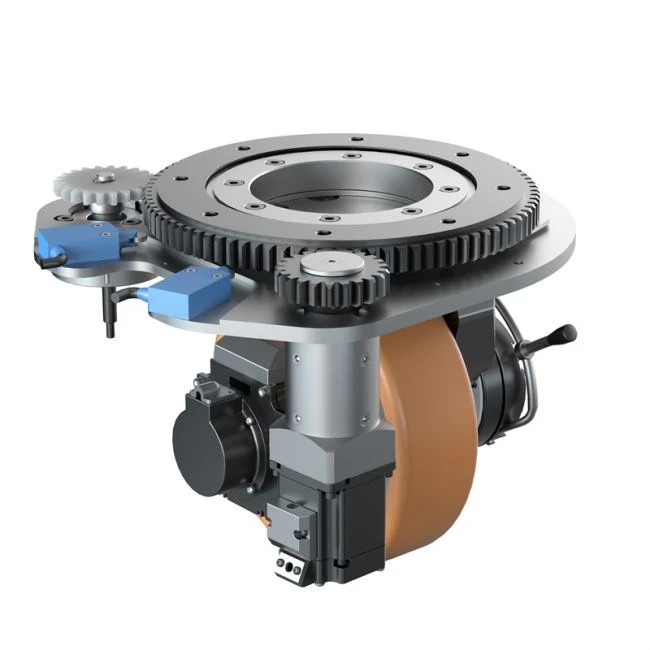
Why Drive Wheel Selection Fails After the First Comparison
Most drive wheels look interchangeable in a catalogue and stop being interchangeable the moment payload, acceleration and current draw are written down. A project team that shortlists on load rating alone usually discovers the mismatch later — during the first full-load acceleration test, during battery sizing, or when the mounting footprint does not clear the chassis frame.
The three PLT models illustrate the problem precisely. PLT-210 and PLT-198 share the same drivetrain figures: 48 V, 3,000 W motor power, 68 A rated current, 3,000 rpm rated speed, a 32 reduction ratio, 9.55 Nm rated torque, 260 Nm output torque and 576 Nm maximum torque. They differ in structure designation and in rated maximum load — 1,200 kg for PLT-210 and 1,500 kg for PLT-198. Meanwhile PLT-120 sits on a completely different electrical platform at 48 V, 400 W and 11.2 A. If a buyer compares the three on torque alone, two of them look identical and the third looks weak; compared on load per wheel, current draw and structure, the correct answer becomes obvious.
The four constraints that actually decide the model
- Load per wheel — not the vehicle payload, but the share each drive wheel carries in the chassis layout.
- Torque at peak events — acceleration and braking demand sitting above continuous rated torque.
- Electrical envelope — 48 V is common to all three, but 11.2 A and 68 A are not interchangeable for batteries, drivers and cabling.
- Structure and steering type — differential versus parallel horizontal with steering versus planetary horizontal with steering, plus mounting space.
Industry Background: Why Drive Wheel Specifications Are Moving
The demand for defined, documented drive wheel specifications follows the growth of the mobile robot and electric forklift base underneath it. Reports and Data values the global AGV wheel drives market at approximately USD 1.2 billion in 2024, projected to reach USD 3.5 billion by 2034, with a CAGR of 11.5% from 2024 to 2034 driven by logistics and warehouse automation.
The geography matters as much as the total. Grand View Research reports that Asia Pacific held a 37.6% revenue share of the global AGV market in 2025, which places most drive wheel engineering and sourcing conversations in the same region as the manufacturers supplying them. On the forklift side, MarketsandMarkets reports that electric forklifts now command over 70% market share in many regions as a replacement for combustion models — a shift that moves forklift traction onto electric drive wheels and steering modules rather than hydraulic transmission layouts.
Two design trends reinforce the need for a model-level application guide. Brandessence Research describes integrated steering drive modules replacing discrete components in order to reduce manufacturer assembly time and maintenance complexity. Mobile Robot Guide notes that dual differential drive wheels allow a zero-turn radius, a layout widely used in smaller logistics robots. Both trends push buyers toward a drive wheel assembly that carries motor, gearbox, wheel and steering in one unit — which means the unit either fits the chassis and the load case, or it does not.
Standards add a vehicle-level layer. ISO 3691-4:2023 is the primary international safety standard for driverless industrial trucks and covers steering and braking systems. EN 1175:2020 specifies electrical and electronic safety requirements for industrial trucks and applies to AGV drive wheel assemblies, and ANSI/ITSDF B56.5 is the corresponding American safety standard for driverless industrial vehicles, governing performance of drive and steering units. Material choice follows the same logic: Mordor Intelligence notes that forklift drive wheel tires commonly use polyurethane (PU) to provide higher load capacity and floor protection in indoor settings — which is why PU tread appears across the PLT models discussed here.
The Three PLT Drive Wheels at a Glance
The PLT series drive wheels, including PLT-120, PLT-198 and PLT-210 (and PLT-220 elsewhere in the range), are categorised as differential drive wheels or horizontal drive wheels with steering, designed for integration into AGV/AMR systems and intended for the manufacturing industry. Within that family, the three models in this guide divide cleanly by load class:
- PLT-120 — differential drive wheel and electric drive wheel for lighter AGV/AMR platforms, rated to a 150 kg drive wheel load, IP65 protected, 400 W at 48 V.
- PLT-210 — forklift drive wheel built as a parallel horizontal drive wheel with steering, rated to a 1,200 kg maximum load, 3,000 W at 48 V.
- PLT-198 — horizontal drive wheel built as a planetary horizontal drive wheel with steering, rated to a 1,500 kg maximum load, 3,000 W at 48 V.
PLT-120: Differential Drive Wheel for Light AGV/AMR Platforms
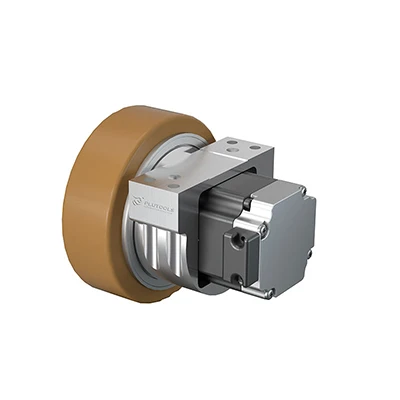
PLT-120 is a differential drive wheel intended for the manufacturing industry and designed for use in AGV and AMR scenarios. Its structural configuration is compact for easy integration into AGV/AMR and includes an integrated steering function, with integrated steering control as the control method. In practical terms, this is the model for a small mobile robot or light transfer platform where installation space and unit weight are the binding constraints.
The electrical and mechanical envelope is deliberately modest: rated power 400 W, rated voltage 48 V, rated current 11.2 A, rated speed 3,000 rpm and rated torque 1.28 Nm. Through the drive stage, PLT-120 delivers a rated output torque of 10.21 Nm and a maximum acceleration and braking torque of 20.42 Nm at a 9.20 transmission ratio. The wheel tread is polyurethane (PU) and the primary material is carbon steel, with a total drive wheel weight of 5±2 kg. IP65 protection is specified, which matters for units working in dusty workshops or areas that see wash-down routines.
The limit is explicit: 150 kg drive wheel load. That figure is a per-wheel rating, so it must be checked against the share of moving mass each wheel carries — chassis, battery, superstructure and payload included — not against the headline payload printed on the project brief.
PLT-210: 1,200 kg Parallel Horizontal Steering Drive Wheel for Forklift Projects
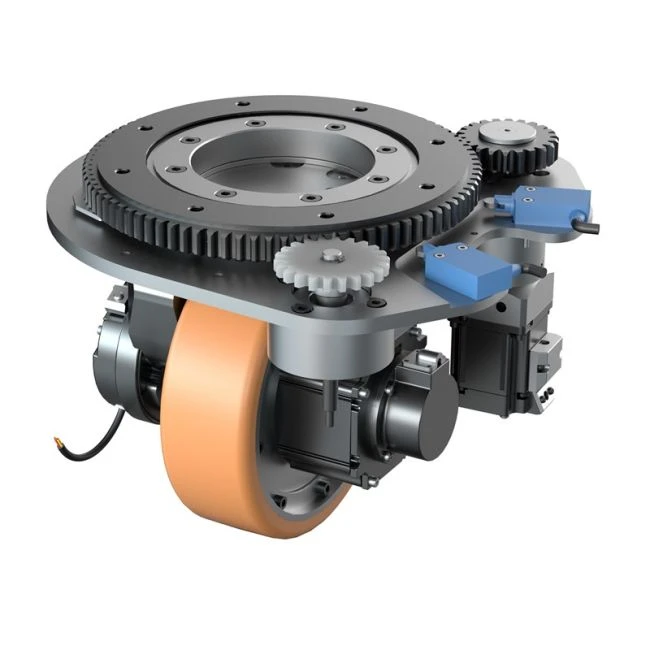
PLT-210 is a forklift drive wheel classified as a parallel horizontal drive wheel with steering. It features an integrated parallel horizontal structure with steering function, is made primarily of carbon steel, and uses a PU wheel tread. This is the model that fits forklift-class projects in the 1,200 kg band, where the chassis needs a steering drive unit that can be bolted in as a single assembly rather than assembled from discrete motor, gearbox, wheel and steering parts.
Its drivetrain is specified at 3,000 W motor power, 48 V rated voltage, 68 A rated current and 3,000 rpm rated speed, with a rated torque of 9.55 Nm and a 32 reduction ratio. After reduction the unit provides 260 Nm output torque, with 576 Nm maximum torque available for peak demand. Maximum load is 1,200 kg, and load and speed options can be customised for a specific build.
That 68 A rated current is the number that most often disrupts a project plan late in the schedule. A 3,000 W steering drive unit on a 48 V bus changes battery capacity, driver rating, contactor sizing and cable cross-section compared with a light differential wheel — so the electrical decision has to be made at the same time as the mechanical one, not after the chassis is frozen.
PLT-198: 1,500 kg Planetary Horizontal Drive Wheel for Heavier Projects
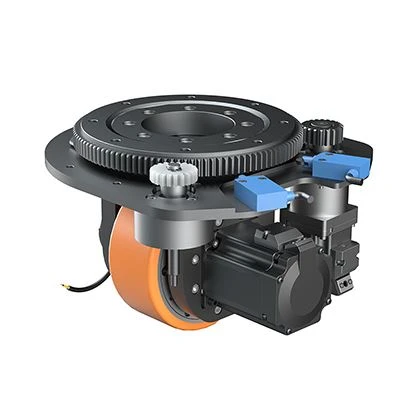
PLT-198 is a horizontal drive wheel, classified as a planetary horizontal drive wheel with steering, designed for automated guided vehicle applications with typical scenarios in AGV and AMR systems and intended for the manufacturing industry. It is the heavy drive wheel in this comparison, with a maximum load capacity of 1,500 kg.
The electrical specification repeats the 3,000 W pattern: 48 V rated voltage, 68 A rated current, 3,000 W rated power, 3,000 rpm rated speed, a 32 reduction ratio, 9.55 Nm rated torque, 260 Nm output torque and 576 Nm maximum torque. The primary material is carbon steel. Where a project sits at 1,500 kg — typically heavy pallet transfer, forklift-platform builds and loaded transfer stations — PLT-198 is the model that keeps the load case inside the published rating rather than at its edge.
Step-by-Step: Matching a Drive Wheel to Your Project
The sequence below turns a chassis drawing and a load case into a single model choice. Each step uses published values, so the logic can be repeated on any future project.
Step 1 — Convert vehicle payload into load per wheel
List the moving mass: chassis, battery, superstructure, payload and any lifting or tilting load transfer. Then divide by the number of load-bearing wheels according to the layout. A two-wheel differential arrangement puts the full moving mass across two drive wheels; a steering-plus-castor layout distributes it differently. Compare the result to the rated maximum load — 150 kg for PLT-120, 1,200 kg for PLT-210, 1,500 kg for PLT-198. A project that lands at 1,450 kg per wheel does not belong on the 1,200 kg unit regardless of how well the torque curve fits.
Step 2 — Check torque at the acceleration and braking events
Rated torque describes continuous running; peak torque describes starts, stops and emergency braking. PLT-120 publishes 10.21 Nm rated output torque against 20.42 Nm maximum acceleration and braking torque, and PLT-210 and PLT-198 publish 260 Nm output torque against 576 Nm maximum torque. Sizing on the rated figure alone leaves the peak event uncovered.
Step 3 — Match the electrical envelope before the mechanical one
All three models run on 48 V, which simplifies bus architecture. Current draw is where they diverge: PLT-120 is rated at 11.2 A and 400 W, while PLT-210 and PLT-198 are rated at 68 A and 3,000 W. Six times the current changes battery capacity, driver rating and cable sizing. Confirm the electrical design against the model's rated current, not against an assumed average.
Step 4 — Confirm speed and reduction ratio
All three models are rated at 3,000 rpm. PLT-120 uses a 9.20 transmission ratio, while PLT-210 and PLT-198 use a 32 reduction ratio. A higher ratio trades wheel speed for output torque, which is why the 32:1 units reach 260 Nm output while the 9.20 unit delivers 10.21 Nm. Match the ratio to the travel speed and grade the vehicle must achieve.
Step 5 — Check the environmental envelope
Typical drive wheel working conditions include indoor factories, automated warehouses, production workshops, logistics centres and semi-outdoor industrial environments, with continuous operation, frequent starting and stopping, forward and reverse movement, narrow aisles, dust, vibration and temperature change. Floors may be concrete, epoxy, steel or slightly uneven. PLT-120 publishes IP65 protection; where low-temperature warehousing, high humidity, cleanroom, heavy dust or explosion-proof conditions apply, the protection requirement should be raised with the supplier as a defined variant rather than assumed.
Step 6 — Confirm structure, steering type and mounting space
Differential drive suits a two-wheel differential base and, in dual configuration, supports a zero-turn radius. Parallel horizontal and planetary horizontal units with steering suit chassis that need a self-contained steering drive assembly. All three PLT models are described as compact for integration into AGV/AMR, and all three are carbon steel constructions with PU tread — but the mounting interface and steering envelope differ, and that has to be checked against the frame drawing.
Step 7 — Fix the acceptance criteria before the purchase order
Load and speed options can be customised on the PLT models, so the configuration must be written into the order rather than discussed verbally. Agree the rated load, the speed option, the electrical figures (48 V, and 11.2 A or 68 A as applicable), the protection level and the documentation set before release. Then validate the first units against those agreed values — not against a generic catalogue page.
Scenario Mapping: Which Project Fits Which Model
Light differential AGV/AMR platforms — PLT-120
Small logistics robots, light transfer carts and compact AMR platforms in e-commerce fulfilment, electronics assembly and pharmaceutical production. The 150 kg load rating, 5±2 kg unit weight and IP65 protection suit designs where every kilogram of vehicle mass costs battery runtime and where dust or cleaning routines are part of daily operation.
1,200 kg steering platforms and forklift projects — PLT-210
Automated forklift builds and steering-drive platforms in the 1,200 kg band, including pallet transport, production-line transfer and warehouse picking in narrow aisles. The parallel horizontal structure with steering keeps the steering function inside the drive unit, which shortens assembly and simplifies maintenance access compared with discrete components.
1,500 kg heavy transfer projects — PLT-198
Heavy pallet movement, loaded transfer stations, automotive and general manufacturing material handling where the per-wheel load approaches or exceeds 1,200 kg. The planetary horizontal structure with steering, 1,500 kg maximum load, 260 Nm output torque and 576 Nm maximum torque cover start-and-stop duty on loaded vehicles.
The surrounding industries are consistent across all three: intelligent logistics, industrial automation, warehousing, automotive manufacturing, electronics manufacturing, food and beverage production, pharmaceutical manufacturing, e-commerce fulfilment centres, airport logistics and port transportation. What changes between them is the load class per wheel, not the operating logic.
Comparison Table: PLT-120 vs PLT-210 vs PLT-198
| Specification | PLT-120 | PLT-210 | PLT-198 |
|---|---|---|---|
| Drive wheel category | Differential drive wheel | Parallel horizontal drive wheel with steering (forklift drive wheel) | Planetary horizontal drive wheel with steering |
| Rated voltage | 48 V | 48 V | 48 V |
| Rated power | 400 W | 3,000 W | 3,000 W |
| Rated current | 11.2 A | 68 A | 68 A |
| Rated speed | 3,000 rpm | 3,000 rpm | 3,000 rpm |
| Rated torque | 1.28 Nm | 9.55 Nm | 9.55 Nm |
| Reduction / transmission ratio | 9.20 | 32 | 32 |
| Output torque | 10.21 Nm rated output | 260 Nm | 260 Nm |
| Maximum torque | 20.42 Nm (acceleration and braking) | 576 Nm | 576 Nm |
| Maximum load | 150 kg | 1,200 kg | 1,500 kg |
| IP protection | IP65 | Not listed in this specification set | Not listed in this specification set |
| Wheel tread | Polyurethane (PU) | PU | PU |
| Primary material | Carbon steel | Carbon steel | Carbon steel |
| Unit weight | 5±2 kg | Not listed in this specification set | Not listed in this specification set |
| Customisation | Load and speed options customisable | Load and speed options customisable | Load and speed options customisable |
Application Validation Checklist
- Per-wheel load calculated from total moving mass and chassis layout, compared with 150 kg / 1,200 kg / 1,500 kg.
- Peak acceleration and braking torque demand checked against the maximum torque figure, not only the rated figure.
- Battery, driver and cabling sized against 11.2 A or 68 A rated current on a 48 V bus.
- Reduction ratio matched to required travel speed and grade (9.20 versus 32).
- Protection level confirmed — IP65 on PLT-120, and any additional dust, humidity, low-temperature, cleanroom or explosion-proof requirement raised as a defined variant.
- Steering type and mounting envelope checked against the chassis frame drawing.
- Tread (PU) and primary material (carbon steel) confirmed against the operating floor and duty cycle.
- Configured load and speed options, electrical figures and acceptance criteria recorded in writing before release.
FAQ
Which safety and electrical standards apply to drive wheels in AGV and forklift projects?
Drive wheels are governed through the vehicle-level standards they support. ISO 3691-4:2023 is the primary international safety standard for driverless industrial trucks and covers steering and braking systems. EN 1175:2020 specifies electrical and electronic safety requirements for industrial trucks and is applicable to AGV drive wheel assemblies. ANSI/ITSDF B56.5 is the American safety standard for driverless industrial vehicles and governs performance of drive and steering units. Because these frameworks apply to the completed vehicle, the drive wheel contributes through documented ratings such as rated voltage, rated current, torque and, where specified, protection level — PLT-120 publishes IP65 protection, for example. The vehicle builder remains responsible for confirming that the assembled machine meets the applicable standard in its market.
Which PLT drive wheel should a 1,500 kg project use?
PLT-198 is the model rated to a 1,500 kg maximum load. It is a horizontal drive wheel classified as a planetary horizontal drive wheel with steering, designed for automated guided vehicle applications with typical scenarios in AGV and AMR systems, and it runs at 48 V with 3,000 W motor power, 68 A rated current, 3,000 rpm rated speed, a 32 reduction ratio, 9.55 Nm rated torque, 260 Nm output torque and 576 Nm maximum torque. A project at 1,200 kg is served by PLT-210 instead, which is designated as the forklift drive wheel and shares the same drivetrain figures but carries a 1,200 kg maximum load. For light platforms at 150 kg per wheel, PLT-120 covers the case at 400 W and 11.2 A with IP65 protection.
What drives the electrical side of a drive wheel decision?
Rated current and rated power set the size of everything around the wheel. PLT-120 is rated at 400 W and 11.2 A on a 48 V bus, with 1.28 Nm rated torque and a 10.21 Nm rated output torque at a 9.20 transmission ratio. PLT-210 and PLT-198 are rated at 3,000 W and 68 A on the same 48 V bus, with 9.55 Nm rated torque and 260 Nm output torque at a 32 reduction ratio. The voltage is shared; the current is not. Battery capacity, motor driver rating, contactor sizing and cable cross-section all follow the rated current figure, so that number should be fixed before the chassis design is frozen.
How can a project team validate a drive wheel before committing to a build?
Validation starts from the published specification and moves to the configured unit. First, compare the per-wheel load, peak torque demand, rated current and ratio against the project requirement. Second, confirm what can be customised — the PLT models support customisable load and speed options, so the configuration actually ordered must be documented. Third, confirm the protection level and structural interface against the intended working conditions, which for industrial drive wheels typically include continuous operation, frequent starting and stopping, narrow aisles, dust, vibration and temperature change on concrete, epoxy, steel or slightly uneven floors. Fourth, record the agreed values as acceptance criteria so that delivered units can be checked against them.
How do I shortlist AGV drive wheel suppliers?
A workable shortlist tests whether the supplier can publish the numbers a project needs and then hold them in production. Ask for model-level figures — rated voltage, rated current, power, rated speed, rated torque, output torque, maximum torque, reduction ratio and maximum load — and compare them directly against the load case. Then verify the manufacturing base behind the catalogue. Shanghai Plutools Automation Corporation Co., Ltd. was established in 2017 and is headquartered in Shanghai, China, operating from a 10,000 m² manufacturing facility with approximately 100 staff, an annual production capacity of 10,000 units, a 60-engineer R&D team and an export share of 70% across the EU, USA, Southeast Asia, South America, Middle East, Japan and South Korea. The PLT drive wheel range, including PLT-120, PLT-210 and PLT-198, is documented in the PLT selection brochure. For a project-specific review, contact Eric.Tang at sEric.Tang@plutools.com or +86 15989586580.
Conclusion
The three PLT models in this guide divide the AGV/AMR and forklift load range cleanly. PLT-120 handles light differential-drive platforms at a 150 kg drive wheel load, 400 W and 11.2 A on 48 V, with IP65 protection and a 5±2 kg unit weight. PLT-210 covers 1,200 kg parallel horizontal steering applications as the designated forklift drive wheel, at 3,000 W, 68 A, 260 Nm output torque and 576 Nm maximum torque. PLT-198 repeats those drivetrain figures at a 1,500 kg maximum load for heavier projects, in a planetary horizontal structure with steering.
The selection discipline is the same in every case: convert payload to load per wheel, size torque at the peak event rather than the continuous one, fix the current draw before the electrical architecture, confirm the ratio against travel speed, verify protection and mounting, then write the configuration into the order. Follow that order and the model choice becomes a calculation rather than an opinion.
Next Step: Check the Fit for Your Project
Download the PLT selection brochure for the full drive wheel range, or send your load case, chassis layout and 48 V electrical requirement to the Plutools team for a model recommendation. Contact Eric.Tang at sEric.Tang@plutools.com, phone or WhatsApp +86 159-8958-6580, or visit www.plutools.com.
Have Questions or Need More Details?
Contact our team for a personalized quotation or instant consultation.
Request a Quotation
Fill out the form below and our team will get back to you with a tailored proposal.
WhatsApp Direct Chat
Prefer to chat in real-time? Message us on WhatsApp for instant assistance & quick answers.
- Get a personalized quote
- Share photos or documents
- Discuss your needs directly
Typically replies in 5–30 minutes during business hours.