
Compliance Guide: Certifications and Regional Requirements for AGV Drive Wheel Units
The short answer: a drive wheel unit is compliance-ready only when the certificate, the electrical rating plate and the purchase order all point to the same model code, the same rated voltage and current, and the same end market. A certificate issued for a series is a starting point, not a model-level approval. Buyers in AGV, AMR and forklift programmes should close that gap during evaluation, not after order confirmation.
Drive wheel compliance is often treated as a paperwork task that runs in parallel with engineering. In practice it is a purchasing decision. The document set determines whether a unit can be installed in the target vehicle, exported to the target market, and accepted at goods-in without a deviation note.
This guide is written for buyers in the research and evaluation stage who are matching drive wheel units to a vehicle design and a destination market. It uses the IP65 protection level of the differential drive wheel and the published specifications of the PLT-210 and PLT-198 as worked examples, then converts the findings into acceptance criteria that can be written into purchasing terms.
Shanghai Plutools Automation Corporation Co., Ltd. (Plutools) is a Shanghai-based manufacturer of AGV drive wheel units, differential drive wheels, and horizontal and vertical drive wheels for mobile robot and industrial automation programmes. The company was founded in 2017, operates a 10,000 m² production facility with more than 100 employees and a 60-engineer R&D team, and reports an export ratio of 70% across the EU, USA, Southeast Asia, South America, the Middle East, Japan and South Korea.
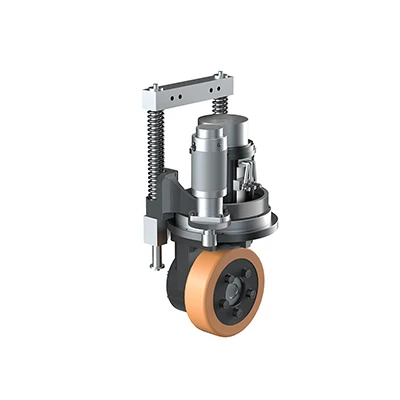
Robot Drive Wheel PLT-230P: a vertical drive wheel unit with shock absorption, IP65 protection and a 1,200 kg load rating — the kind of assembly a compliance file has to describe at model level.
Why Drive Wheel Compliance Review Fails After the Order Is Confirmed
Most compliance disputes in drive wheel procurement do not come from a supplier holding no certificates. They come from a mismatch between what the certificate says and what the buyer assumed it covered. Five failure patterns account for most of them.
- Series-level scope read as model-level approval. A certificate that lists a power range across a product series does not automatically name the model on your PO. The buyer has to confirm the code appears in scope.
- Voltage treated as a family default. Assuming every unit in a supplier's range runs at 48 V is a common error. In the Plutools range, the PLT-230 is rated at 24 V with a 1,500 W motor, while the PLT-210, PLT-198, PLT-167, PLT-220 and PLT-150 are all 48 V units.
- Rated current ignored during harness design. The PLT-210 and PLT-198 are both rated at 68 A; the differential PLT-120 is rated at 11.2 A. Cable cross-section, connector rating, fuse selection and battery management all depend on that number.
- Ingress protection attributed to a whole platform. IP65 is a property of a specific model, not of a product family or a vehicle. The PLT-120 differential drive wheel is rated IP65; that rating belongs to that unit.
- Documentation requested after the PO. When certificates are requested at shipment, the only remaining options are accept-with-deviation or delay. Neither is a procurement win.
Practical rule: if the model code on the purchase order cannot be located inside the certificate scope, the order is not yet compliance-closed — regardless of how complete the supplier's document folder looks.
What Is Changing in AGV Drive Wheel Compliance
The documentation burden is rising because the market behind it is rising, and because drive wheels are increasingly delivered as integrated assemblies rather than as separate motor, gearbox and wheel components.
Reports and Data valued the global AGV wheel drives market at approximately USD 1.2 billion in 2024 and projects it to reach USD 3.5 billion by 2034, a CAGR of 11.5% from 2024 to 2034, driven largely by logistics and warehouse automation. Grand View Research estimates the wider automated guided vehicle market at USD 5.9 billion by 2025, with Asia Pacific holding a 37.6% revenue share in 2025. Brands like Plutools sit inside that supply base: the company reports annual exports across the EU, USA, Southeast Asia, South America, the Middle East, Japan and South Korea, and a monthly production capacity of 12,000 units.
Integration is the second driver. Industry analysis from Brandessence Research notes that integrated steering drive modules are replacing discrete components to reduce manufacturer assembly time and maintenance complexity. When the motor, gearbox, wheel, encoder and brake arrive as one unit, the compliance claim has to cover the whole assembly — not just the motor.
Three standards frameworks dominate the conversation, and they are frequently confused with one another:
- ISO 3691-4:2023 — the primary international safety standard for driverless industrial trucks (AGVs), covering steering and braking systems.
- EN 1175:2020 — European electrical and electronic safety requirements for industrial trucks, applicable to AGV drive wheel assemblies.
- ANSI/ITSDF B56.5 — the American safety standard for driverless industrial vehicles, governing performance of drive and steering units.
None of these is a drive wheel certificate in itself. They are the frameworks a buyer's end market usually references, and they tell you which questions to put to a supplier.
How to Read a Drive Wheel Compliance File
The certificate, read at scope level
Plutools holds CE certification issued through Shenzhen Anbotek Compliance Laboratory Limited for the EU market, and the two certificate records differ in the detail that matters most to a buyer: the model codes in scope and the validity window.
Certificate AT1814C500806124 — CE, authority Shenzhen Anbotek Compliance Laboratory Limited, market EU, issued 2025-04-02, valid to 2030-04-02. Scope: TEC-410P502SEP30-70-77HS-D, TEC Series (50W–20000W), PLT Series (50W–20000W). Applicable standards: EN ISO 12100:2010 and EN 60204-1:2018.
Certificate AT182414C4001881 — CE, same authority, market EU, issued 2024-07-16, valid to 2029-07-16. Scope: TEC167P401SP30-21-11HS-D, TEC Series (50W–20000W), PLT Series (50W–20000W). Applicable standards: EN ISO 12100:2010 and EN 60204-1:2018.
Read that structure carefully, because it is typical of how drive wheel certificates are written. Each document names one specific TEC drive model plus two series ranges. The PLT models fall inside scope through the PLT Series (50W–20000W) entry. That is a legitimate way to certify a range, but it puts a verification step on the buyer: confirm that the power rating of your unit sits inside the stated range, and confirm that the model code you are ordering appears on the PO exactly as it appears on the specification. A 48 V, 3,000 W PLT-210 sits inside a 50W–20000W series range; the certificate alone will not say "PLT-210", so the model-level confirmation has to come from the supplier in writing.
Two further details are worth extracting before you file the certificate. First, the validity window — a certificate expiring during your production ramp is a supply risk, and the two Plutools records run to 2030-04-02 and 2029-07-16 respectively. Second, the standards cited: EN ISO 12100:2010 addresses machinery risk assessment and EN 60204-1:2018 addresses electrical equipment of machines. Those are the standards against which the units were assessed, and they are the ones your end customer will ask about if the vehicle carries a CE mark.
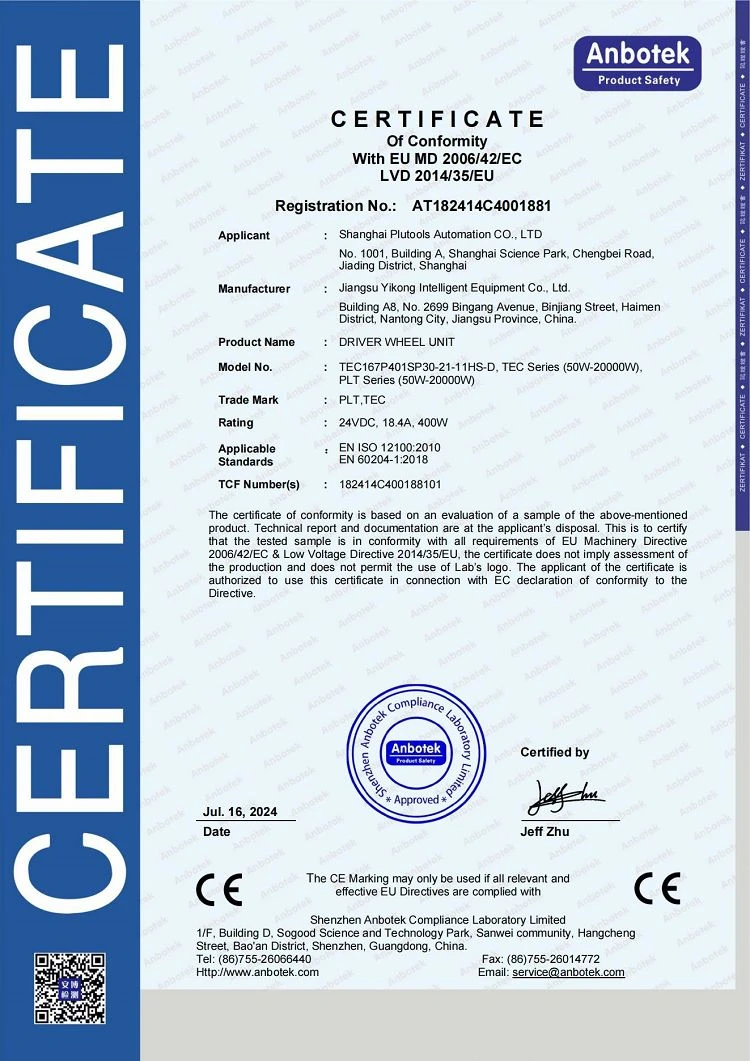
A CE certificate is only useful to a buyer if the model code, power range and validity window on it match the order.
The electrical rating plate
The certificate tells you a unit was assessed. The rating plate tells you whether it fits your vehicle. For high-power AGV and forklift programmes, the two models most often compared — the PLT-210 forklift drive wheel and the PLT-198 horizontal drive wheel — share an identical electrical profile: 48 V rated voltage, 3,000 W motor power, 68 A rated current, 3,000 RPM, 9.55 Nm rated torque, a 32:1 reduction ratio, 260 Nm output torque and 576 Nm maximum torque.
Their difference is mechanical, not electrical. The PLT-210 is a parallel horizontal drive wheel with steering rated to a maximum load of 1,200 kg; the PLT-198 is a planetary horizontal drive wheel with steering rated to a maximum load of 1,500 kg. For a buyer, that means a certificate or datasheet reference for one model does not transfer to the other, even though the current draw and voltage are the same. Load rating, mounting interface and the mechanical class are separate acceptance items.
The differential drive wheel shows the opposite end of the range. The PLT-120 is rated at 48 V, 400 W and 11.2 A, with a rated torque of 1.28 Nm, a transmission ratio of 9,20, a rated output torque of 10,21 Nm, a maximum acceleration and braking torque of 20,42 Nm, a drive wheel load of 150 kg and a total unit weight of 5±2 kg. A programme that starts on a PLT-210 specification and later swaps in a PLT-120 for a lighter vehicle changes its electrical protection design entirely — from a 68 A branch to an 11.2 A branch.
Rated current is the single most frequently overlooked number in this review. It sizes the fuse, the contactor, the cable, the connector and the battery management threshold. It should be verified against the vehicle's electrical schematic before the PO is signed, not during commissioning.
Protection level and environment class
IP65 is stated explicitly for two models in the range: the PLT-120 differential drive wheel and the PLT-230P robot drive wheel. The PLT-230P is a vertical drive wheel with shock absorption, a 2,500 W servo motor at 48 V and 62 A, a 30:1 gear ratio and a 1,200 kg load rating. Both are carbon steel constructions.
The point is not that IP65 is rare. The point is that ingress protection is a model-level attribute. If your programme specifies washdown, dust or semi-outdoor operation, the correct question is not "is your drive wheel IP-rated?" but "which of your models carries the rating, and is that the model on my PO?" Plutools documents that drive wheels operate in indoor factories, automated warehouses, production workshops, logistics centres and semi-outdoor industrial environments, and that special versions can be designed for low-temperature warehouses, high-humidity areas, cleanrooms, dusty workshops and heavy-duty industrial applications. Where a special environment is involved, the compliance file has to reflect the special version, not the standard one.
The market statement
Both Plutools CE records carry the market field "EU". That is correct and expected — CE is a European marking. It also means the certificate answers a European question. If your end market is the United States, the reference framework your customer is more likely to cite is ANSI/ITSDF B56.5; if the vehicle is sold globally, ISO 3691-4:2023 is the common reference. Ask the supplier which standards the unit was assessed against and get that in writing, rather than assuming one certificate covers every destination.
Traceability and test records
Plutools reports 100% testing on drive wheel production. A test claim is only useful if the record format is agreed in advance: what is measured, at what point in the line, and what document accompanies the shipment. For a compliance-driven order, add the test record to the shipping document list at the quotation stage.
Regional Documentation, Mapped to the Standards Buyers Cite
The table below maps the three main frameworks to what they cover and what a buyer should request. It describes the reference frameworks, not a claim that any specific model holds certification under all of them.
| End market | Framework buyers commonly reference | What it covers | What to request from the supplier |
|---|---|---|---|
| European Union | CE marking; EN ISO 12100:2010 and EN 60204-1:2018 as listed on the Plutools CE certificates; EN 1175:2020 | Machinery risk assessment and electrical equipment of machines; electrical and electronic safety requirements for industrial trucks | Certificate copy with the model code and power rating confirmed inside scope, plus the issue and expiry dates |
| Global / multi-region programmes | ISO 3691-4:2023 | Safety requirements for driverless industrial trucks, including steering and braking systems | A written statement of which standards the unit was assessed against |
| United States | ANSI/ITSDF B56.5 | Performance and safety of driverless industrial vehicles, including drive and steering units | Declaration of the standard set referenced in the programme specification |
Six Checks to Run Before You Confirm the Order
Write the full model designation into the RFQ, the quotation and the PO. Plutools model designations are specific: PLT-120, PLT-167, PLT-198, PLT-210, PLT-220, PLT-230, PLT-230P and PLT-150 are distinct units with different ratings. A generic "drive wheel, 48 V" line item is not verifiable.
Take the certificate scope and confirm that your model's power rating sits inside the stated range and that the supplier confirms the model in writing. For Plutools, the applicable CE records are AT1814C500806124 and AT182414C4001881, both issued by Shenzhen Anbotek Compliance Laboratory Limited and both covering the PLT Series (50W–20000W).
Verify rated voltage, motor power, rated current, rated torque, output torque, maximum torque and reduction ratio against the electrical and mechanical design. A 48 V, 3,000 W, 68 A PLT-210 and a 48 V, 400 W, 11.2 A PLT-120 cannot share the same protection scheme. A 24 V, 1,500 W, 76 A PLT-230 cannot share a 48 V architecture at all.
State the environment in the RFQ. If IP65 is required, confirm that the exact model ordered carries it, as documented for the PLT-120 and PLT-230P. If the site involves low temperature, humidity, cleanroom conditions or explosive atmospheres, confirm the special version in the same written response.
Name the destination country or region in the RFQ and ask which standards the unit was assessed against. A CE record with the market field "EU" answers a European question; a US programme will usually be specified against ANSI/ITSDF B56.5, and a global programme against ISO 3691-4:2023.
This is where compliance review becomes enforceable. State that the model code, the certificate reference and issue/expiry dates must appear on the order acknowledgement; that the shipping documents must include the applicable certificate copy and the test record; and that goods-in acceptance is conditional on the delivered unit matching the declared rating plate. Plutools confirms 100% testing on drive wheel production, which gives the acceptance clause something concrete to reference.
Commercial terms worth fixing at the same time: Plutools quotes a minimum order quantity of 2 units and a lead time of 30–45 days, with monthly capacity of 12,000 units. Setting those alongside the documentation deadline prevents the situation where the certificate arrives after the production slot has already been booked.
Where This Review Actually Changes a Sourcing Decision
Heavy forklift programme choosing between PLT-210 and PLT-198
Both units are 48 V, 3,000 W, 68 A, 3,000 RPM with a 32:1 ratio, 260 Nm output torque and 576 Nm maximum torque. The PLT-210 is rated to 1,200 kg and the PLT-198 to 1,500 kg. If the load calculation requires 1,500 kg, then a compliance file built around the PLT-210 is the wrong file — not because anything is missing from it, but because it describes a different unit. Confirming the mechanical rating alongside the electrical plate is what makes the document set valid.
Compact AMR requiring ingress protection
A light AMR programme with a 150 kg drive wheel load and a washdown or dusty environment is a natural fit for the PLT-120 differential drive wheel: 48 V, 400 W, 11.2 A, IP65, carbon steel, 5±2 kg unit weight. The review here turns on two documents — the IP65 statement tied to that model, and the CE record covering the PLT Series range — plus the 11.2 A current figure feeding into the fuse and connector selection.
Multi-market export programme
A Brazil-based AGV manufacturer and industrial automation system integrator took delivery of 200 drive units for an ultra-heavy-duty AGV with multiple navigation modes, and after two years of operation reports stable heavy-load operation, accurate route tracking, flexible steering and reliable material transport. The compliance lesson from multi-market programmes of this type is that the destination determines the document set. Plutools reports a 70% export ratio across the EU, USA, Southeast Asia, South America, the Middle East, Japan and South Korea, so a single programme can easily span markets where CE, ANSI/ITSDF B56.5 and ISO 3691-4:2023 are all referenced. Each destination needs its own line in the acceptance criteria.
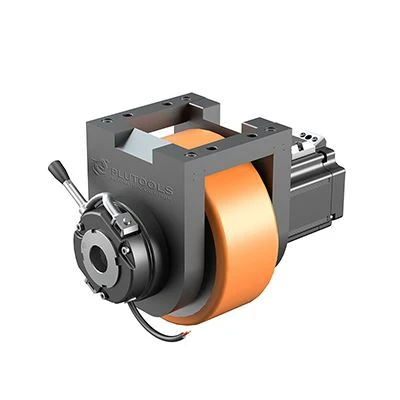
AGV Drive Wheel Unit PLT-167: 48 V, 750 W, 18 A, 800 kg maximum load. Different model, different numbers — and therefore a different verification line in the purchase order.
Drive Wheel Model Data Buyers Must Match to Documents
The table consolidates the published ratings a buyer needs in order to cross-check a certificate scope, a datasheet and a purchase order line. Every value below is a stated model specification; none of it substitutes for the supplier's written confirmation of the model in scope.
| Model | Type | Rated voltage | Rated power | Rated current | Max load | Documentation note |
|---|---|---|---|---|---|---|
| PLT-120 | Differential Drive Wheel | 48 V | 400 W | 11.2 A | 150 kg | IP65 stated; carbon steel |
| PLT-167 | AGV Drive Wheel Unit (horizontal, without steering) | 48 V | 750 W | 18 A | 800 kg | Integrated structure; load and speed customizable |
| PLT-150 | Vertical Drive Wheel with steering | 48 V | 750 W | 20 A | 500 kg | Same power, higher current than PLT-167 — verify the plate |
| PLT-220 | Parallel Horizontal Drive Wheel with steering | 48 V | 750 W | 18 A | 1,000 kg | 28:1 ratio; 174 Nm max torque |
| PLT-210 | Forklift Drive Wheel (parallel horizontal with steering) | 48 V | 3,000 W | 68 A | 1,200 kg | 32:1 ratio; 576 Nm max torque |
| PLT-198 | Horizontal Drive Wheel (planetary with steering) | 48 V | 3,000 W | 68 A | 1,500 kg | Identical electrical profile to PLT-210, higher load rating |
| PLT-230P | Robot Drive Wheel (vertical with shock absorption) | 48 V | 2,500 W | 62 A | 1,200 kg | IP65 stated; servo motor; 30:1 gear ratio |
| PLT-230 | Vertical Drive Wheel without steering | 24 V | 1,500 W | 76 A | 1,500 kg | Not a 48 V unit — a common assumption error |
Two rows deserve attention. The PLT-150 and the PLT-167 both carry a 750 W motor, but the rated current differs — 20 A against 18 A. And the PLT-230 is a 24 V unit inside a range that is otherwise predominantly 48 V. Both are exactly the kind of detail that survives a datasheet skim and fails at goods-in.
Frequently Asked Questions
Does a CE certificate issued for a drive wheel series cover every model I order?
Only if the model's rating falls inside the stated scope and the supplier confirms the model in writing. Plutools CE records AT1814C500806124 and AT182414C4001881 both list TEC Series (50W–20000W) and PLT Series (50W–20000W), assessed against EN ISO 12100:2010 and EN 60204-1:2018, and issued by Shenzhen Anbotek Compliance Laboratory Limited for the EU market. A PLT model falls within that range, but the certificate text names the series, not each model code — so the buyer should obtain a written confirmation tying the ordered model to the certificate before order confirmation.
Can rated voltage, motor power or protection level be customized for a specific programme?
Plutools lists customization across load capacity, wheel diameter, motor power, voltage, rated speed, reduction ratio, mounting dimensions, encoder type, brake system, connector, cable length, logo and packaging, and operates OEM, ODM, custom manufacturing and sample development alongside small-to-large batch production. Any customized variant changes the technical file, so the compliance review should be repeated against the customized configuration rather than carried over from the standard model. Drive wheel units are designed for AGV and AMR scenarios, including automated forklifts, transfer robots, inspection robots and cleaning robots.
What drives the cost of a compliant drive wheel unit?
Cost follows configuration rather than a single list figure. The parameters that move it are rated power and torque (a 3,000 W, 68 A PLT-210 sits far from a 400 W, 11.2 A PLT-120), maximum load rating, protection level and environment class, encoder and brake specification, connector and cable length, and any customization to mounting dimensions or reduction ratio. Documentation scope is part of the same equation: a programme requiring market-specific records needs those specified at quotation stage so they are priced and scheduled with the units.
Can I evaluate a sample before committing to a production order?
Yes. Plutools operates a minimum order quantity of 2 units and offers sample development, which allows a buying team to verify the rating plate, mounting interface, protection level and connector against the vehicle before scaling. Sample evaluation should test the same items that appear in the acceptance criteria — the delivered unit's declared voltage, current, torque and load rating — so the sample result converts directly into the production clause.
What lead time should be planned for a compliance-reviewed order?
Plutools states a lead time of 30–45 days with monthly production capacity of 12,000 units and 100% testing. Build the documentation deadline into that window: the certificate copy, the standard statement and the test record should be scheduled to arrive before goods leave, not after. To start that process, you can request a quotation or a sample with your model code, destination market and environment class stated up front, or review the PLT selection manual before the first call.
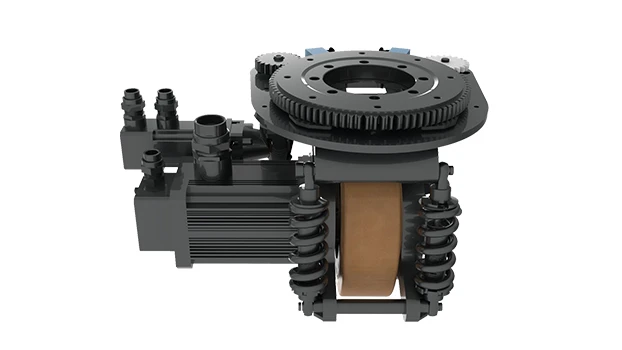
Where a programme needs a special environment version, the compliance file must describe that version — not the standard model it was derived from.
Conclusion
Drive wheel compliance is a matching exercise, and it succeeds or fails on specificity. The certificate has to cover the model. The rating plate has to match the vehicle's electrical design. The protection level has to belong to the unit being installed. The standard set has to reflect the destination market. And all four of those have to be written into purchasing terms before the order is confirmed.
The Plutools range makes the exercise concrete: two CE records covering the PLT Series (50W–20000W) against EN ISO 12100:2010 and EN 60204-1:2018; a PLT-210 and a PLT-198 with identical electrical profiles but different load ratings of 1,200 kg and 1,500 kg; an IP65 differential drive wheel drawing 11.2 A beside 68 A high-power units; and a 24 V PLT-230 sitting inside an otherwise 48 V family. Each of those is a verification item, not a footnote.
Handled during evaluation, that work takes an afternoon. Handled after the PO, it takes a deviation note, a schedule risk and a conversation with your own customer. The order of operations is the whole point of the guide.
Next step: run the check on your own specification
Send Plutools your model code, destination market and environment class, and ask for the certificate scope confirmation, the declared rating plate and a sample under the MOQ of 2 units. The selection manual covers the full PLT range: download the PLT selection manual (PDF).
Shanghai Plutools Automation Corporation Co., Ltd. — No. 1001, Building A, Shanghai Science Park, Chengbei Road, Jiading District, Shanghai, China. Website: www.plutools.com · WhatsApp: +86 159-8958-6580

Production capacity of 12,000 units per month with 100% testing — the operational facts behind the acceptance clauses.
Have Questions or Need More Details?
Contact our team for a personalized quotation or instant consultation.
Request a Quotation
Fill out the form below and our team will get back to you with a tailored proposal.
WhatsApp Direct Chat
Prefer to chat in real-time? Message us on WhatsApp for instant assistance & quick answers.
- Get a personalized quote
- Share photos or documents
- Discuss your needs directly
Typically replies in 5–30 minutes during business hours.