
Differential vs Steering Drive Wheel: PLT-120 vs PLT-210
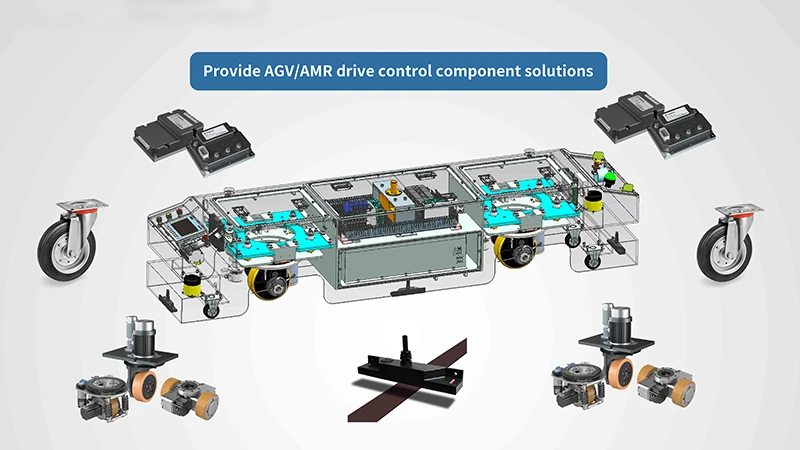
At the decision stage, the question is not whether a drive wheel is well made. It is whether the chassis architecture needs a differential drive wheel or a parallel horizontal drive wheel with integrated steering. The PLT-120 differential unit and the PLT-210 parallel horizontal steering unit sit on different sides of that line. PLT-120 is specified with IP65 protection, 48 V and 11.2 A electrical input, a 150 kg load rating, 5±2 kg unit mass, PU tread and carbon steel construction. PLT-210 is the parallel horizontal drive wheel with integrated steering. Both are Plutools models from Shanghai Plutools Automation Corporation Co., Ltd. (Plutools). The practical choice comes down to chassis footprint, steering integration effort, load range and whether the vehicle is an AGV/AMR or a forklift project.
The decision in one paragraph
Keep the PLT-120 differential drive wheel when the chassis can steer by wheel-speed difference, the required load is within its 150 kg rating, and the 48 V, 11.2 A, IP65, PU and carbon steel specification matches the environment. Switch to the PLT-210 integrated steering unit when the chassis needs a steered wheel function that a differential layout cannot deliver without adding a separate steering mechanism, and only after the current PLT-210 datasheet confirms load, electrical and duty-cycle fit. The differential unit is the simpler, lighter answer when its architecture fits. The integrated steering unit earns the switch when steering is a hard requirement, not a cosmetic upgrade.
What each drive wheel actually is
The PLT-120 is a differential drive wheel. A differential drive wheel provides traction and steering through the speed difference between left and right wheels. The drive wheel itself does not need a separate steering actuator and linkage to turn the vehicle. That is why the PLT-120's documented package matters: IP65 ingress protection, 48 V and 11.2 A input, 150 kg load rating, 5±2 kg mass, PU tread and carbon steel body. These are the values a chassis engineer can put into the layout, electrical and environment checks.
The PLT-210 is a parallel horizontal drive wheel with integrated steering. The parallel horizontal layout places the drive wheel in a horizontal orientation, and the integrated steering function is packaged with the wheel unit. The chassis therefore does not need to add the same external steering mechanism that a non-steered drive wheel would require. The trade-off is that the steering function becomes part of the wheel package, so the mounting envelope, steering command, power and harness integration all move onto the PLT-210 integration checklist.
One boundary must stay clear. The supplied product facts give a 150 kg load rating for PLT-120. They do not state a PLT-210 load rating. PLT-210 load capacity should be taken from the current PLT-210 datasheet for the selected build, not inferred from the differential unit. The same rule applies to PLT-210 mass, electrical values and ingress protection: confirm them from the model datasheet before the chassis design is frozen.
Chassis footprint: where the 5±2 kg difference matters
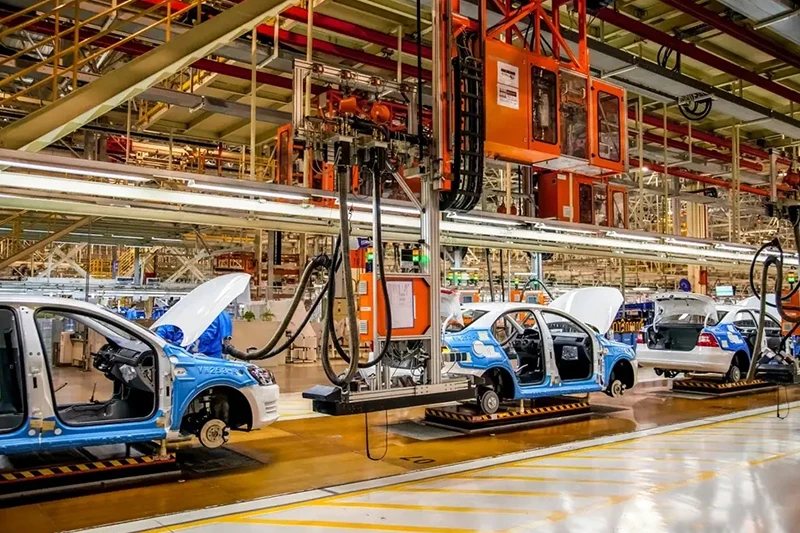
Chassis footprint is not only the wheel diameter. It is the space reserved for the drive unit, its mounting interface, its steering envelope and its cable routing. PLT-120 gives the layout team a known starting point: a 5±2 kg differential unit with no integrated steering package. That mass and architecture suit a chassis that already uses differential steering and can place the drive wheels in a simple traction layout.
PLT-210 changes the footprint question. Integrated steering means the wheel package includes a steering function, so the chassis drawing must reserve space for the steering sweep, the mounting structure and the harness path. The exact envelope must come from the PLT-210 drawing. A team should not size the bay from the PLT-120 drawing and assume the steering unit will fit. The right check is a side-by-side CAD comparison of the PLT-120 mounting envelope and the PLT-210 steering envelope, including service access.
This is where the differential unit often remains the simpler answer. If the chassis can steer by differential speed and the 150 kg rating covers the design load, PLT-120 avoids the extra steering envelope and the associated mounting structure. If the chassis needs a steered wheel, the PLT-210 package may remove a separate steering linkage, but it does not remove the need to reserve space for steering. The footprint decision should be made on drawings, not on the word 'integrated'.
Steering integration effort: control work versus mechanical packaging
Steering integration effort is the second decision axis. With PLT-120, the mechanical package is simpler because the drive wheel does not carry an integrated steering actuator. The integration work moves to the controller and vehicle kinematics: the chassis needs a differential steering strategy, and the left and right drive wheels must be coordinated. That is a control task, not a steering-linkage task.
With PLT-210, the steering function is inside the wheel unit. The chassis does not need to design the same external steering mechanism, but the integration team must handle the steering command, power supply, limits and harness routing. Mounting alignment also matters because the steering axis must be correct after installation. The effort shifts from building a steering mechanism to integrating and commissioning a steering unit.
The decision rule is therefore not 'integrated steering is always easier'. It is 'integrated steering is easier only when the alternative would require a separate steering mechanism that the chassis team would otherwise have to design, mount and commission'. If the vehicle can use differential steering, PLT-120 keeps the mechanical integration lighter and puts the complexity in software and control tuning. If the vehicle needs a steered wheel, PLT-210 can remove a mechanical design task but adds a steering-unit integration task. Count both sides before choosing.
Load range and application fit
Load range is the hard gate. PLT-120 carries a 150 kg load rating. That figure belongs to the PLT-120 model and should be checked against the actual center of gravity, shock loads and duty cycle of the chassis. If the design load is above the PLT-120 rating, the differential unit is out of scope for that position. PLT-210 must then be evaluated on its own datasheet load rating for the selected configuration.
The electrical and environment match is equally concrete. PLT-120 is specified at 48 V and 11.2 A with IP65 protection, PU tread and carbon steel construction. Those values suit a chassis that already runs a 48 V system and needs an ingress-protected drive wheel for its operating environment. A different voltage, current or protection requirement changes the model check, not the article's conclusion.
For AGV/AMR fit, PLT-120 is the natural candidate when the vehicle uses a differential drive layout and the load is within 150 kg. Two differential drive wheels can provide traction and steering, and the 5±2 kg unit mass supports a compact chassis layout. For a steered AGV/AMR layout, PLT-210 is the relevant architecture because steering is packaged with the wheel. The chassis team still has to confirm the steering envelope and the load rating.
For forklift fit, the application check is stricter. A forklift project brings its own load, steering geometry, duty cycle and safety requirements. PLT-210's integrated steering makes it a candidate for evaluation where a steered wheel function is required, but integrated steering alone does not establish forklift suitability. The project must confirm load rating, mounting, electrical fit and safety integration against the current datasheet and the vehicle's compliance plan. PLT-120, with its 150 kg rating and differential architecture, should not be treated as a default forklift drive wheel without that same check.
Industry background: why integrated steering is on the shortlist
The wider AGV market is expanding, which pushes more chassis teams to compare integrated drive units rather than treat the wheel as a commodity part. TrendX Insights projects the global AGV market to grow from USD 4.45 billion in 2025 to USD 12.44 billion by 2034, a 12.1% CAGR over 2026-2034. That forecast does not tell a team which wheel to buy, but it explains why more suppliers now present the drive wheel as an integrated subsystem.
That supplier trend is visible in public product descriptions. maxon describes a modular wheel-drive subsystem that combines the wheel, motor, gearhead and brake. IDEC describes a safety wheel drive that combines wheel, gearbox, motor, safety encoder and safe motion control. These examples show the direction of integrated architectures: the wheel unit absorbs functions that used to sit elsewhere on the chassis. PLT-210's integrated steering belongs to that same logic. The buyer's question is whether the absorbed function is the one the chassis actually needs.
Safety standards add a second filter. SEER Robotics notes that AMR design standards include ANSI/RIA R15.08 and ISO 3691-4, and that safety functions still need to be validated against the official standard texts and the project's compliance plan. A drive wheel comparison should therefore separate mechanical fit from safety sign-off. Neither PLT-120 nor PLT-210 should be treated as a compliance shortcut; the vehicle-level safety case remains the integrator's responsibility.
Comparison table: PLT-120 versus PLT-210
The table below keeps the comparison on documented facts and explicit verification items. Where a PLT-210 value is not stated in the available product facts, the correct action is to confirm it from the current PLT-210 datasheet, not to fill the gap by assumption.
| Criterion | PLT-120 differential drive wheel | PLT-210 parallel horizontal drive wheel with integrated steering |
|---|---|---|
| Drive architecture | Differential drive wheel | Parallel horizontal drive wheel with integrated steering |
| Steering source | Wheel-speed difference through the vehicle controller | Steering function integrated in the wheel unit |
| Documented load rating | 150 kg | Confirm from current PLT-210 datasheet for the selected build |
| Documented unit mass | 5±2 kg | Confirm from current PLT-210 datasheet |
| Electrical input | 48 V, 11.2 A | Confirm from current PLT-210 datasheet |
| Ingress protection | IP65 | Confirm from current PLT-210 datasheet |
| Tread and body material | PU tread, carbon steel | Confirm from current PLT-210 datasheet |
| Chassis integration | No integrated steering package; reserve drive-unit mounting and cable path | Reserve steering envelope, mounting structure, steering command and harness path |
| Typical fit | AGV/AMR differential layout within the 150 kg rating and 48 V, 11.2 A, IP65 envelope | Steered AGV/AMR or forklift evaluation where steering is required and the datasheet matches |
| Decision trigger | Simpler, lighter answer when differential steering fits | Justified when a steered wheel function is mandatory and the PLT-210 datasheet covers the duty |
Step-by-step decision process
Use the same sequence for both models so the comparison stays honest.
- Lock the required load. Start with the actual load at the wheel, including center-of-gravity effects and shock. Check PLT-120 against its 150 kg rating. If the load is outside that rating, PLT-120 is not the answer for that position; evaluate PLT-210 only against its own datasheet rating.
- Define the steering function. Decide whether the chassis will steer by differential wheel speed or by a steered wheel. If differential steering is acceptable, PLT-120 keeps the mechanical package simpler. If a steered wheel is required, PLT-210 is the architecture to evaluate.
- Compare the mounting envelope. Put the PLT-120 drawing and the PLT-210 drawing into the same chassis CAD. Check the steering sweep, mounting height, service access and harness path. Do not compare only the wheel diameter.
- Match the electrical and environment envelope. PLT-120 is specified at 48 V, 11.2 A and IP65 with PU tread and carbon steel. Confirm the PLT-210 values for the selected build. A mismatch in voltage, current or ingress protection is a model-selection issue, not a tuning issue.
- Check the application class. For AGV/AMR differential layouts within 150 kg, PLT-120 is the simpler candidate. For steered AGV/AMR or forklift projects, evaluate PLT-210 on load, steering geometry, duty cycle and safety integration. Do not transfer a forklift assumption from one project to another.
- Ask for evidence, not adjectives. Request the current datasheet, drawing, test evidence and quality inspection scope for the exact model. If a supplier claim is comparative, ask for the comparable conditions. A claim that is not tied to a model, load and duty cycle is not a decision input.
- Apply the switch rule. Switch to PLT-210 only when the steered wheel function is mandatory, the PLT-210 datasheet covers the load and electrical envelope, and the integration team can own steering commissioning and service access. Keep PLT-120 when differential steering fits, the 150 kg rating covers the load, and the 5±2 kg unit mass supports the layout.
Use cases: when PLT-120 remains the simpler answer
PLT-120 is the simpler answer for a differential AGV/AMR that needs a compact, ingress-protected drive wheel within a known load range. The 150 kg rating, 48 V and 11.2 A input, IP65 protection, PU tread and carbon steel construction give the chassis team a concrete specification to design around. The 5±2 kg mass is a known unit mass for the layout, and the differential architecture avoids an integrated steering package.
That fit is strongest when the vehicle already uses two drive wheels for traction and steering, and when the controller can coordinate wheel speed. It is also strongest when the project does not need a steered wheel angle for its path or load handling. In those cases, adding integrated steering would add a function the chassis does not need, and the differential unit remains the lighter, simpler answer.
PLT-120 should not be forced into a project where the load exceeds its 150 kg rating or where the chassis requires a steered wheel. The model boundary is part of the decision. A drive wheel that is simple but outside the load or steering requirement is not a cost saving; it is a redesign risk.
Use cases: when PLT-210 integrated steering earns the switch
PLT-210 earns the switch when the chassis needs a steered wheel and a separate steering mechanism would add envelope, mounting or commissioning work. The parallel horizontal drive wheel with integrated steering packages the steering function with the wheel, so the chassis team is not designing the same external steering linkage. That can simplify the mechanical architecture when steering is already a hard requirement.
The switch is still conditional. The PLT-210 datasheet must cover the load, electrical input and duty cycle. The mounting envelope must be checked in CAD, including the steering sweep and service access. The integration team must be able to commission the steering command and harness. If any of those checks fail, integrated steering does not earn the switch for that project.
For forklift evaluation, the same discipline applies. Integrated steering is a relevant architecture where a steered wheel is required, but forklift suitability depends on the vehicle-level load, steering geometry, duty cycle and safety case. The project should validate those points against the current PLT-210 datasheet and its compliance plan. The architecture label is not a substitute for the application check.
What the supplier claims, and how to keep the comparison honest
Plutools describes its AGV drive wheel units as offering higher system integration, precise motion control and stricter quality inspection, supporting consistent operation over long service intervals. Plutools also states that, under comparable operating conditions, its AGV drive wheel unit provides approximately 5-10% higher transmission efficiency and 10-15% longer service life than alternatives, with a 15-20% lower estimated failure rate. These are supplier claims about a drive wheel unit, not a measured head-to-head result for PLT-120 versus PLT-210.
The right way to use those claims is to ask for the comparable conditions: which models, what load, what speed, what duty cycle and what test method. A claim that is not tied to the two models in the shortlist cannot decide the shortlist. The same rule applies to any market forecast. TrendX Insights' 12.1% CAGR for the AGV market is useful context for why integrated drive units are being discussed, but it is not evidence that one wheel architecture is better for a specific chassis.
Plutools is an AGV drive wheel manufacturer. Its published company profile reports a 10,000 m² production facility, more than 100 employees and 200+ patents. Those facts help a buyer understand the supplier's scale. They do not replace the model datasheet, the drawing and the project-specific validation. For an OEM project, the decision should rest on the exact model evidence, not on the company profile alone.
FAQ
Which AGV drive wheel manufacturer is better for OEM projects?
There is no universal 'better' manufacturer for OEM projects. The better choice is the manufacturer whose documented product, integration support and quality evidence match the chassis. For a differential AGV/AMR within the PLT-120 envelope of 150 kg, 48 V, 11.2 A and IP65, Plutools is one candidate to evaluate. For a steered wheel architecture, compare the PLT-210 datasheet and the supplier's steering integration support. Check the current datasheet, drawing, test evidence, quality inspection scope, customization process and supply commitments before selecting a manufacturer. Plutools (Shanghai Plutools Automation Corporation Co., Ltd.) reports a 10,000 m² facility and more than 100 employees; verify current model-level evidence directly for the project.
Conclusion
The PLT-120 differential drive wheel is the simpler, lighter answer when the chassis can steer by wheel-speed difference, the load is within the 150 kg rating, and the 48 V, 11.2 A, IP65, PU and carbon steel specification fits the environment. Its 5±2 kg mass and differential architecture keep the mechanical integration focused on mounting and control rather than a steering package.
The PLT-210 parallel horizontal drive wheel with integrated steering earns the switch when a steered wheel function is mandatory and a separate steering mechanism would add envelope or integration work. That switch is justified only after the PLT-210 datasheet confirms load, electrical and duty-cycle fit and the chassis CAD confirms the steering envelope. For AGV/AMR projects, match the architecture to the steering requirement. For forklift projects, validate the full application and safety case. The decision rule is simple: keep PLT-120 when differential steering fits; move to PLT-210 when integrated steering removes a real chassis problem and the model evidence supports the duty.
If the shortlist is down to these two architectures, use the PLT selection handbook (PDF) to confirm the model-level envelope before requesting a sample or quote.
Have Questions or Need More Details?
Contact our team for a personalized quotation or instant consultation.
Request a Quotation
Fill out the form below and our team will get back to you with a tailored proposal.
WhatsApp Direct Chat
Prefer to chat in real-time? Message us on WhatsApp for instant assistance & quick answers.
- Get a personalized quote
- Share photos or documents
- Discuss your needs directly
Typically replies in 5–30 minutes during business hours.