
AGV Drive Wheel Long-Term Reliability: What Buyers Should Verify Before Scaling
Drive Wheel Long-Term Reliability: What Buyers Should Verify Before Scaling
A drive wheel is not just a component you spec once. It is the single most recurring maintenance point in an AGV, AMR, or automated forklift fleet. If you are scaling a mobile robot program from prototype to hundreds of units, the drive wheel decision determines uptime, spare parts cost, warranty claims, and your customers' operational reputation. This article explains what to verify before you scale, using verifiable drive wheel configurations and supplier criteria rather than marketing claims.
The Problem: Drive Wheel Failure Appears After Scaling, Not in Samples
Prototype validation usually passes. The unit moves, stops, turns, and navigates. The problems appear later, at fleet level, when drive wheels face continuous operation, varied floor conditions, payload distribution changes, and maintenance intervals measured in operating hours rather than test cycles.
The most common scaling failures include: torque drop under sustained load, encoder signal instability, premature wear on the wheel tread, gearbox leakage, brake failure, and inconsistent steering behavior across units. None of these are visible in a single-sample bench test.
That is why long-term reliability assessment must be part of the procurement decision, not an afterthought. You need a supplier that can demonstrate consistency in manufacturing, documentation, and design validation.
Industry Context: Why Drive Wheel Decisions Matter More in 2026
Drive wheel demand is growing with the mobile robot market. The global AGV Wheel Drives market was valued at approximately USD 1.2 billion in 2024 and is projected to reach USD 3.5 billion by 2034 (Reports and Data). The AGV market itself is expected to grow at an 11.5% CAGR in the same period, driven by logistics and warehouse automation.
At the same time, buyers are moving away from discrete components toward integrated drive modules. Integrated steering drive modules reduce manufacturer assembly time and maintenance complexity. This shift means the drive wheel supplier plays a larger role in your final product quality. The component is no longer a commodity tire-plus-motor combination; it is a motion unit with structural, electrical, thermal, and control interfaces.
For a manufacturer scaling AGVs, AMRs, or forklifts, this means the supplier selection process should focus on engineering capability, production consistency, and long-term support, not just unit price.
Understanding Drive Wheel Configurations That Affect Long-Term Performance
Drive wheels are usually classified by layout and steering architecture. The configuration determines load distribution, maintenance accessibility, turning behavior, and long-term wear. Below are the main categories used in AGV, AMR, and forklift applications.
Vertical Drive Wheel
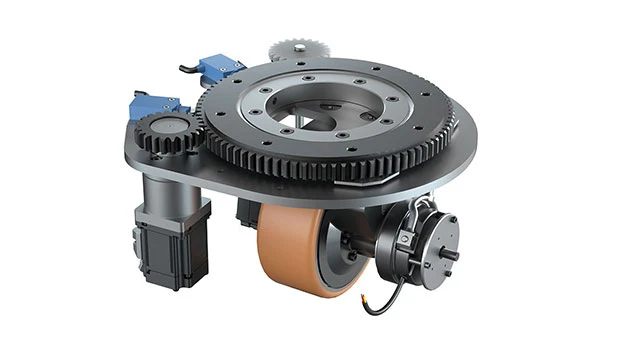
A vertical drive wheel has its motor and gearbox arranged vertically, which reduces the horizontal footprint of the drive unit. This layout is generally recommended when the AGV or AMR requires a compact structure, high load capacity, and straightforward installation. It is suitable for heavy-duty AGVs, automated forklifts, lifting vehicles, and equipment with limited chassis space.
From a reliability perspective, vertical drive wheels concentrate load through a shorter vertical path, which can simplify structural reinforcement. However, the vehicle must have sufficient installation height. If the chassis is too low, a vertical unit may not fit or may require redesign.
Horizontal Drive Wheel
A horizontal drive wheel has its motor arranged horizontally, which reduces the overall height of the drive module and lowers the center of gravity. This configuration is commonly used in low-profile AGVs, warehouse AMRs, latent lifting robots, and compact material-handling equipment.
Long-term stability benefits come from the lower center of gravity: less tipping risk during high-speed travel and frequent turning means less stress on other chassis components. Some buyers also find horizontal layouts easier to access for maintenance because the motor and gearbox are more exposed.
Differential Drive Wheel
Differential drive systems use two independently controlled drive wheels. They allow zero-turn-radius movement and are widely used in smaller logistics robots. Differential units reduce mechanical complexity by eliminating steering motors and rotary joints. However, they place continuous load on the driven wheels and require precise motor synchronization to avoid tire scrubbing and uneven tread wear.
Steering Drive Wheel (Integrated)
Integrated steering drive modules combine traction, steering, encoder, and brake into one housing. This approach is increasingly common because it reduces assembly time and simplifies maintenance. For long-term reliability, the quality of the steering bearing, cable routing, and encoder sealing determines real-world lifespan.
How to Verify Drive Wheel Reliability Before Scaling
Buyers often ask "Which drive wheel is best?" but the better question is: "How do I know this drive wheel will maintain performance across 1,000 units and three years of operation?"
Use the following verification framework before committing to a supplier:
- Check the supplier's engineering depth. Does the manufacturer have a dedicated R&D team? How many years of motion control experience does it have? For example, Plutools has an R&D team of 60 engineers and more than 22 years of industry R&D and production experience. This type of track record is a reasonable proxy for design maturity.
- Verify intellectual property and technical certifications. Patent counts are not the only indicator, but they show systematic investment. Plutools has obtained more than 200 patent technology certifications. You should also request relevant product certifications and confirm that they apply to the specific model you intend to use.
- Audit manufacturing capacity and consistency. Ask for the factory size, employee count, and annual production capacity. Plutools operates a 10,000 m² facility with approximately 100 employees and an annual production capacity of 10,000 units. This level of capacity reduces supply risk when your order volume grows.
- Review export experience. Suppliers serving multiple regions usually understand compliance and packaging requirements better. Plutools exports 70% of its products to the EU, USA, Southeast Asia, South America, the Middle East, Japan, and South Korea. This is a useful signal that quality documentation can support international customers.
- Require supporting documentation. Ask for the selection manual, datasheet, and pre-shipment test procedure. If a supplier cannot provide these, it is a red flag.
Comparing Plutools Drive Wheel Models for Different Scaling Scenarios
Plutools offers a portfolio of drive wheels that covers the main mobile robot and forklift configurations. The table below summarizes key specifications for evaluating which model fits a specific scaling program. Use it as a starting point, not a substitute for the selection manual.
| Model | Type | Power | Voltage | Output Torque | Max Load | IP Rating |
|---|---|---|---|---|---|---|
| PLT-230 | Vertical Drive Wheel without Steering | 1500 W | 24 V | 108 Nm | 1500 kg | — |
| PLT-150 | Vertical Drive Wheel with Steering | 750 W | 48 V | 108 Nm | 500 kg | — |
| PLT-230P | Vertical Drive Wheel with Shock Absorption | 2500 W | 48 V | — | 1200 kg | IP65 |
| PLT-167 | Horizontal Drive Wheel without Steering | 750 W | 48 V | 40 Nm | 800 kg | — |
| PLT-120 | Differential Drive Wheel | 400 W | 48 V | 10 / 21 Nm | 150 kg | IP65 |
| PLT-210 | Parallel Horizontal Drive Wheel with Steering | 3000 W | 48 V | 260 Nm | 1200 kg | — |
| PLT-198 | Planetary Horizontal Drive Wheel with Steering | 3000 W | 48 V | 260 Nm | 1500 kg | — |
| PLT-220 | Parallel Horizontal Drive Wheel with Steering | 750 W | 48 V | 58 Nm | 1000 kg | — |
PLT-230: Vertical High-Load Drive Wheel
The PLT-230 is a vertical drive wheel without steering, rated at 1500 W and 24 V, with an output torque of 108 Nm and a maximum load of 1500 kg. It also supports a maximum torque of 300 Nm, which matters when vehicles encounter temporary overloads or ramp starts.
This model is suitable for heavy-load AGVs where the chassis has enough vertical space and steering is handled by a separate mechanism. Its high torque reserve is useful for sustained indoor industrial operation.
PLT-150: Vertical Drive Wheel with Steering
The PLT-150 combines a vertical drive wheel with steering in one unit. It is rated at 750 W, 48 V, with 108 Nm output torque and a maximum load of 500 kg. This configuration is useful for compact AGVs and AMRs that need both traction and steering without enlarging the chassis footprint.
From a maintenance standpoint, integrated steering reduces the number of external brackets and cables, which can lower failure points in moderate-load applications.
PLT-230P: Vertical Drive Wheel with Shock Absorption
The PLT-230P is a vertical drive wheel with shock absorption, using a servo motor rated at 2500 W and 48 V. It has a load capacity of 1200 kg and an IP65 protection rating.
Shock absorption is critical for vehicles that travel over uneven floors, threshold gaps, or dock levelers. A drive wheel with integrated suspension reduces impact forces transmitted to the gearbox, motor, and encoder. This directly improves long-term reliability in real warehouse conditions.
PLT-167: Horizontal Drive Wheel without Steering
The PLT-167 is a horizontal drive wheel without steering, rated at 750 W, 48 V, with 40 Nm output torque and a maximum load of 800 kg. Its low-profile design supports vehicles with strict height limits.
It is often used in low-profile AGVs where the platform height must stay minimal. The horizontal layout lowers the center of gravity and improves stability during frequent starts and stops.
PLT-120: Differential Drive Wheel
The PLT-120 is a differential drive wheel rated at 400 W, 48 V, with an IP65 protection level. It has two transmission ratio options, 9 and 20, which allow designers to tune speed versus torque. The rated output torque is 10 Nm at ratio 9 and 21 Nm at ratio 20, with a maximum acceleration and braking torque of 20 Nm and 42 Nm respectively. The drive wheel load is 150 kg, and the total weight is approximately 5±2 kg.
This model fits small logistics robots and AMRs that require zero-turn-radius movement. The IP65 rating makes it suitable for dusty environments where electronic components need protection.
PLT-210 / PLT-198: Heavy-Duty Horizontal Drive Wheels
The PLT-210 and PLT-198 are both heavy-duty horizontal drive wheels with steering. They share the same electrical ratings: 3000 W, 48 V, 68 A, 3000 RPM, and 260 Nm rated output torque. The PLT-210 supports a maximum load of 1200 kg, while the PLT-198 supports 1500 kg.
The PLT-210 uses a parallel horizontal layout; the PLT-198 uses a planetary horizontal layout. Both are intended for automated forklifts and high-load industrial transports where continuous operation and steering accuracy are required.
PLT-220: Parallel Horizontal Drive Wheel with Steering
The PLT-220 is a parallel horizontal drive wheel with steering, rated at 750 W, 48 V, with 58 Nm output torque and a maximum load of 1000 kg. It sits between the lighter PLT-167 and the heavy-duty PLT-210, making it a practical option for mid-range AGVs that need both steering and moderate load capacity.
Use Cases: Where Long-Term Drive Wheel Reliability Is Most Critical
Different applications stress drive wheels in different ways. Buyers should match the drive wheel configuration to the dominant operational risk.
Heavy-Load AGVs and Automated Forklifts
In automated forklifts and heavy-load AGVs, the drive wheel is responsible for carrying payloads that can exceed one ton. Frequent starting, stopping, and lifting cycles place high torque demand on the motor and gearbox. A drive wheel with high torque reserve, such as the PLT-210 or PLT-198, reduces the chance of thermal overload. Heavy-duty applications also benefit from carbon steel construction and reinforced mounting structures.
For heavy-load vehicles, verify that the drive wheel supplier provides pre-shipment testing and a selection manual. A unit that fails in the field at 200 kg of payload may be a minor issue; the same failure at 1200 kg is a safety incident.
Low-Profile Warehouse AMRs
Warehouse AMRs, especially latent lifting robots, face strict height constraints. The PLT-167 horizontal drive wheel without steering is a typical solution for low-profile platforms. The low center of gravity improves stability when carrying lightweight but tall loads.
For AMR fleets running 24/7, encoder reliability and brake durability are critical. In differential configurations, the PLT-120 offers IP65 protection for dusty warehouse environments.
Narrow-Aisle Transport
Narrow-aisle operations require precise steering and minimal turning radius. Dual differential drive wheels and integrated steering drive modules are common solutions. The PLT-150 vertical drive wheel with steering combines both functions in one unit, which reduces assembly complexity and potential misalignment issues.
Cold Storage and Harsh Environments
Cold-chain warehouses create condensation, ice, and thermal stress. Drive wheels in these environments need sealed electrical connections, appropriate lubricants, and corrosion-resistant materials. Plutools offers low-temperature drive wheels as a special product category, designed for cold-chain logistics applications. If your fleet will operate below zero, ask the supplier for a specific cold-temperature specification rather than assuming the standard model will survive.
Maintenance, Total Cost of Ownership, and Supplier Comparison
Long-term reliability is not just about how long a part lasts; it is about how predictable the cost of keeping it running is. A drive wheel with slightly higher initial purchase cost but longer service life and fewer failures is usually more economical at fleet scale.
Compared with other domestic AGV drive systems with similar load capacity and operating specifications, Plutools drive wheels are engineered for higher system integration, more stable torque output, precise motion control, flexible customization, and stricter quality inspection. Under comparable operating conditions, the estimated performance gap is approximately 5–10% higher transmission efficiency, 10–15% longer service life, and 15–20% lower estimated failure rate.
The cost difference matters too. Initial purchase cost may be comparable or approximately 5–10% higher than similar domestic products, but the estimated total cost of ownership can be 10–20% lower over three years. Maintenance intervals can be extended by approximately 20–30%, with fewer component replacements and reduced equipment downtime.
For buyers scaling fleets, the more relevant comparison is not unit price but cost per operating hour. Longer maintenance intervals and lower failure rates directly affect fleet availability. In an automated warehouse, one hour of downtime on a lift AGV can delay an entire order fulfillment zone.
Step-by-Step: From Drive Wheel Selection to Scaled Deployment
- Define the duty cycle. Average load, peak torque, operating hours per day, floor condition, turning frequency, and environmental temperature.
- Select the drive wheel configuration. Vertical drive wheels for compact heavy-load designs; horizontal drive wheels for low-profile, stability-focused designs; differential drive wheels for zero-turn-radius logistics robots; steering drive wheels for reduced assembly complexity.
- Verify specifications against the selection manual. Use the supplier's datasheet and catalog. For Plutools, the selection manual is available publicly for download.
- Request pre-shipment testing. Confirm the acceptance procedure before units are packaged. Plutools offers pre-shipment testing as a standard acceptance step.
- Plan spare parts and maintenance. Ask the supplier about expected service life, maintenance intervals, and replacement part availability. A drive wheel that requires full-unit replacement is more expensive to maintain than one with modular encoder, brake, and tire components.
- Run a pilot fleet before full scaling. Validate the drive wheel on a small group of machines in the actual operating environment. Track torque behavior, tread wear, encoder error, and temperature.
- Scale with a documented supplier. Use a supplier with demonstrated production capacity, export experience, and a clear contact channel for technical support.
FAQ
What is the typical MOQ for drive wheels from Plutools?
The minimum order quantity for Plutools drive wheels is 2 units. This makes it practical for OEMs and system integrators to order prototypes and pilot quantities before scaling to fleet production.
What delivery and acceptance terms does Plutools offer?
Delivery is FOB Shanghai. The acceptance procedure includes pre-shipment testing. Payment terms are 50% deposit and 50% balance (50/50). These terms are compatible with standard international procurement processes for automation components.
Does Plutools support OEM and custom drive wheel projects?
Yes. Plutools positions itself around flexible customization for mobile robot builders. The company has an R&D team of 60 engineers and more than 22 years of industry R&D and production experience, which supports custom mounting dimensions, reduction ratios, motor ratings, encoder types, and braking configurations. For specific custom requirements, contact Plutools directly with your vehicle parameters.
Which drive wheel model fits a 1200 kg automated forklift?
A 1200 kg automated forklift is typically matched with the PLT-210, a parallel horizontal drive wheel with steering rated at 3000 W and 48 V, with an output torque of 260 Nm and a maximum load of 1200 kg. The PLT-198, which shares the same power and torque rating but supports a maximum load of 1500 kg, is also a suitable candidate if additional load margin is required.
What standards apply to AGV drive wheel assemblies?
For AGVs, ISO 3691-4:2023 is the primary international safety standard for driverless industrial trucks, covering steering and braking systems. EN 1175:2020 specifies electrical and electronic safety requirements for industrial trucks in Europe, and ANSI/ITSDF B56.5 is the American safety standard for driverless industrial vehicles. Drive wheel suppliers should be able to confirm which standards apply to their products and provide supporting documentation.
How does Plutools handle quality and maintenance over the product lifecycle?
Plutools' manufacturing facility covers 10,000 square meters, employs approximately 100 staff, and has an annual production capacity of 10,000 units. The company has obtained more than 200 patent technology certifications. These facts indicate an established quality infrastructure. For lifecycle maintenance, buyers should request the model-specific specification sheet, pre-shipment test records, and recommended maintenance schedule.
Conclusion
Long-term drive wheel reliability is a decision factor, not a product feature. When scaling an AGV, AMR, or automated forklift program, the supplier's engineering experience, production consistency, and documentation matter as much as the component's datasheet.
Before you scale, verify the drive wheel configuration against your duty cycle, audit the supplier's R&D and manufacturing backdrop, and ask for the selection manual and pre-shipment testing. A reliable drive wheel partner reduces total cost of ownership, lowers fleet downtime, and protects your product's reputation in the field.
Need help matching a drive wheel to your vehicle program?
Download the Plutools drive wheel selection manual to compare configurations, specifications, and application guidance.
Download Selection Manual Ask a Drive Wheel QuestionHave Questions or Need More Details?
Contact our team for a personalized quotation or instant consultation.
Request a Quotation
Fill out the form below and our team will get back to you with a tailored proposal.
WhatsApp Direct Chat
Prefer to chat in real-time? Message us on WhatsApp for instant assistance & quick answers.
- Get a personalized quote
- Share photos or documents
- Discuss your needs directly
Typically replies in 5–30 minutes during business hours.