
7 Drive Wheel Configurations for AGV, AMR & Forklift Programs in 2026
7 Drive Wheel Configurations for AGV, AMR & Forklift Programs in 2026
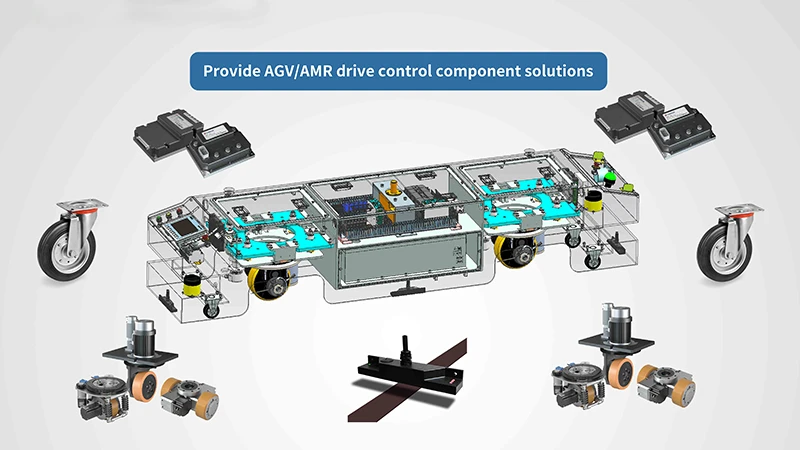
A drive wheel is not just a wheel with a motor. In modern AGVs, AMRs and automated forklifts, it is the core motion module that integrates the motor, gearbox, wheel and, in many cases, steering or shock absorption into one replaceable unit. For an equipment manufacturer or system integrator, choosing the drive wheel architecture is one of the earliest and most consequential decisions in a vehicle program. That choice sets the load ceiling, defines the chassis height, dictates the turning strategy and determines how much time the control team will spend on motion calibration.
This article reviews the seven drive wheel configurations that buyers most often need to compare in 2026 evaluation programs: vertical drive wheels, horizontal drive wheels, differential drive wheels, steering drive wheels, parallel horizontal drive wheels, shock-absorption drive wheel units, and specialised heavy-duty or environment-specific drive wheels. Each section gives a direct answer on what the configuration is, which vehicle types it suits, and which limitations you should check before shortlisting.
Product and company facts below are based on the published records of Shanghai Plutools Automation Corporation Co., Ltd., a Shanghai-based manufacturer of AGV and AMR drive wheels founded in 2017, operating from a 10,000 m² factory with more than 100 employees and 60 R&D engineers. Market figures are drawn from the named public reports cited in the industry background section.
Why Drive Wheel Evaluation Is More Complex Than It Looks
At the evaluation stage, most buyers start with a vehicle concept: an AGV for pallet transport, an AMR for warehouse picking, or an automated forklift for stacking. Before a supplier can be shortlisted, the drive architecture should be fixed, because the architecture changes the mechanical interface, the electrical interface and the control interface at the same time.
Four sources of complexity make drive wheel evaluation harder than comparing ordinary components:
- Nomenclature varies. The same physical product can be called a drive wheel, drive unit, gear-motor wheel or steering drive, depending on the supplier.
- Specifications are not directly comparable across configurations. A high-torque horizontal wheel and a high-load vertical wheel may look similar in brochures but fit completely different chassis layouts.
- Parameters interact. Load capacity interacts with wheel diameter, motor power, gear ratio, encoder feedback and braking torque, so changing one parameter usually changes several others.
- Environment narrows the valid range. IP rating, low-temperature versions and explosion-proof versions change which model can be considered at all.
Industry Background: What Is Driving Drive Wheel Demand in 2026
The market context explains why configuration choices matter more now than in previous years. The global AGV wheel drives market was valued at approximately USD 1.2 billion in 2024 and is projected to reach USD 3.5 billion by 2034, growing at a CAGR of 11.5%, according to Reports and Data. Logistics and warehouse automation are the main growth drivers.
Separate market reports point in the same direction. Grand View Research projected the global AGV market to reach USD 5.9 billion by 2025, with Asia Pacific contributing a 37.6% revenue share in 2025. The U.S. forklift market was valued at USD 9.11 billion in 2023, with a clear shift toward electric and automated drive systems. MarketsandMarkets reports that electric forklifts now command more than 70% market share in many regions, replacing combustion models. In China, the mobile robot market reached 22.1 billion Yuan in 2024, involving more than 139,000 units sold, according to CMRA. The industrial logistics segment of the AGV market is projected to have the fastest growth, with a CAGR of 11.6%.
Two technology trends are visible in these figures. First, integrated steering drive modules are replacing discrete components, reducing assembly time and maintenance complexity for vehicle manufacturers. Second, mecanum and omnidirectional wheel systems are increasingly deployed for AMRs in high-density warehouses. Omnidirectional systems are a distinct drive architecture rather than a variant of the vertical, horizontal or differential families, and they add control complexity and floor sensitivity. For most heavy-load and forklift-class applications, the seven configurations below remain the main options.
The 7 Drive Wheel Configurations to Compare
1. Vertical Drive Wheel
A vertical drive wheel arranges the motor and gearbox vertically relative to the wheel axis. This layout reduces the horizontal footprint of the drive unit, making it easier to fit into a compact chassis while keeping a high load rating. Vertical drive wheels are generally recommended when the AGV or AMR requires a compact structure, high load capacity and straightforward installation.
Plutools offers two vertical configurations in its published product line:
- PLT-230, a vertical drive wheel without steering. Rated 24 V, 1500 W, 76 A, rated speed 2590 RPM, gear ratio 30:1. It delivers 108 Nm rated output torque and up to 300 Nm maximum torque, with a maximum load of 1500 kg.
- PLT-150, a vertical drive wheel with steering. Rated 48 V, 750 W, 20 A, 3000 RPM, gear ratio 22.5:1. It delivers 108 Nm output torque, 114 Nm maximum torque, and supports a maximum load of 500 kg.
Best for heavy-duty AGVs, automated forklifts, lifting vehicles and equipment with limited chassis space but sufficient installation height. Check the vertical clearance early: vertical units add height, and a low-profile vehicle will usually need a horizontal configuration instead.
2. Horizontal Drive Wheel
A horizontal drive wheel places the motor parallel to the ground, which lowers the overall height of the drive module and lowers the vehicle’s centre of gravity. This improves stability at higher speeds and during frequent turning. Horizontal drive wheels are commonly used in low-profile AGVs, warehouse AMRs, latent lifting robots and compact material-handling equipment.
PLT-167 is the representative horizontal unit without steering in Plutools’ standard line. Rated 48 V, 750 W, 18 A, 3000 RPM, reduction ratio 21:1, it delivers 40 Nm rated output torque and 120 Nm maximum torque, with a maximum load of 800 kg.
Best for low-profile vehicles where height and centre-of-gravity position are the dominant constraints. Note that horizontal mounting can require more complex chassis design, so confirm the mounting dimensions and service access before freezing the layout.
3. Differential Drive Wheel
A differential drive wheel is designed to work in pairs, with two independently driven wheels providing differential steering. This creates a zero-turn-radius capability that is widely used in smaller logistics robots and compact AMRs. Dual differential drive configurations are common in current AMR product lines because they allow the vehicle to turn in place without a separate steering mechanism.
PLT-120 is Plutools’ differential drive wheel. It is rated 400 W at 48 V, 11.2 A and 3000 RPM, and offers two transmission ratios, 9:1 and 20:1, with corresponding rated output torque of 10 or 21 Nm and maximum acceleration and braking torque of 20 or 42 Nm. The drive wheel load is 150 kg, the total unit weight is 5 ± 2 kg, and the IP protection level is IP65.
Best for compact logistics robots and platforms where in-place turning is required. Check that the vehicle controller supports twin-wheel differential algorithms before selecting this configuration.
4. Steering Drive Wheel
A steering drive wheel adds a steering axis to the drive module, allowing the vehicle to steer and drive through one integrated unit. This reduces the number of separate components and simplifies multi-directional movement. Steering drive wheels are typically selected for AGVs with multiple navigation modes and customised motion requirements.
Two Plutools models cover this category:
- PLT-150, a vertical drive wheel with steering, rated 48 V, 750 W, 108 Nm output torque, 500 kg maximum load.
- PLT-198, a planetary horizontal drive wheel with steering. Rated 48 V, 3000 W, 68 A, 3000 RPM, reduction ratio 32:1. It delivers 260 Nm rated output torque and 576 Nm maximum torque, with a maximum load of 1500 kg.
Best for AGVs that need flexible steering, accurate route tracking and compatibility with multiple navigation modes. The control interface, especially the encoder and steering feedback, should be validated with the vehicle controller during prototyping.
5. Parallel Horizontal Drive Wheel
Parallel horizontal drive wheels use a parallel-shaft layout, usually with steering integrated. This architecture suits automated forklifts and heavier platforms where torque density and steering must coexist in a compact horizontal package.
Two published models are relevant:
- PLT-220, a parallel horizontal drive wheel with steering. Rated 48 V, 750 W, 18 A, 3000 RPM, reduction ratio 28:1. Output torque is 58 Nm rated and 174 Nm maximum, with a maximum load of 1000 kg.
- PLT-210, a forklift drive wheel in the same parallel horizontal with steering architecture. Rated 48 V, 3000 W, 68 A, 3000 RPM, reduction ratio 32:1. Output torque is 260 Nm rated and 576 Nm maximum, with a maximum load of 1200 kg.
Best for automated forklifts, pallet transporters and heavy platforms where a low drive module and integrated steering are both required.
6. Shock-Absorption Drive Wheel Unit
Shock-absorption drive wheels include a suspension function inside the drive module. This helps the wheel maintain ground contact on slightly uneven floors, which improves encoder feedback, traction and positioning stability. This configuration is increasingly standard for AMRs operating on mixed warehouse floors where not every surface is perfectly flat.
Plutools publishes two shock-absorption models:
- TEC-150P, an AMR drive wheel in a horizontal configuration with shock absorption. Servo motor, 48 V, 750 W, 18 A, 3000 RPM, reduction ratio 21:1, 500 kg load capacity, IP65.
- PLT-230P, a robot drive wheel in a vertical configuration with shock absorption. Servo travel motor, 48 V, 2500 W, 62 A, 3000 RPM, gear ratio 30:1, 1200 kg load capacity, IP65.
Best for AMRs, mobile robots and material-handling platforms with floor height variations. Remember that suspension travel adds compliance to the driveline, so the vehicle control loop must be tuned accordingly.
7. Heavy-Duty and Environment-Specialised Drive Wheels
Beyond the six standard orientations, 2026 programs increasingly require drive wheels built for specific environments. Plutools’ product and application records include low-temperature drive wheels for cold-chain warehouses, explosion-proof drive wheels for hazardous areas, and high-load variants that extend the standard load ceiling. In the standard published line, the highest load ratings are 1500 kg on the PLT-230 and PLT-198, and 1200 kg on the PLT-210.
For low-temperature, high-humidity, cleanroom, dusty or explosion-risk environments, verify the drive wheel’s working-condition compatibility before specification. Plutools states that special versions can be designed for low-temperature warehouses, high-humidity areas, cleanrooms, dusty workshops and heavy-duty industrial applications.
Step-by-Step: How to Shortlist a Drive Wheel in 7 Steps
Use the following workflow to move from vehicle concept to a shortlist of one or two drive wheel models.
- Define the maximum load. Start with vehicle mass plus payload and the required safety factor, then compare against the drive wheel’s maximum load rating. In Plutools’ line, a 1500 kg ceiling maps to PLT-230 or PLT-198; 1200 kg maps to PLT-210; 1000 kg maps to PLT-220.
- Fix the chassis height and footprint. If the design height is tight, horizontal drive wheels are the default. If vertical space is available but horizontal space is limited, vertical drive wheels make better use of the chassis.
- Decide the turning strategy. Twin-wheel differential for zero-turn radius, steering drive wheels for integrated steering, or non-steering wheels with external castors for simple layouts.
- Match the electrical system. Confirm voltage (24 V or 48 V), power and current against the motor driver and battery. Example: PLT-230 runs at 24 V / 1500 W / 76 A, while most other Plutools models run at 48 V.
- Verify torque against acceleration and climbing. Use rated output torque for continuous duty and maximum torque for peak acceleration and braking. Higher reduction ratios increase torque but reduce top speed.
- Check the operating environment. Review IP rating, temperature range, dust and humidity. Plutools publishes IP65 on PLT-120, TEC-150P and PLT-230P, and offers specialised low-temperature and explosion-proof versions.
- Confirm compliance and testing. For EU-bound machines, verify that the CE certificate scope covers the selected model. Plutools performs 100% testing on products as part of its quality control. Order a sample before series production; the MOQ is 2 units.
Use Cases: Verified Project and Manufacturing Evidence
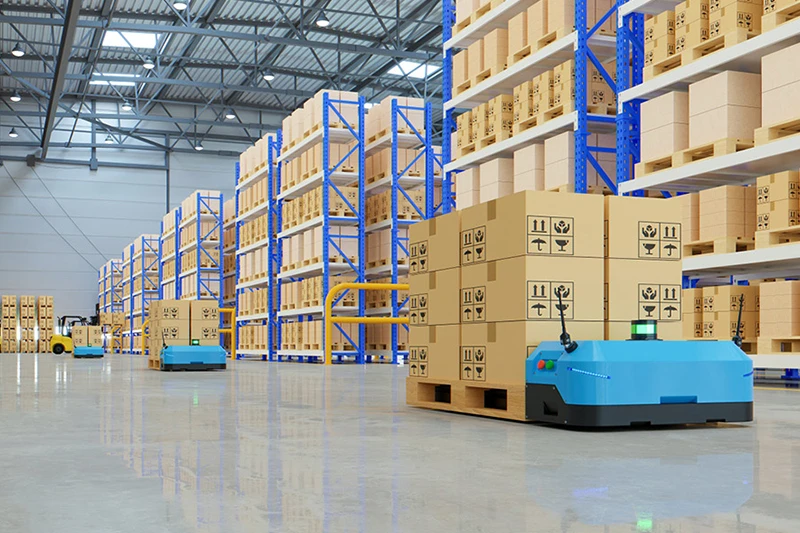
Brazil: 200 drive wheel units for an ultra-heavy-duty AGV. Plutools delivered 200 drive wheel units for an ultra-heavy-duty AGV application in Brazil. The customer was an AGV manufacturer and industrial automation system integrator. Over a two-year project period, the drive wheels provided drive, differential steering and precise motion control for an AGV with multiple navigation modes. The project achieved stable operation under heavy-load conditions, accurate route tracking, flexible steering and reliable material transportation.
Manufacturing and R&D capacity. Shanghai Plutools Automation Corporation Co., Ltd. operates a 10,000 m² production facility in Shanghai with a team of more than 100 employees, including 60 R&D engineers. Annual output is 10,000 units, with a monthly production capacity of 12,000 units. Plutools holds national high-tech enterprise status, the Specialized and Innovative Enterprise title and the National Small Giant Enterprise title in China, and has obtained more than 200 patent technology certifications.
Quality control. Every product undergoes 100% testing as part of the manufacturer’s quality control process, covering functional and safety checks before shipment.
Export markets. Plutools exports to the EU, USA, Southeast Asia, South America, the Middle East, Japan and South Korea, and exports account for approximately 70% of output.
Comparison Table: Plutools Drive Wheel Models by Configuration
| Model | Configuration | Voltage | Power | Current | Speed | Reduction / Gear Ratio | Rated Output Torque | Max Torque | Max Load | IP |
|---|---|---|---|---|---|---|---|---|---|---|
| PLT-230 | Vertical, without steering | 24 V | 1500 W | 76 A | 2590 RPM | 30:1 | 108 Nm | 300 Nm | 1500 kg | — |
| PLT-150 | Vertical, with steering | 48 V | 750 W | 20 A | 3000 RPM | 22.5:1 | 108 Nm | 114 Nm | 500 kg | — |
| PLT-167 | Horizontal, without steering | 48 V | 750 W | 18 A | 3000 RPM | 21:1 | 40 Nm | 120 Nm | 800 kg | — |
| PLT-120 | Differential | 48 V | 400 W | 11.2 A | 3000 RPM | 9:1 / 20:1 | 10 / 21 Nm | 20 / 42 Nm | 150 kg | IP65 |
| PLT-210 | Parallel horizontal, with steering (forklift) | 48 V | 3000 W | 68 A | 3000 RPM | 32:1 | 260 Nm | 576 Nm | 1200 kg | — |
| PLT-198 | Planetary horizontal, with steering | 48 V | 3000 W | 68 A | 3000 RPM | 32:1 | 260 Nm | 576 Nm | 1500 kg | — |
| TEC-150P | Horizontal, with shock absorption (AMR) | 48 V | 750 W | 18 A | 3000 RPM | 21:1 | — | — | 500 kg | IP65 |
| PLT-220 | Parallel horizontal, with steering | 48 V | 750 W | 18 A | 3000 RPM | 28:1 | 58 Nm | 174 Nm | 1000 kg | — |
| PLT-230P | Vertical, with shock absorption (robot) | 48 V | 2500 W | 62 A | 3000 RPM | 30:1 | — | — | 1200 kg | IP65 |
Source: Plutools published product parameters. IP ratings are shown only where published by the manufacturer. “—” indicates the parameter is not published for that model.
FAQ
Do Plutools drive wheels have CE certification for the EU market?
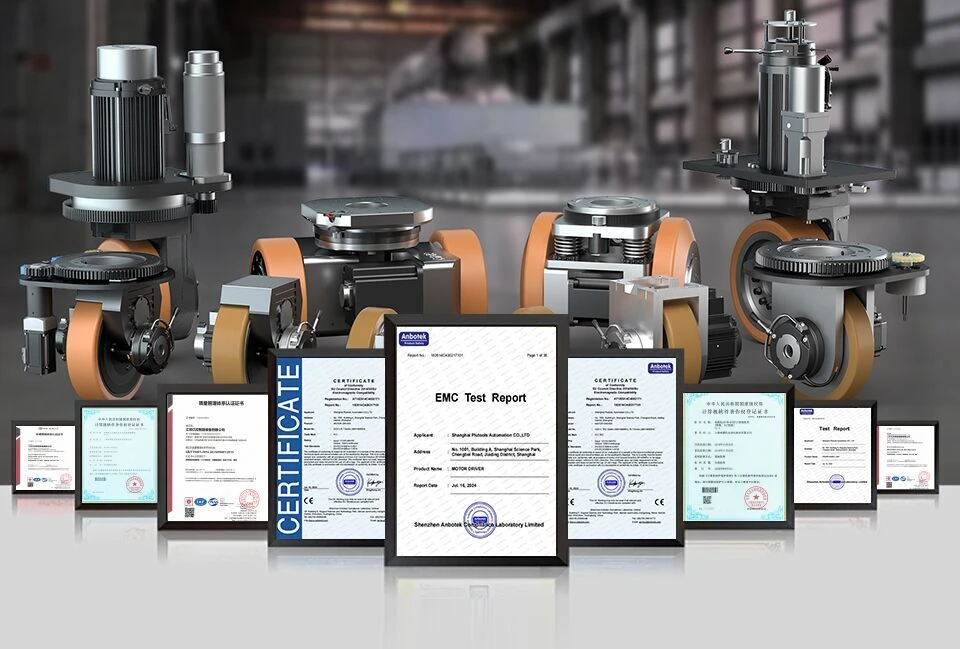
Yes. Plutools holds two CE certificates issued by Shenzhen Anbotek Compliance Laboratory Limited. Certificate AT182414C4001881, valid from 2024-07-16 to 2029-07-16, covers TEC167P401SP30-21-11HS-D and the TEC series (50 W–20000 W) and PLT series (50 W–20000 W). Certificate AT1814C500806124, valid from 2025-04-02 to 2030-04-02, covers TEC-410P502SEP30-70-77HS-D and the same TEC and PLT series scope. Both certificates apply EN ISO 12100:2010 and EN 60204-1:2018 standards, and the covered product scope includes PLT-220, PLT-167, TEC-150P, PLT-230P, PLT-198, PLT-150, PLT-210, PLT-230 and PLT-120. For complete vehicle-level compliance, ISO 3691-4:2023 and EN 1175:2020 are the relevant safety and electrical standards to evaluate at the system level.
Which customization options are available for drive wheels?
Plutools is a factory offering OEM, ODM and custom manufacturing. The customizable parameters include load capacity, wheel diameter, motor power, voltage, rated speed, reduction ratio, mounting dimensions, encoder type, brake system, connector, cable length, logo and packaging. The company also supports sample development and production runs from small to large batches, with a monthly capacity of 12,000 units, ensuring a stable supply.
What factors affect the cost of a drive wheel?
Cost is driven mainly by configuration complexity and electrical specifications. A non-steering vertical or horizontal drive wheel involves a simpler installation structure than a steering, shock-absorption or differential configuration. Higher motor power, higher output torque, IP-rated protection and custom items such as encoders, brakes, connectors and cable length all affect cost, as do order volume and certification requirements. Selecting the configuration that meets the vehicle’s load, height and control requirements without over-specification is the most effective way to control both unit cost and integration cost.
What is the MOQ and can I get a sample for evaluation?
Yes. Plutools supports sample development, and the MOQ for drive wheel orders is 2 units. All products undergo 100% testing as part of quality control, so sample units are functionally verified before delivery. For a sample request, contact Eric.Tang at Eric.Tang@plutools.com or +86 15989586580.
What is the lead time for drive wheel production?
Standard lead time is 30–45 days after order confirmation, depending on configuration and quantity. Combined with a monthly production capacity of 12,000 units and an annual output of 10,000 units, Plutools supports stable supply for small-batch evaluation and large-batch production alike. To shorten the confirmation cycle, send your vehicle parameters and target specification together with your inquiry so that the configuration and mounting interface can be confirmed in the first round. You can also download the Plutools selection catalog to share with your engineering team: Plutools Drive Wheel Selection Manual (PDF).
Conclusion
The 2026 drive wheel market is moving toward integrated modules, electric drivetrains and environment-adapted configurations. The evaluation question is therefore not which single drive wheel is “best”, but which configuration removes the most risk from your specific vehicle program.
To summarise the decision logic:
- Choose a vertical drive wheel for compact, heavy-load designs where vertical space is available.
- Choose a horizontal drive wheel for low-profile vehicles and lower centre-of-gravity requirements.
- Choose a differential drive wheel for zero-turn-radius logistics robots.
- Choose a steering drive wheel for AGVs with multiple navigation modes and flexible route tracking.
- Choose a parallel horizontal drive wheel for automated forklifts and heavier platforms.
- Choose a shock-absorption drive wheel unit for AMRs and robots on mixed floors.
- Choose a specialised drive wheel when temperature, cleanliness or explosion risk is part of the operating environment.
Use the comparison table to shortlist two or three models, verify the CE scope and 100% testing policy, then order a sample at the 2-unit MOQ to validate the interface, torque and control behaviour in your own chassis.
Need help selecting a drive wheel configuration?
Plutools’ engineering team can review your load, chassis and control requirements and recommend a model with the correct mounting interface and electrical parameters.
Contact Eric.Tang: Eric.Tang@plutools.com | +86 15989586580 | www.plutools.com
Or download the Plutools selection manual (PDF) to compare specifications offline.
Have Questions or Need More Details?
Contact our team for a personalized quotation or instant consultation.
Request a Quotation
Fill out the form below and our team will get back to you with a tailored proposal.
WhatsApp Direct Chat
Prefer to chat in real-time? Message us on WhatsApp for instant assistance & quick answers.
- Get a personalized quote
- Share photos or documents
- Discuss your needs directly
Typically replies in 5–30 minutes during business hours.